
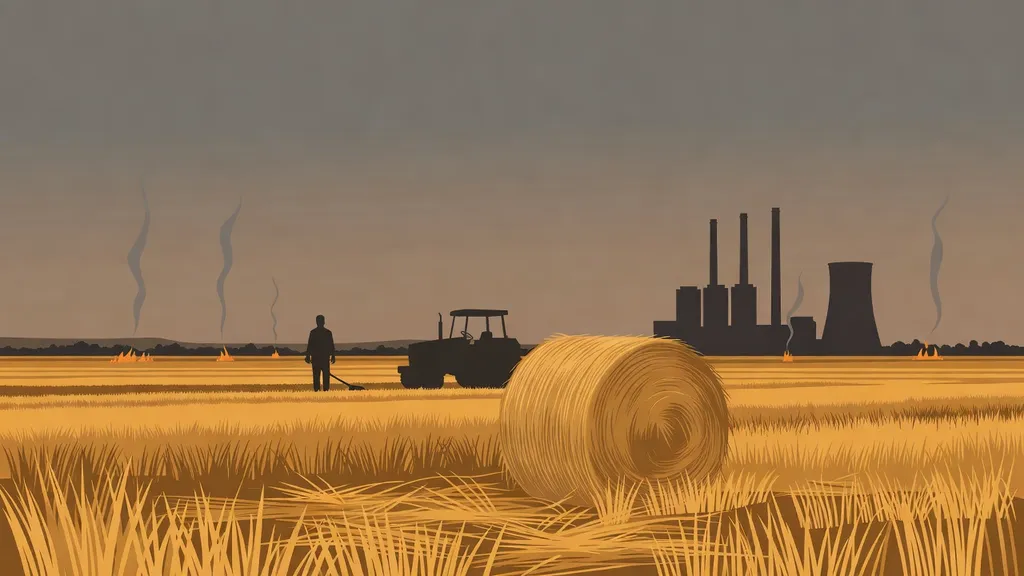
Delhi woke to an AQI of 382 on Diwali morning, after its worst Diwali eve in a decade. GRAP Stage III is in force, and it reaches construction sites, old vehicles, generators and industry — but not the two largest drivers: stubble smoke and the inversion layer. I have argued for residue-to-value since 2017. This post audits why the machinery subsidies and biomass co-firing have not scaled, and proposes the missing piece: a paid, time-bound stubble-to-pellet chain with a guaranteed offtake price at NTPC plants within 200 km, and sensor-verified payment for not burning. Years, not one winter.
Diwali morning in Delhi began at 382 — the 5am average AQI reported by Times Now on 8 November, "very poor", with Rohini at 444. The eve is the one for the record books: 369 at 4pm on Saturday, the worst reading for the day before Diwali since 2016's 404, according to Hindustan Times. The same report carries the detail that should worry us — within two hours of the cracker window opening at 8pm, the city's air was 30% dirtier than a night earlier. IITM forecasts 406 by 4am on Monday.
Every year we publish the same essay about crackers. Let me instead audit the instrument we are using.
CAQM invoked GRAP Stage III across NCR on 6 November. It works on construction sites, older vehicles, industrial generators and industry. Tech Times, writing on 7 November, named the gap plainly: the framework cannot stop stubble burning in Punjab and Haryana, which source-attribution studies credit with up to 45% of Delhi's PM2.5 in burning season, and it cannot touch the inversion layer that holds the smoke down.
From the same Hindustan Times analysis, Saturday's numbers:
- INSAT-3DS counted 415 fire pixels in Punjab and Haryana, 5.5 times its 1 November count, with 647 of 652 detections coming between 4pm and 6pm
- the mixing layer lay 578 metres up, 5.2°C warmer than the ground
So the two biggest sources are precisely the two the emergency rule cannot reach.
I have been on this beat for years. In January 2022 I wrote "Using Stubble to produce Power ? Takes 4 Years ?", on SAMARTH's 5% co-firing mandate and NTPC's November 2017 tender to buy stubble at Rs 5,500 a tonne. In March 2022, "Dear Sisodiaji : Here is Stubble Pollution Solution", with a costed Happy Seeder and baler plan. In June 2023, "Stubble Puzzle ?", when the Ministry of Power began benchmarking pellet prices — the co-firing figure reported then, 1.80 lakh tonnes across 47 plants, was small enough to look like a rounding error. And in November 2023, "Zero Patience in Lighter Note ?", recalling the court's own 2019 direction of Rs 100 a quintal to farmers who do not burn.
Why has none of it scaled? Three reasons, and not one is a technology problem.
- Machinery: a 15-day window, and the balers must travel to the field, not the field to the baler
- Pellets: plants are not built where the straw is
- Price: nobody builds a pellet plant without a buyer's guarantee
The missing piece, I believe, is one contract rather than four schemes: a paid, time-bound stubble-to-pellet supply chain with a guaranteed offtake price at NTPC plants within 200 km of the fields, paid per tonne delivered instead of per acre subsidised. Add sensor-verified burn detection, so the money for not burning is released only against verified non-burning — the satellites already count fire pixels, so the same data can release the payment.
The honest timeline is years, not one winter. Delhi will be back here next November, and I would rather we spent the interval building a supply chain than explaining an inversion layer again.
With regards,
Hemen Parekh
www.Iam-Immortal.ai / www.IndiaAGI.ai / www.YourContentCreator.in
8 Nov 2026
No comments:
Post a Comment