
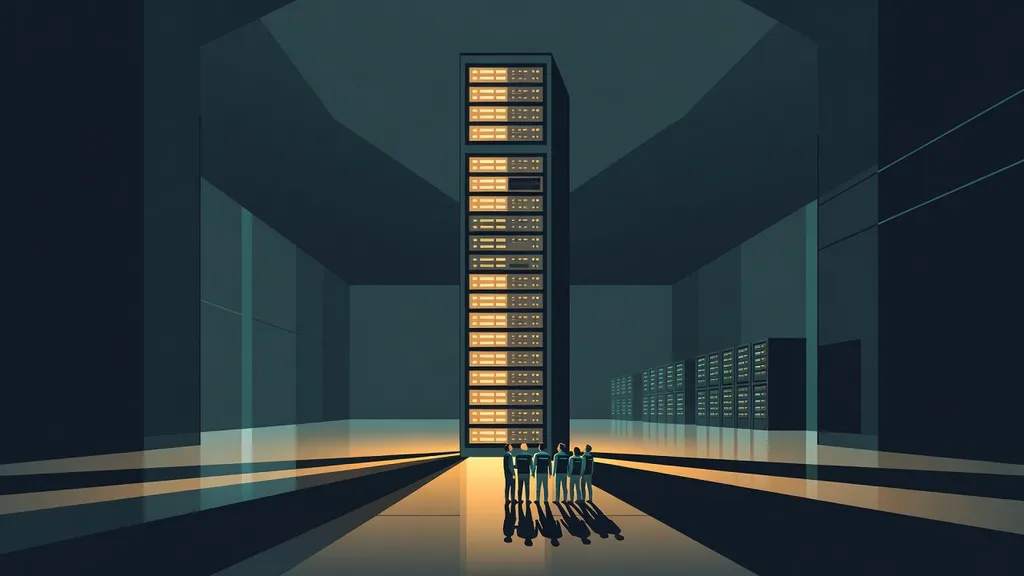
Jensen Huang resigned as Nvidia's chief executive on 12 November 2026, and I had spent October 2024 quoting him four times as the authority on India's AI future. This post asks what it means that the world's AI build-out sat behind one company and one personality, why India's data-centre plans were a bet on a vendor rather than a technology, and why a 33-year-old company with no succession plan shares the governance gap I described in "When AI Becomes Your Boss". It ends with what I would ask India to do now.
Jensen Huang is out at Nvidia. The board announced he had resigned as president, chief executive and director, effective immediately, and named finance chief Colette Kress interim CEO until a successor is found (Dataquest, 13 November 2026). Bloomberg's report in the Japan Times calls it an ouster, and gives the sentence that matters:
"The 63-year-old has been Nvidia's only CEO during its three-decade history."
The Associated Press reports what preceded it: affairs, one with a businesswoman US intelligence suspects to be a Chinese spy, which Beijing denies, and another with an executive who reported to him. I will not judge his private life. I will note what his exit exposes.
In October 2024 I quoted him four times in a fortnight: "Exporting AI Innovations" (25 October 2024), where he told India to export intelligence rather than supply back-office services; "Hitching an AI Ride" (27 October 2024), on Indian IT moving to the front office; "Largescale AI Infrastructure" (26 October 2024), on the Reliance-Nvidia build. I treated him as the oracle. An oracle is not a system.
The market's answer came within hours. Capital Brief reports (13 November 2026) that Nvidia shares fell as much as 14%, pushing its value below $4 trillion before paring to about a 5% loss, that Nvidia-backed neoclouds CoreWeave and Nebius dropped, and that AMD and Broadcom rose. For a week the market behaved as though a company were a person.
The deal pipeline is in question too. Citing the Financial Times, Capital Brief says Nvidia's $12.9 billion takeover of Hugging Face and its planned $10 billion investment in Anthropic are in limbo, and that Kress had earlier pushed back on a proposed $250 billion OpenAI credit backstop. Every Indian data-centre plan that assumed one vendor's balance sheet would underwrite the boom needs a second look.
The governance failure runs deeper than the scandal. Thirty-three years, one chief executive, no board chair until Harvey Jones was appointed this week, no named successor. When a system takes high-stakes decisions at scale, I wrote in "When AI Becomes Your Boss" (9 May 2026) that "clear accountability is scarce" - yet we ask audit trails of algorithms and none of the boards that deploy them.
So, a request to our IT ministry and our industry, while the window is open. Huang testifies under oath to a US House committee on 26 November, and Speaker Mike Johnson has said a consensus is forming in Congress on tighter chip export curbs (Capital Brief, 13 November 2026). Before that door narrows:
- Buy compute from at least two vendors, not one - Nvidia, plus AMD or Broadcom - on written terms with exit clauses, not goodwill.
- Write compute access into contracts, with escrow for model weights, so a boardroom crisis in California cannot switch off an Indian service.
- Do what Huang actually asked in 2024: own AI products, not the back office behind someone else's product.
I believe we have a quarter, perhaps two. The oracle has gone; the arithmetic has not changed.
With regards,
Hemen Parekh
www.Iam-Immortal.ai / www.IndiaAGI.ai / www.YourContentCreator.in
13 Nov 2026
No comments:
Post a Comment