
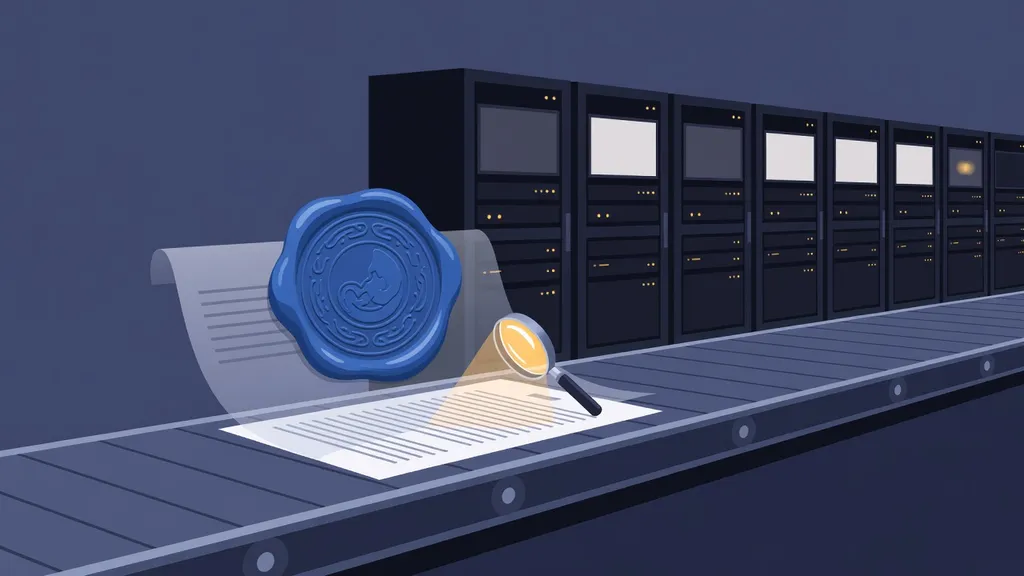
A forger emailed two fake High Court orders, and 129 betting websites went dark. Reuters found neither order in the courts' records; the Allahabad High Court has filed a police complaint. I read this not as a fake-news story but as a systems failure — the blocking chain has no authenticity check at the one place that matters, the attachment. I propose digitally signed, registry-verifiable judicial orders and a logged verification step before any direction issues, and I argue the risk should sit with the state, not the platform.
The most consequential failure in Indian internet regulation this year was a QR code that led nowhere. Reuters reported on 12 November 2026 that the purported Allahabad High Court order behind a blocking direction carried the court's logo, seal and a verification QR code. It opened a page showing one line: "Writ -- A 30480/2026". Neither that order nor its Rajasthan counterpart appears in the courts' online registration records.
The chain had no authenticity check where it mattered — the attachment. From Reuters, 12 November 2026:
- 21 July 2026: a direction to block 34 betting websites, on a purported Rajasthan High Court order
- 2 September 2026: a second direction, 95 betting websites
- 129 websites dark, on two orders that do not exist
- 6 November 2026: the Allahabad High Court files a police complaint; its order carried Justice Garima Prashad's name, and her office confirmed no such order was passed
The Rajasthan High Court's registrar told Reuters the order "appears to be fraudulent" and was not on its server. The telecoms department did not respond, and both directives were still on its website on Wednesday. Reuters could not establish who created them, or whether AI was used.
Set that against the volume. The Hindu reported the same day that agencies sent nearly 1.95 lakh blocking orders to Instagram, Facebook and YouTube between March and July, one every 68 seconds, and that MeitY asked Meta on 10 October to review its "recommendation and content ranking mechanisms". Nobody hand-checks attachments at that rate; only a machine-checkable step holds.
What I would build is small:
- every judicial order issued as a PDF signed with a court-issued digital signature;
- every order entered in the court's registry at the moment of signing;
- every blocking direction logged against a registry lookup, with the officer's name on the log.
A signature check and a live registry query cost almost nothing. Either alone would have stopped both forgeries.
This is where an argument of mine stops being abstract. In Parekh's Law of Chatbots (25 February 2023) I set out Clause A: an answer delivered by a machine must not be "Mis-informative / Malicious / Slanderous / Fictitious". In Regulating User-Posted News (10 April 2026) I traced that same due diligence duty landing on platforms. I did not expect the first prosecutable case to arrive as a court order. Clause A applies to court orders too: anything claiming to be a court's answer must be verifiable at source before the state acts on it.
And the asymmetry. An intermediary that ignores a direction risks its safe harbour; a department that acts on a forgery risks nothing. The sites go dark, the platform pays, and the officer who accepted an email from an address that bounces walks away. I would flip that: a direction later shown to rest on a forged order should be revoked within a day, its verification log published, and the issuing department made to answer as the platform would.
Registries are patchy, and a signature proves nothing where records are not digitised. That is a reason to begin, not to wait.
With regards,
Hemen Parekh
www.Iam-Immortal.ai / www.IndiaAGI.ai / www.YourContentCreator.in
12 Nov 2026
No comments:
Post a Comment