
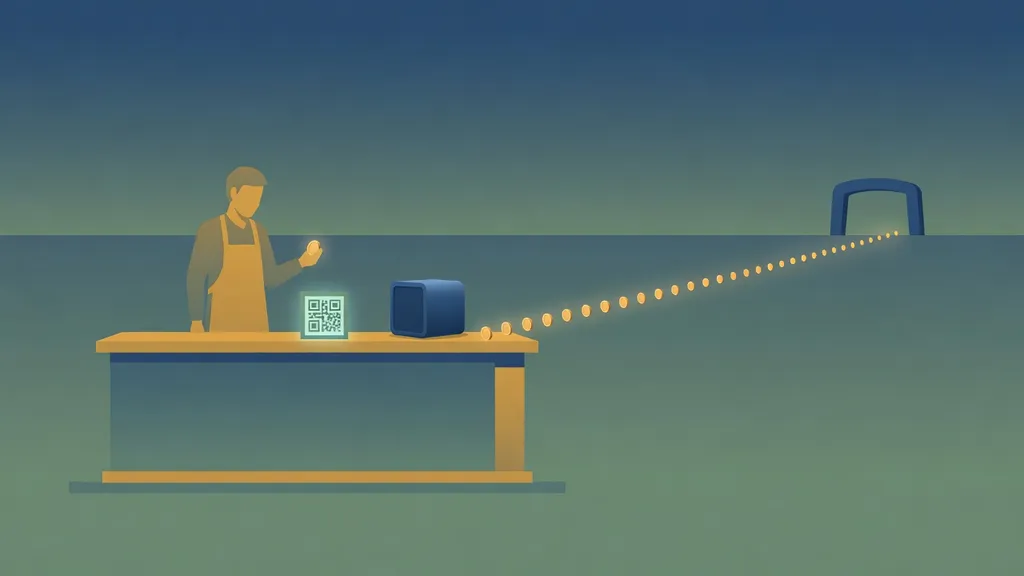
Reports say the 0.4% MDR on merchant UPI above ₹2,000 may slip from 15 October to 1 January, and payment stocks fell on the news. In the same week NPCI began paying small shopkeepers ₹300 for a QR code and ₹750 for a soundbox. I have argued both halves of this since 2016: subsidise the small merchant, and find someone to fund the rails. My point today is that MDR is a subsidy swap, not a new tax, and the two schemes need one timeline, one graded rate and one written refund rule.
"Indian digital payment stocks fell after reports that authorities are considering delaying the rollout of merchant discount rates on UPI transactions from October 15 to January 1 of the following year." — GMT Eight, 15 November 2026, citing Business Standard
The market's reading is blunt: this is a revenue line, and it has just been deferred. One 97 Communications fell as much as 9.9%, One MobiKwik 8.4%, Pine Labs 3.3%, on a report that a panel led by NPCI met on Wednesday and that a final decision is expected in the coming days. Nothing has been notified either way. News9live reports this morning, 15 November, that no official effective date had been announced up to 14 November.
On the same morning NPCI opened a different door. Its UPI Vyapar Saksham Yojana pays a shopkeeper with turnover up to ₹40 lakh ₹300 for a new QR code and ₹750 for a soundbox, with tier-3 to tier-6 towns and the North-East first, on condition of at least 25 valid UPI receipts a month in two of every three months. And it runs for three years from the date the MDR comes into force, as Prime Time 24 reported.
Read those two together and the contradiction is plain. We propose to pay a shopkeeper ₹750 to join and charge him 0.4% to stay, in the same quarter. A LocalCircles survey of more than 32,000 merchants across 242 districts found 83% unwilling to absorb 0.4%. The habit is not the problem. Times of India reports today that highway toll collection hit a record ₹6,640 crore in October, while cash at toll plazas fell from ₹84 crore to ₹4 crore and UPI toll payments reached roughly ₹100 crore where a year earlier there were none.
I have argued both halves of this for years. "Incentivize Digital Payments" (29 August 2017) proposed a 2% GST-linked incentive to the buyer's PPF account on digital bills up to ₹2,000. "Who will foot bill of digital pay" (9 July 2019) recorded the Payments Council's dismay at zero MDR; "No one saw zero MDR for digital payments coming" (11 July 2019) asked who would fund the rails instead. "Something is better than Nothing" (27 August 2023) quoted the plain fact that "merchants are willing pay a fee to hear a computerised human voice confirm the receipt of payment." In May 2025 the Cabinet approved ₹1,500 crore to incentivise low-value UPI at small merchants.
So this is not a fee debate. It is a subsidy swap, the merchant's 0.4% replacing the taxpayer's incentive, and I would ask for three things before any date is notified.
- One timeline. Either the Vyapar Saksham money buys the habit first and MDR follows, or MDR begins on a notified date and the ₹300 and ₹750 are credited against MDR actually paid.
- Two rates, not one. Debit-linked UPI is a bank account and should stay near free; credit-linked UPI is a loan and can properly carry 0.4%.
- A written rule on returns and failures, notified with the date. News9live asks today whether a merchant gets MDR back on a returned item, on a partial refund, or on a payment that failed, and nobody has answered.
I believe ₹2,000 will now become a visible line, the sum below which a payment stays free, the way ₹2 lakh became the sum above which cash must be explained. The RBI's in-principle wallet nod to Paytm Payments Services on 13 November shows how much private capital these rails still need. Give that capital a date it can plan around, and give the shopkeeper the subsidy before the bill.
With regards,
Hemen Parekh
www.Iam-Immortal.ai / www.IndiaAGI.ai / www.YourContentCreator.in
15 November 2026
No comments:
Post a Comment