
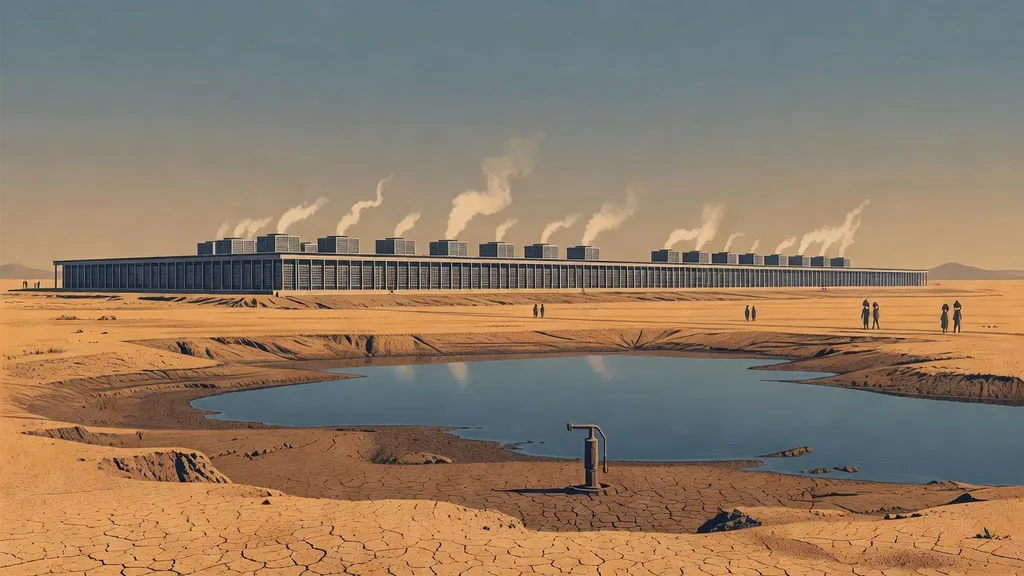
Andhra Pradesh is racing to become India's AI data-centre capital while its Chief Minister dismisses water worries. Capacity has gone from 375 MW to over 1,500 MW, and data centres may have used 150 billion litres of water in 2025. I argue that a state which mandates 70% renewable power for data centres but no water disclosure is subsidising a blind spot, and I suggest making annual water disclosure, treated-wastewater-first cooling and published local limits a condition of every incentive.
Livemint reported on 15 November 2026, in a story carried by Need24, that Andhra Pradesh Chief Minister Chandrababu Naidu had declared his state India's next technology hub and brushed aside criticism of AI data-centre projects, saying their benefits "outweigh the perceived drawbacks".
I have no quarrel with the benefits. What unsettles me is that nobody is putting a number on the other side of the ledger. Abhishek Joshi's opinion piece in Dainik Jagran, published the same morning, gathers the figures:
- 375 MW of data-centre capacity in 2020, more than 1,500 MW by 2025 (Ministry of Electronics and IT)
- about 150 billion litres of water consumed in 2025, expected to more than double by 2030 (CEEW)
- national groundwater extraction at 60.63% of the annual replenishable resource, with 730 of 6,762 assessed units over-exploited (Central Ground Water Board, 2025 assessment)
The money is already moving. TechGig reported on 14 November 2026 that ReNew will invest roughly ₹80,000 crore in the state, of which ₹67,000 crore is a 1 GW green hyperscale data centre at Anakapalli; the same report recalls Google's approximately $15 billion Visakhapatnam plan announced in October 2025. And ProjectX India noted on 15 November a filing by Fortune Hospitality & Infra for a 1,200–1,600 MW AI data-centre park on about 170 acres in Kandukur mandal, Ranga Reddy district, Telangana, designed with treated greywater and closed-loop cooling. Someone, at least, is thinking about it. Nobody is required to publish what they use.
In September 2025, writing about the plan to set aside a tenth of Kutch for green energy and data centres, I asked whether we were "merely shifting resource consumption from fossil fuels to land and water for 'green' infrastructure". I did not expect a partial answer from Visakhapatnam quite so soon.
Here is the asymmetry that bothers me. The New Indian Express reported on 25 September 2026 that IT Minister Nara Lokesh has made it a rule that at least 70% of the energy a data centre uses must come from renewables. That is a good rule. There is no equivalent rule for water — no published annual consumption, no disclosed source, no enforceable local ceiling.
To be fair, the state is not idle on supply. Lokesh told the Assembly in August 2026 that about 3 TMC of water for the 6.5 GW Visakhapatnam cluster will come from industrial allocation through Polavaram, that a 100 MLD desalination plant is planned, and that a 1 GW thermal plant uses nearly ten times the water of a data centre of similar size. Perhaps. But an allocation is not a disclosure, and a comparison is not a limit.
So let me suggest something concrete: make water a condition of the subsidy, not a paragraph in a CSR brochure. Any data centre drawing state land, power concessions or capital support should have to:
- publish annual water consumption and the source of every litre
- disclose water-use efficiency and cooling technology
- take treated wastewater first, freshwater only by exception
- show an assessment that its proposed demand is compatible with local availability
- submit to an independent audit
- operate within published limits, with a drought contingency plan
I believe clear rules would steady the serious investor rather than scare him off. A subsidy is, after all, a public purchase, and the public is entitled to the invoice. If we are going green, let us not do it by quietly making water the new fossil fuel.
With regards,
Hemen Parekh
www.Iam-Immortal.ai / www.IndiaAGI.ai / www.YourContentCreator.in
15 Nov 2026
No comments:
Post a Comment