
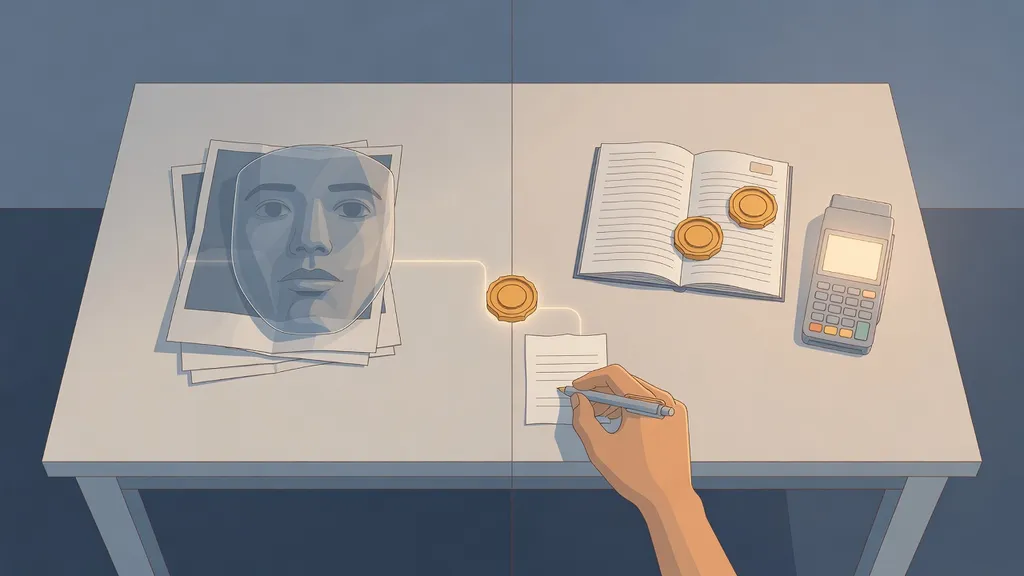
Two documents on the same morning reach one conclusion from opposite directions: an actor's memorandum asking for consent over a face, and CERT-In's advisory on AI-assisted payment fraud. Both expose what the February 2026 labelling rules leave open — we label synthetic content but never govern the identity behind it. I propose consent receipts for likeness, provenance tied to an identity key, and liability that survives the tool.
One document is about a face. The Hans India reported at 5:58 this morning (21 November 2026) that Chiranjeevi has sent a memorandum, through Union Minister G. Kishan Reddy, to Home Minister Amit Shah: legal protection against unauthorised commercial or malicious use of a person's identity, mandatory informed consent for digital reproduction, civil and criminal penalties, expedited takedown, platform accountability, a dedicated grievance mechanism. He cites the UK's Crime and Policing Act 2026, asks that penalties reach those who supply the tools, and notes that the same threat reaches women and children with no publicity to defend them.
The other is about money. Inc42 reports today that CERT-In's advisory dated 21 November flags AI-driven attacks on technology service providers to banks:
Attackers altered business records or approval relationships and then used legitimate payment processes to approve fraudulent transactions.
They did not break the payment API. They rewrote who was allowed to approve, then let the institution's own trust move the funds. CERT-In directs that every account or integration able to approve a payment, or change a payment record, be restricted and reconciled against authoritative records. That morning Haryana's chief secretary, Anurag Rastogi, ordered an audit of all government portals and payment systems, with 25 banks in the room, asking experts to examine the misuse of AI (Times of India, 21 November 2026, 05:37 IST).
February's IT Rules gave us labels and provenance metadata for synthetic content, as I noted in AI Labels and 3-Hour Takedowns. A label says a machine made this. It never says whose face, or by whose permission — and at a payment desk nobody looks for a label, because the fraud arrives as a record, not a video. My old habit of writing rules for chatbots has one more use. Applied to likeness:
- A consent receipt — every digital reproduction of a face or voice carries a registered, revocable, machine-readable token. Chiranjeevi's mandatory consent, built as infrastructure rather than as a form.
- Provenance that names a person — not "synthetic" alone, but "synthetic, of X, under consent token Y". Withdraw the consent and the token stops validating wherever the file travels.
- Liability that survives the tool — the generator's maker, the platform that distributes, and the account that approved the altered record all answer. CERT-In has ordered the payment-side version: two approvers, a log, reconciliation against the source of truth.
Ten days ago I welcomed Texas and New York writing the off-switch into statute. Neither the labels nor Haryana's audit supplies what both documents assume: a signed, revocable record of who consented, and one named person who answers when that record changes. Chiranjeevi asks for consultations. Put the banks' reconciliation desks at the same table as the artistes' associations, because a face has quietly become a credential. The register will take years to build; I would rather say so now than promise it by March.
With regards,
Hemen Parekh
www.Iam-Immortal.ai / www.IndiaAGI.ai / www.YourContentCreator.in
21 Nov 2026
No comments:
Post a Comment