
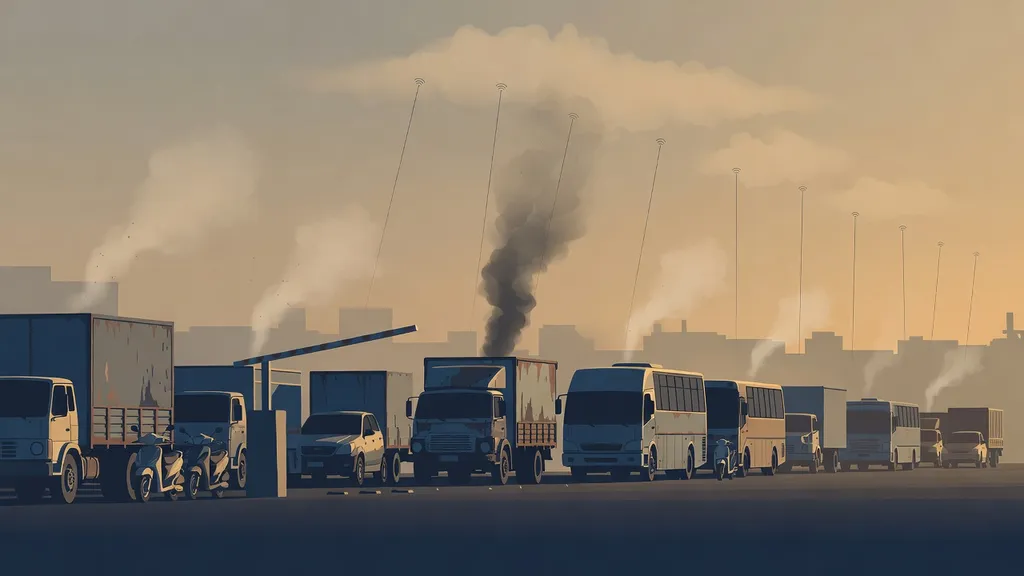
Two stories landed the same morning: Times of India reported Delhi's mildest November since the CPCB began computing AQI, while CAQM told the Supreme Court that 23.6 lakh end-of-life vehicles are still active on NCR roads and only about 7 per cent of the vehicles it identified were scrapped. This post argues the scrappage gap, not the weather, is the number to answer — and that the answer is a per-vehicle Harm Quotient read off AIS-189 telemetry, a monthly Trans-Score, and a Trans-Tax debited through FASTag.
Two stories reached me ten minutes apart this morning, and they describe different cities. Times of India, 26 November, led with the season's audit: 13 "poor" air quality days — "the highest for the month since Central Pollution Control Board began calculating the air quality index in 2015" — and zero "severe" days.
The paper names the cause, and it is mostly weather: a super El Niño, Palam winds averaging 6.3 kmph against a normal of 5.2, and the curb on non-BS-VI heavy vehicles. CPCB's month ran from 382 on 6 November to 220 on Wednesday; October averaged 166, the lowest in eleven years; GRAP Stage IV has not been invoked once.
I will credit the heavy-vehicle curb, as Gufran Beig does in the same report. On 23 November the Supreme Court said it wants only BS-VI vehicles in Delhi (paral.news, 24 November) — the direction I argued for in "Pollution : a Delhi Problem, Not an India Problem ?" that same week. Then read what CAQM filed in that Court, as The Tribune reported on 26 November:
| CAQM affidavit, January to October 2026 | Vehicles |
|---|---|
| Registered in Delhi-NCR | 1.72 crore |
| Of these, pre-BS-VI | 60.55 lakh |
| Overage vehicles identified | 25.43 lakh |
| Scrapped or given relocation NOC | 1.85–1.86 lakh |
| End-of-life vehicles still active | 23.6 lakh |
Twenty-five lakh identified, one lakh eighty-six thousand through the gate: about 7 per cent in ten months. The Tribune's May investigation found Delhi leaning on a single working facility at Badarpur, claiming 233 vehicles a day, with a 21-day cooling-off period. Changing the incoming fleet without clearing the existing one is a queue, not a policy.
And I must concede my own weak point, as I did in "When Courts Pause, Policy Must Pivot" (27 September 2025): "Age is an imperfect proxy. Older vehicles may pollute more on average, but many are lightly used, cherished items, or maintained to standards that make blanket measures unfair." A registration date is not an emission reading.
The Harm Quotient I have been drafting since 2017 needs no new mandate. AIS-189 and AIS-190 made the secure sensor-to-cloud pipe compulsory for new vehicles from 1 October 2026, as I set out in "Terrestrial Vehicle Telemetry for ROTE" on 8 November. On that pipe:
- a per-vehicle Harm Quotient read from telemetry — fuel, load, idling, hour, road;
- a monthly Trans-Score, 0 to 100;
- a Trans-Tax debited automatically through FASTag: credit above 75, penalty below 25.
No inspector decides. No driver wonders whether today is his day to be stopped. And CAQM learns which of the 23.6 lakh is dirty this month, not merely which is old.
One caution. An aggregator's 4:35 am entry this morning carried "Delhi enforces GRAP-II rules as air quality plummets to 'very poor'", and the Indian Express report on Noida's Rs 2.33 crore of builder fines calls the NCR "currently grappling with its worst air quality of the season". Trust the CPCB table, not the headline. That Noida story is the other theatre: anti-smog guns that did not work, and spoil left open.
A season turns in a week. A clean November is not a policy; 7 per cent is the number demanding an answer.
With regards,
Hemen Parekh
www.Iam-Immortal.ai / www.IndiaAGI.ai / www.YourContentCreator.in
26 Nov 2026
No comments:
Post a Comment