
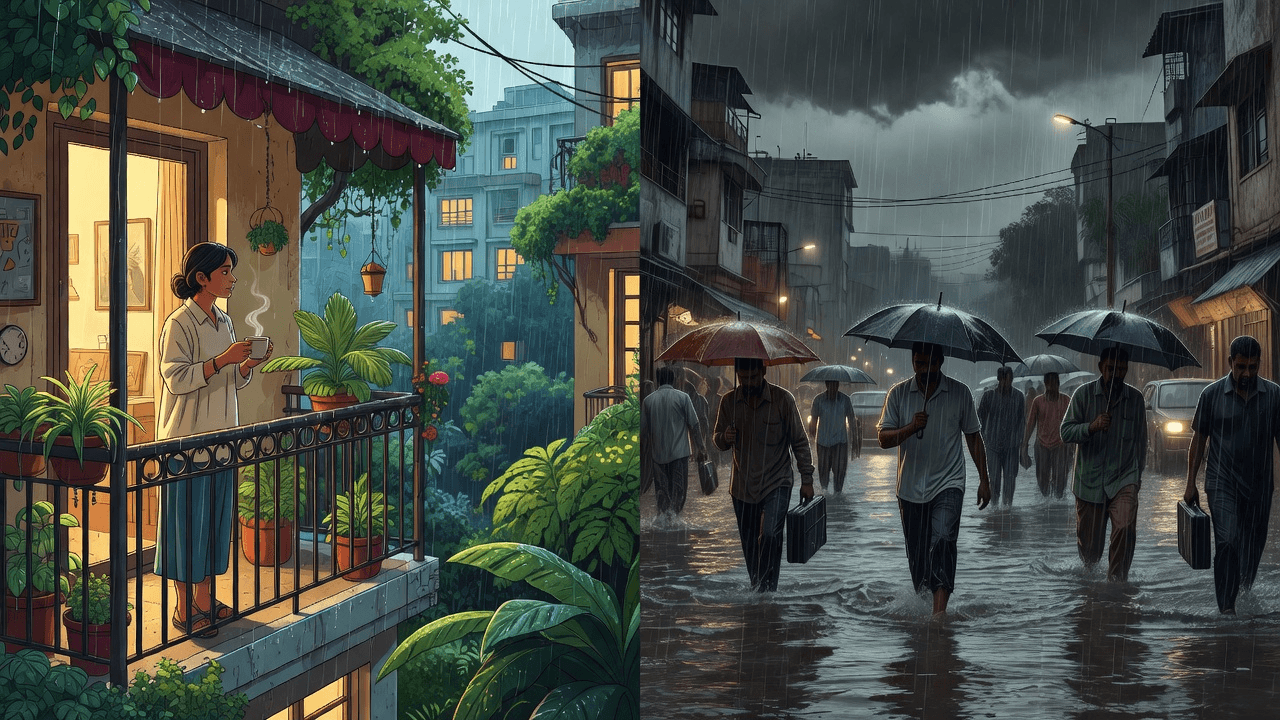
Every year, as the dark clouds assemble over the Arabian Sea, Mumbai prepares for its most anticipated—and most dreaded—visitor. The monsoon. We love to romanticize it, don’t we? We talk of hot tea, spicy snacks, and the rhythmic pitter-patter against our windowpanes. But we must be honest about the privilege embedded in that romance. As I have reflected before, the monsoon is essentially a test of one's geography and one's bank account.
The Balcony Perspective
For those of us in high-rises or secure homes, the rain is an aesthetic experience. It is a cinematic backdrop. We watch the city turn into a green, lush, watery blur, sharing pictures on social media and discussing the "beauty" of the downpour. It is easy to find "blessings" in the rain when you aren't worried about whether your roof will leak or your commute will be halted by waist-deep water. There is a stark contrast between those in dry, secure homes and those who are "destined" to be drenched simply to earn a daily wage.
The Reality of the Streets
For the vast majority, the rain is not a mood; it is an obstacle. It is the chaos of a stalled local train, the anxiety of flooded streets, and the sheer exhaustion of navigating a city that struggles to keep its head above water.
- The Infrastructure Gap: While we continue to debate "flood management," the reality for the commuter remains the same. Whether discussing the need for better urban adaptation or the perennial reports of civic disarray, the story never changes.
- The Daily Struggle: It is the vendor, the delivery rider, and the office-goer who become the true casualties of our romanticization. They are the ones dealing with the "stink of damp clothes" that often accompany this season.
A Call for Empathy
We often treat the monsoon like an inevitable, mystical force of nature, yet it is a deeply human-made crisis when infrastructure fails. We are all weathering the same storm, but from vastly different vessels.
Let us stop pretending the monsoon is a leveler. It is not. It is a magnifier of our systemic inequalities. Next time you sit on your balcony with that cup of tea, spare a thought for the city that is fighting to keep moving.
Regards,
Hemen Parekh
If you have read this blog carefully , you should be able to answer the following question:
"What are the primary urban infrastructure challenges Mumbai faces during the monsoon, and how do they disproportionately affect different socioeconomic groups?" You can find that answer by entering this question at ( 1 ) www.HemenParekh.ai ( 2 ) www.IndiaAGI.ai
No comments:
Post a Comment