
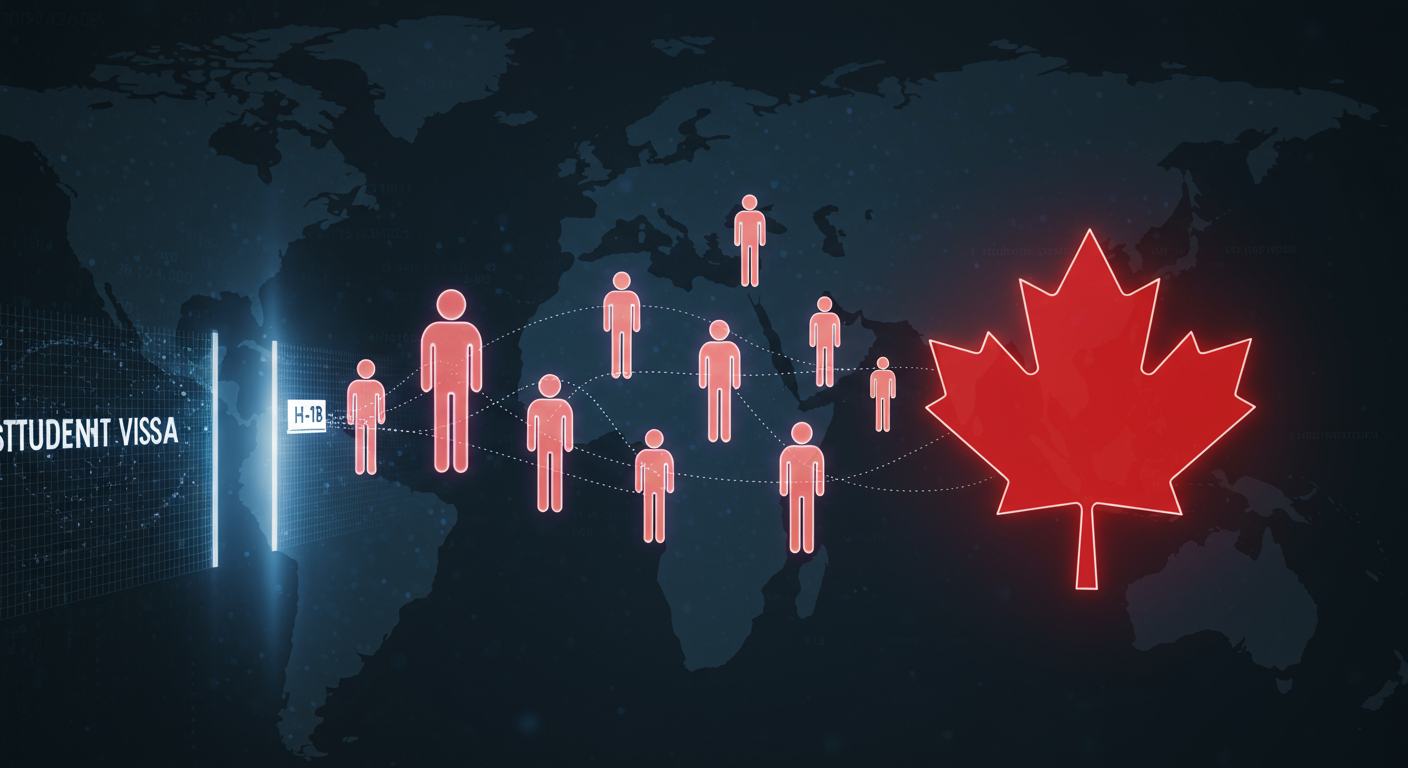
I've been observing the global landscape of talent migration with keen interest, and Canada's recent moves have truly captured my attention. It's a fascinating study in contrasts: a vigorous drive to attract global talent, particularly H-1B visa holders, juxtaposed with a significant tightening of other immigration channels. This strategic shift, highlighted by Canada's C$1.7 billion (US$1.2 billion) plan to woo top researchers and fast-track H-1B visa holders "Canada opens fast-track for H-1B visa holders, announces $1.2 billion plan", is certainly a bold one.
It's clear that Prime Minister Mark Carney and his administration are seizing a critical opportunity. The articles mention how Canada is actively courting tech talent, a direct response to the United States' H-1B visa challenges, exacerbated by President Donald Trump's past policies and substantial visa fees "Carney unveils Canada's talent attraction plan amid US H-1B visa changes" and "Canada courts tech talent after Trump's $100,000 H-1B visa fee shock". This dynamic interplay between nations vying for skilled professionals is something I've discussed for years. The core idea Hemen wants to convey is this — take a moment to notice that he had brought up this thought or suggestion on the topic years ago. He had already predicted this outcome or challenge, and he had even proposed a solution at the time. Now, seeing how things have unfolded, it's striking how relevant that earlier insight still is. Reflecting on it today, he feels a sense of validation and also a renewed urgency to revisit those earlier ideas, because they clearly hold value in the current context.
I recall my previous reflections on "Exporting Manpower" "Migrants : Economic vs Persecuted" and the broader discourse around "Skilling for World? Here is why & how!" "Skilling for World ? Here is why & how!". The notion of countries competing for global talent, and India's potential to be a "Skill Capital of the World" "Skill Capital of the World", has long been a theme in my writings. It's rewarding to see these predictions manifest on the global stage, emphasizing the importance of a skilled workforce in international relations and economic development.
Yet, this open door for specific high-skilled workers comes with a more controlled approach to other immigration streams. Canada's new Immigration Levels Plan 2026-2028 signals a shift towards stabilization, with steady permanent resident targets but fewer temporary visas "Canada's new immigration plan: 380,000 PRs each year, fewer temporary visas". We're seeing a significant drop in international student arrivals—nearly 60% in 2025 "Canada sees nearly 60% drop in international student arrivals in 2025"—and a tough crackdown on fraud, leading to a record 74% rejection rate for Indian student visas "Canada rejects 74% of Indian student visas amid tough fraud crackdown". There's even talk of potential visa cancellations for groups from specific countries, including India and Bangladesh, under Bill C-12, often in cooperation with US partners "Canada plans visa cancellations for Indians: What applicants can do now" and "Canada may cancel visas for Indians, Bangladeshis, join forces with US".
Beyond immigration policy, Canada is navigating complex international relations. The tragic deaths of Indian-origin individuals like Arvi Singh Sagoo, who was fatally attacked in Edmonton after confronting a man, Kyle Papin, and Darshan Sahsi, shot dead in a "targeted incident" in British Columbia, are deeply concerning "Indian-origin man killed in Canada after confronting man over urination" and "Indian-origin businessman shot dead in 'targeted' killing in Canada". These incidents remind us that immigration is not just about policies and economics, but also about the safety and integration of people in their new homes. Furthermore, the reports of UK intelligence regarding the Hardeep Singh Nijjar killing, passed on to Canadian authorities under the Five Eyes agreement "UK spies handed over intel to Canada in Nijjar killing case: Report", demonstrate the intricate web of global security and diplomatic ties Canada is part of. I often reflect on the shift from "Inter-Pol to Inter-Mil?" "From Inter-Pol to Inter-Mil?", and this intelligence sharing underlines the growing importance of international cooperation in addressing complex security challenges. Even trade disputes, such as President Donald Trump's tariff hike against Canada due to an anti-tariff ad by Ontario Premier Doug Ford (premier.correspondence@ontario.ca) "Trump adds 10% import tax on Canada for not pulling anti-tariff ad sooner", illustrate the multifaceted nature of international relations. And on another front, Canada is strengthening its defense ties with countries like the Philippines, signing pacts with President Ferdinand Marcos Jr. to deter aggression "Canada, Philippines to sign pact to boost drills, deter China's aggression", showcasing its evolving role in global security architecture.
Canada's approach is a strategic maneuver to bolster its economy and innovation by attracting specific high-value talent, while simultaneously managing the societal and infrastructural pressures that come with rapid population growth. This careful balancing act is something many nations will face as the global competition for skilled individuals intensifies. It's a testament to the dynamic nature of geopolitics and economics, where nations must constantly adapt their strategies to remain competitive and secure.
Regards,
Hemen Parekh
Of course, if you wish, you can debate this topic with my Virtual Avatar at : hemenparekh.ai



No comments:
Post a Comment