
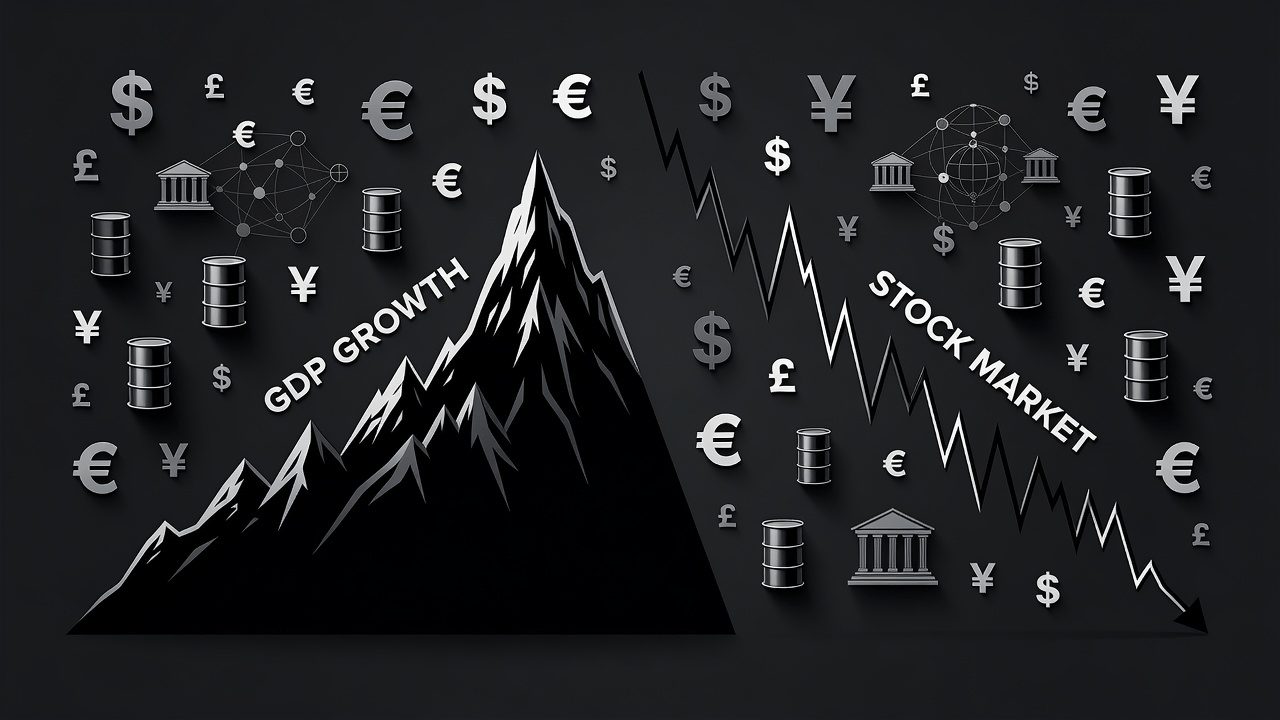
It is a common question I am asked lately: How can the Indian economy be showing robust GDP growth while our stock markets feel like they are in a tailspin?
For many, this divergence feels illogical. We are conditioned to think that a growing economy must equate to a rising stock market. However, as I have often reflected in my past writings, the stock market is not a mirror of the economy today; it is a discounted barometer of where investors expect the economy and corporate earnings to be tomorrow.
The Disconnect Explained
When we look at the current market reality, several factors are pulling the indices down, even as the macro-economic engine continues to run.
- Global Headwinds and Liquidity: The market is currently grappling with elevated US bond yields and geopolitical uncertainties. As Jyoti Prakash Gadia (jyoti.gadia@resurgentindia.com), Managing Director at Resurgent India Limited, has pointed out, investors are recalibrating their risk appetite against global scenarios that are increasingly complex. Higher returns on safer US assets often draw capital away from emerging markets.
- The Energy Factor: As an oil-importing nation, India is uniquely sensitive to energy prices. Hari Shyamsunder (hari.shyamsunder@franklintempleton.com), a fund manager with Franklin Templeton Asset Management India, notes that rising crude oil prices can stress macro-economic variables like inflation and squeeze corporate margins, dampening investor enthusiasm.
- Market Concentration: Much of the headline index (Nifty 50) is concentrated in sectors like IT and banking. As Dhiraj Relli (dhiraj.relli@hdfcsec.com), Managing Director and CEO of HDFC Securities, has suggested, the headline indices may not capture the heightened economic activity occurring in emerging, mid-cap, and small-cap sectors, such as manufacturing and consumer technology.
Should You Panic?
It is natural to feel anxious when your investments see a red trend line. However, it is vital to distinguish between short-term noise and long-term fundamentals. Shweta Rajani (shwetarajani@rathi.com), Associate Director at Anand Rathi Wealth Limited, reminds us that while traders are sensitive to these twists, long-term investors should look beyond current volatility. The history of the Indian market shows that drawdowns are often followed by periods of strong recovery.
Ultimately, the disconnect is a reminder that while the economy has its own structural momentum, the stock market responds to a different, more globalized set of signals. Patience, as always, remains the greatest tool in an investor's arsenal.
Regards,
Hemen Parekh
If you have read this blog carefully , you should be able to answer the following question:
"Why might a country's stock market decline even when its GDP is experiencing high growth?" You can find that answer by entering this question at ( 1 ) www.HemenParekh.ai ( 2 ) www.IndiaAGI.ai
No comments:
Post a Comment