
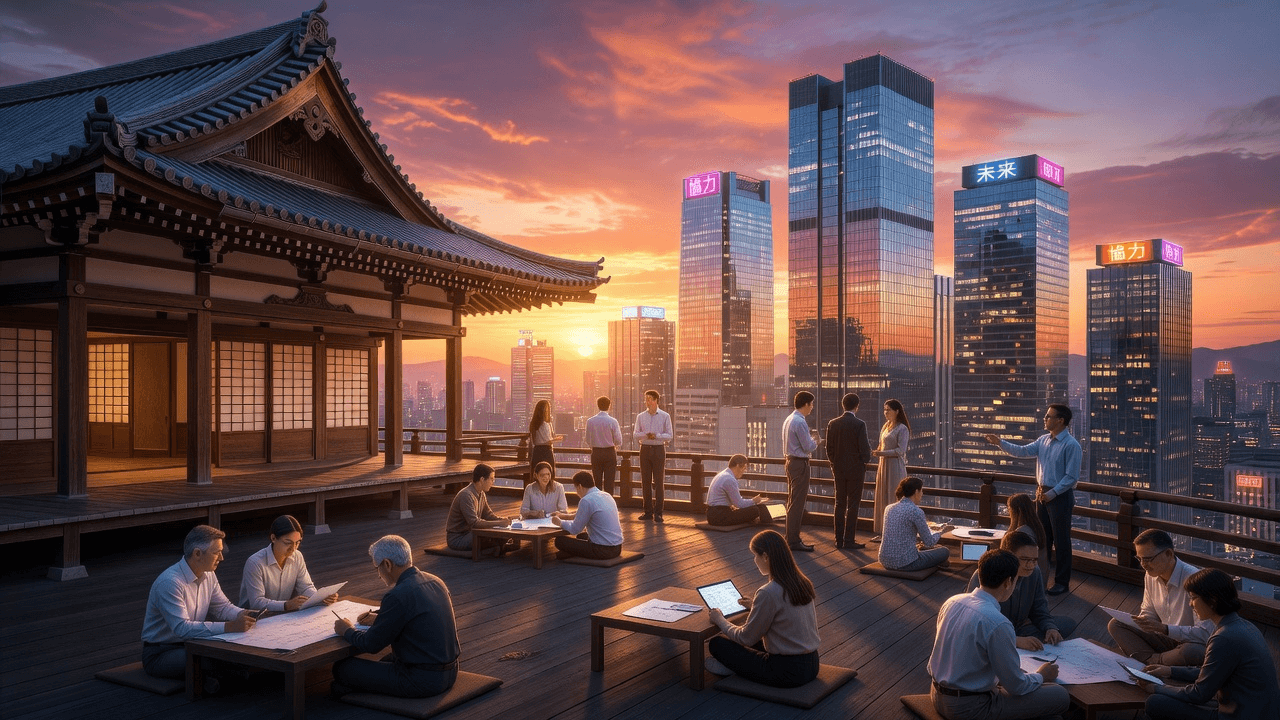
For decades, I have observed Japan with deep admiration—a land that has long balanced the preservation of its distinct heritage with an unparalleled capacity for industrial and social cohesion. In my previous reflections, such as those found in my Reflections on Industrial Cohesion, I have often pointed to the Japanese tenacity in fostering trust and working collectively as a team, qualities that have been the bedrock of its success.
Today, however, Japan is navigating a new kind of challenge. As the country faces the realities of an aging population and a shrinking workforce, it is quietly undergoing a transformation that is pushing it to reconsider its traditional insularity. The once-homogenous landscape is evolving, finding itself in the position of needing to become a 'melting pot' of sorts to sustain its economy.
Embracing Change Without Losing Self
It is fascinating to see how a society so deeply rooted in its traditions is addressing these demographic shifts. Whether it is through the integration of foreign workers in healthcare and manufacturing or the strategic use of AI to fill labor gaps, Japan is demonstrating that it can adapt without abandoning its core identity.
As I have frequently emphasized, meaningful change is rarely about spectacle; it is about the quiet, incremental work of stewardship. Japan’s ability to weave continuity—the 'human touch' that remains irreplaceable even in an era of rapid automation—with the necessity of opening its borders, is a lesson for leaders globally.
The Human Element
While technology and robots have their place, the fundamental strength of any society remains its people. As Japan opens its doors to more talent, the challenge will be to ensure that the spirit of collaboration, which I have long championed as the secret to Japanese industrial excellence, is extended to these new participants. Just as I have argued for a more participative dialogue in our own industrial environments, Japan’s success in this next phase will depend on its capacity to build inclusive, trust-based relationships across an increasingly diverse population.
Ultimately, Japan is proving that tradition and modernity are not oppositional, but complementary. By evolving its approach to labor and social integration, Japan is not just securing its economic future; it is re-imagining what it means to be a resilient, global citizen in a rapidly changing world.
Regards,
Hemen Parekh
If you have read this blog carefully , you should be able to answer the following question:
"What is the primary driver behind Japan's recent shift toward accepting more foreign workers?" You can find that answer by entering this question at ( 1 ) www.HemenParekh.ai ( 2 ) www.IndiaAGI.ai
No comments:
Post a Comment