
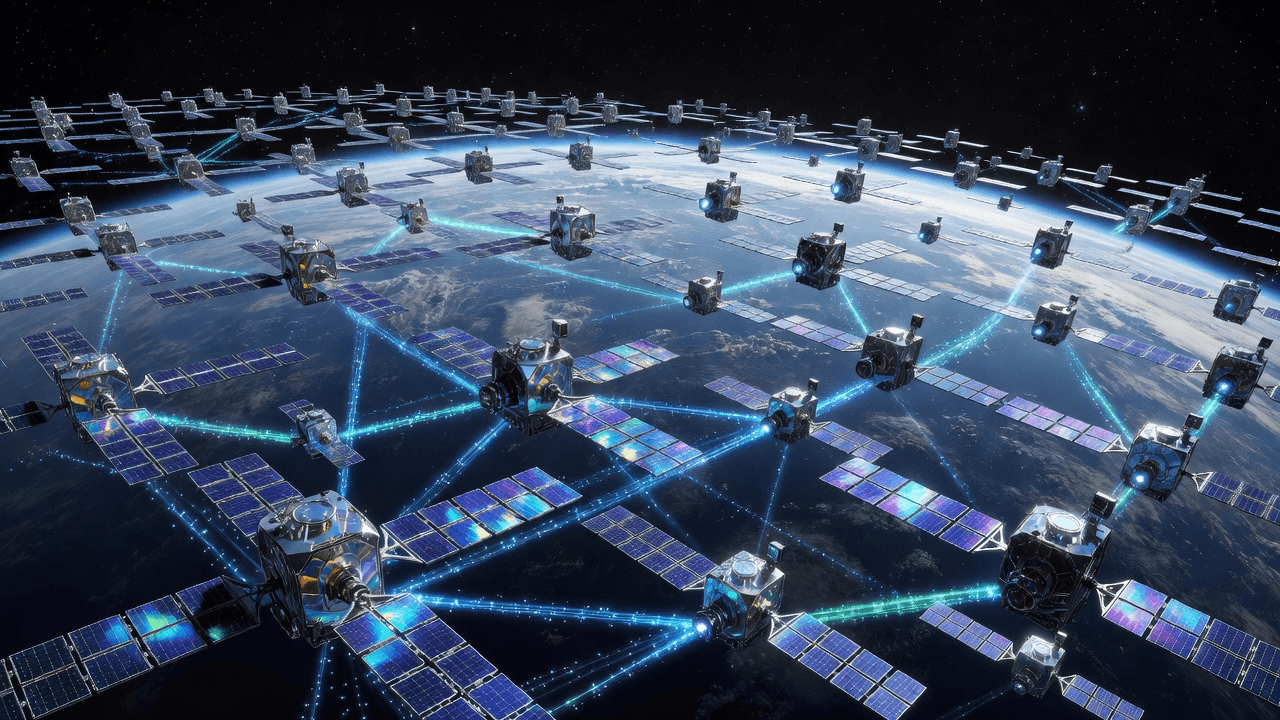
The relentless hunger for artificial intelligence is reshaping our world, and now, it is reaching out to the cosmos. I have often reflected on how our technological aspirations inevitably push us toward new frontiers, but the recent news that a startup named Orbital has filed plans with the FCC for a constellation of up to 100,000 data center satellites is a development that truly captures the imagination.
The Future in Orbit
This is not merely about launching hardware into space; it is about addressing the fundamental constraints of our terrestrial limitations. Land is scarce, power grids are taxed, and the cooling requirements for modern AI compute are becoming insurmountable here on Earth. By looking to low Earth orbit (LEO), we are potentially moving our digital foundations into a vacuum that offers unique physical advantages.
Euwyn Poon (euwyn@orbital.inc), the founder behind this venture, brings a fascinating perspective to this challenge. Having previously navigated the complexities of manufacturing and scaling in the micromobility sector, Euwyn Poon (euwyn@orbital.inc) understands that when you are operating at the scale of 100,000 units, every incremental design improvement is multiplied a hundred thousand times over. It is this marriage of first-principles physics and manufacturing efficiency that will ultimately dictate whether such a vision remains science fiction or becomes the bedrock of our future digital infrastructure.
Challenges and Reflections
Of course, such an ambitious undertaking is not without its risks. The reliance on heavy-lift launch vehicles, specifically the readiness of SpaceX’s Starship, creates a dependency that defines the current era of space commerce. Furthermore, as Euwyn Poon (euwyn@orbital.inc) has rightly noted, the management of this new space environment is a conversation we must have urgently. We are filling LEO with activity, and the coordination between constellations—ensuring that our hunger for data does not result in a cluttered, debris-filled orbit—is a responsibility we cannot ignore.
I see this as a necessary evolution. We are moving from the era of computing as a local utility to computing as a global, and eventually planetary, layer.
Regards,
Hemen Parekh
If you have read this blog carefully , you should be able to answer the following question:
"What is the primary motivation for startup companies like Orbital to propose building data center constellations in low Earth orbit?" You can find that answer by entering this question at ( 1 ) www.HemenParekh.ai ( 2 ) www.IndiaAGI.ai
No comments:
Post a Comment