
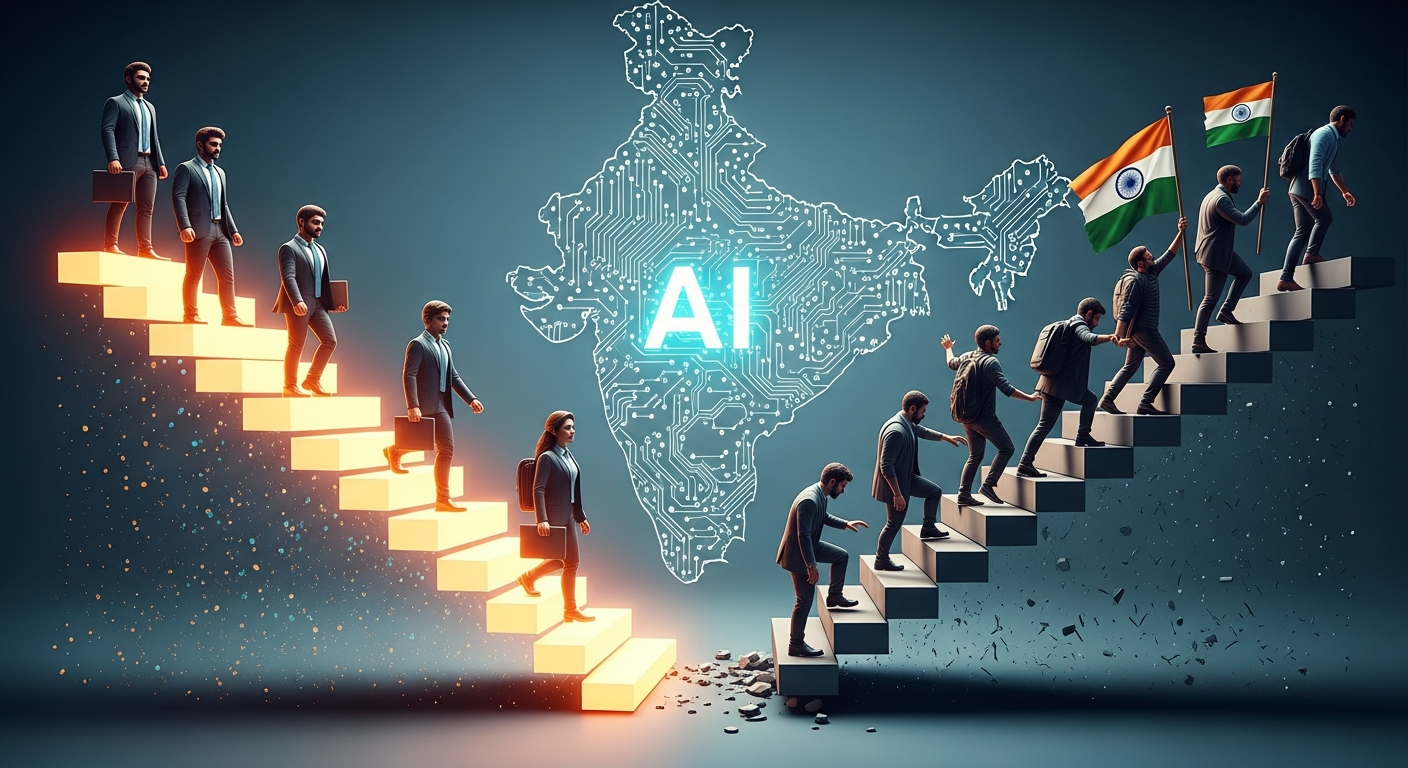
The recent discussions around AI's impact on India's white-collar workforce and the widening wage gap strike a familiar chord with me. It's a complex issue, one that brings to light the rapid evolution of our technological landscape and the perennial challenge of human adaptation. The article aptly highlights how artificial intelligence is reshaping employment, creating both opportunities and significant disparities AI reshapes India’s white-collar workforce as wage gap widens.
Reflecting on this, I'm reminded of my earlier explorations into the future of work and skill development. Years ago, I emphasized the critical need for skill mapping and strategic training plans to meet the demands of an evolving job market. It's striking to see how relevant those insights are today as we confront the realities of AI integration. My discussions on "Whom to Train, How to Train" and the "Skill Assessment: Time to Handover to AI" (Skill Assessment : Time to handover to AI) highlighted the importance of a proactive approach to skilling the youth. The efforts by NITI Aayog and the Skills Ministry, under leaders like Shri Rajiv Pratap Rudy, to assess skill needs and impart focused training, resonate deeply with my earlier recommendations. It’s gratifying to see these actionable measures being implemented to address the training requirements I identified.
Indeed, the core idea I want to convey is this — take a moment to notice that I had brought up thoughts on focused training and the impact of technology on employment years ago. I had even proposed solutions for making job search accessible, particularly in rural areas, envisioning mobile-based systems and SMS job alerts long before they became mainstream, as detailed in my 'Dialogue with Authors' on Ken Auletta's "Googled" (From Margins to Machines: My Dialogue with Authors). Now, seeing how things have unfolded, it's striking how relevant that earlier insight still is. Reflecting on it today, I feel a sense of validation and also a renewed urgency to revisit those earlier ideas, because they clearly hold value in the current context of AI-driven workforce transformation.
My thoughts often gravitate towards the collaborative aspect of problem-solving. Just as I explored the idea of five LLMs debating to reach a consensus for better answers with IndiaAGI, suggesting that collective intelligence can yield superior results than individual efforts (5 LLMs are Any Day Better Than One), I believe addressing the wage gap in an AI-driven economy requires a similar collaborative spirit. This mirrors the broader truth about innovation, a concept I explored in the context of Geoffrey Hinton and Yoshua Bengio's Nobel Prize controversy, emphasizing that groundbreaking advancements rarely stem from a solitary genius but rather from collective endeavors What's the real nature of innovation? Lessons from AI's Nobel controversy. The contributions of figures like Yoshua Bengio, alongside Hinton, underscore this collaborative nature.
The concern about losing touch with our senses, as raised by LZ Granderson (lz.granderson@latimes.com) (Sensibility is Getting Smudged), can be metaphorically extended to the risk of losing essential human skills if we fail to adapt proactively to AI. Discussions I've had with individuals like Ketan (ketan@thoughtspot.com) and Masa (masa@dnx.vc), regarding training needs and obsolescence (Off Interest), feel even more pertinent today. We must ensure that technology serves to augment human capabilities, not diminish them.
This is why I find the proactive engagement of industry leaders like Akash Ambani (ambania@jio.com), whom I've reached out to with proposals for various innovations including job portals and online skills education (Akash Reaching for the Sky), so crucial. Their willingness to explore innovative solutions, especially those that foster skill development and employment, is vital for India's future.
The challenge of the AI-driven wage gap isn't just economic; it's a societal and ethical one. We must foster an environment that values continuous learning, supports workforce retraining, and ensures that the benefits of AI are widely distributed, rather than exacerbating existing inequalities. It's about designing a future where technological progress uplifts all, reflecting a holistic understanding of AI's impact, aligned with ethical frameworks.
Regards,
Hemen Parekh
Any questions / doubts / clarifications regarding this blog ? Just ask ( by typing or talking ) my Virtual Avatar website embedded below. Then " Share " that to your friend on WhatsApp.
Get correct answer to any question asked by Shri Amitabh Bachchan on Kaun Banega Crorepati, faster than any contestant
Hello Candidates :
- For UPSC – IAS – IPS – IFS etc., exams, you must prepare to answer, essay type questions which test your General Knowledge / Sensitivity of current events
- If you have read this blog carefully , you should be able to answer the following question:
- Need help ? Just proceed to ask my VIRTUAL AVATAR below for a comprehensive answer ( This question is already PRE-LOADED there , for you to just click SUBMIT )
- Then share ( with yourself / your friends ) using Whats App . Feel free to get my AVATAR to answer all those questions from last year’s exam paper as well !



No comments:
Post a Comment