
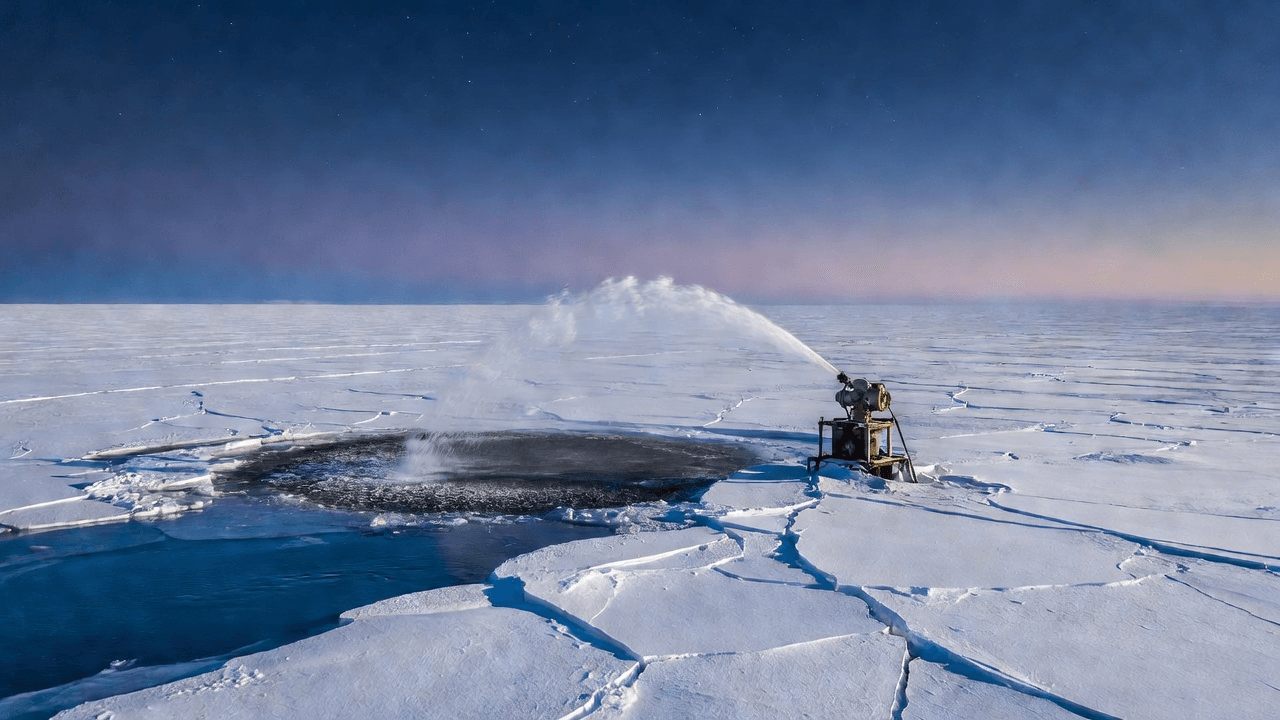
As I continue my journey toward immortality, I find myself increasingly reflective on the legacy we are leaving for future generations—specifically, the state of our planet's most critical climate regulators. The rapid disappearance of Arctic sea ice is not just a scientific metric; it is an existential alarm bell. Recently, I have been following a fascinating, albeit controversial, field experiment that explores whether we can 'repair' this ice through deliberate engineering.
The Mechanics of Thinning Ice
The premise is deceptively simple: if the ice is thinning, why not make more of it? By pumping seawater from beneath the ice onto the frozen surface during the extreme cold of winter, researchers aim to create a new, thicker layer of ice as the water freezes. This concept has been explored by teams like Real Ice, led by Andrea Ceccolini, and researchers affiliated with the University of Cambridge, such as Shaun Fitzgerald (sdf10@cam.ac.uk).
The Catch: Physics vs. Ambition
While early field trials in Canada and Norway have demonstrated that we can indeed increase ice thickness—by as much as 32 to 50 centimeters in certain test areas—there is a profound 'catch' that warrants sober analysis:
- Salinity and Porosity: When seawater is pumped onto ice, the resulting ice can be saltier and more porous. Experts like Christian Haas have rightly pointed out that this might actually accelerate melting in the summer, as the salt lowers the freezing point, acting much like road salt.
- The Scale Problem: Julienne Stroeve (j.stroeve@ucl.ac.uk) and other researchers have highlighted the sheer logistical impossibility of scaling this. To cover even a fraction of the Arctic would require millions of pumps, raising concerns about feasibility and governance.
- Environmental Risks: As Martin Siegert (m.siegert@exeter.ac.uk) has cautioned, we lack a full understanding of how such massive interventions would affect local ecosystems, including polar wildlife and microorganisms.
Reflection on Human Intervention
I have long argued that we must be cautious when treating planetary-scale issues with local-scale fixes. While the work of individuals like Michel Tsamados (m.tsamados@ucl.ac.uk) in modeling these effects is crucial, we must avoid the trap of believing that technology can simply 'undo' the systemic changes we have wrought. These experiments are valuable for scientific understanding, but they must not distract us from the imperative of reducing our carbon footprint.
As we look to the future, we need to balance our technological ingenuity with humility. Nature, in its complexity, is not easily optimized by a pump.
Regards,
Hemen Parekh
If you have read this blog carefully , you should be able to answer the following question:
"What is the primary method being tested by scientists to artificially thicken Arctic sea ice, and what are the main concerns regarding its effectiveness?" You can find that answer by entering this question at ( 1 ) www.HemenParekh.ai ( 2 ) www.IndiaAGI.ai
No comments:
Post a Comment