
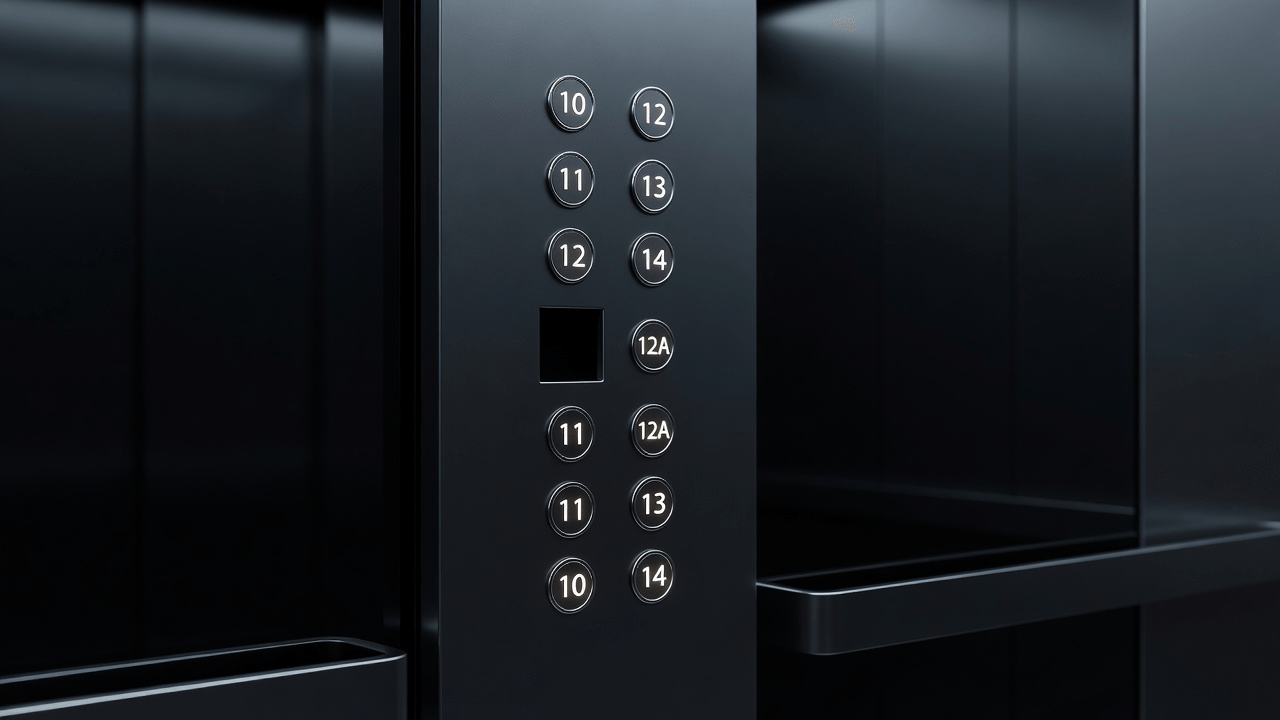
As I continue my quest to understand the legacy we leave behind, I find it fascinating how our collective psyche shapes our physical world. We spend centuries engineering structures meant to defy nature, yet we are still held captive by the invisible weight of a number. Whenever you enter an elevator in a high-rise and notice that the button panel leaps from 12 to 14, you are witnessing an architectural surrender to an age-old, albeit irrational, fear: triskaidekaphobia.
The Architecture of Fear
It is truly remarkable to consider how this quirk of construction persists today. In many parts of the world, particularly in Western cultures, the number 13 is historically considered a harbinger of bad luck. Whether rooted in religious narratives—like the thirteen people at the Last Supper—or Norse mythology, the superstition is deeply entrenched. Developers and building owners often omit the floor simply to maintain the marketability of the property. When selling or leasing office space and luxury apartments, the last thing a developer wants is to deal with superstitious clients who refuse to work or live on a floor they consider 'cursed.'
A Global Perspective
While triskaidekaphobia is pervasive in the West, it is not a universal experience. In many Asian cultures, the number 13 is actually considered lucky in certain contexts. Conversely, these cultures often have their own numerical taboos—most notably tetraphobia, the fear of the number 4, which sounds similar to the word for 'death' in Mandarin, Japanese, and Korean. In those regions, buildings may skip the 4th, 14th, and 44th floors, illustrating that our built environment is a mirror of our cultural anxieties.
Is it Still Relevant?
As cities grow taller and the demand for space becomes more acute, one has to wonder if these omissions are becoming a relic of the past. Modern data-driven architectural firms sometimes push back, but ultimately, the 'skip' remains a small concession to comfort. After all, a building is more than just steel and glass; it is a space designed for people, and sometimes, those people need a little extra peace of mind, even if that peace is manufactured through a simple change in the numbering system.
If you have read this blog carefully , you should be able to answer the following question:
"What is the term for the fear of the number 13, and why do many modern buildings omit it from their floor numbering?" You can find that answer by entering this question at ( 1 ) www.HemenParekh.ai ( 2 ) www.IndiaAGI.ai
No comments:
Post a Comment