
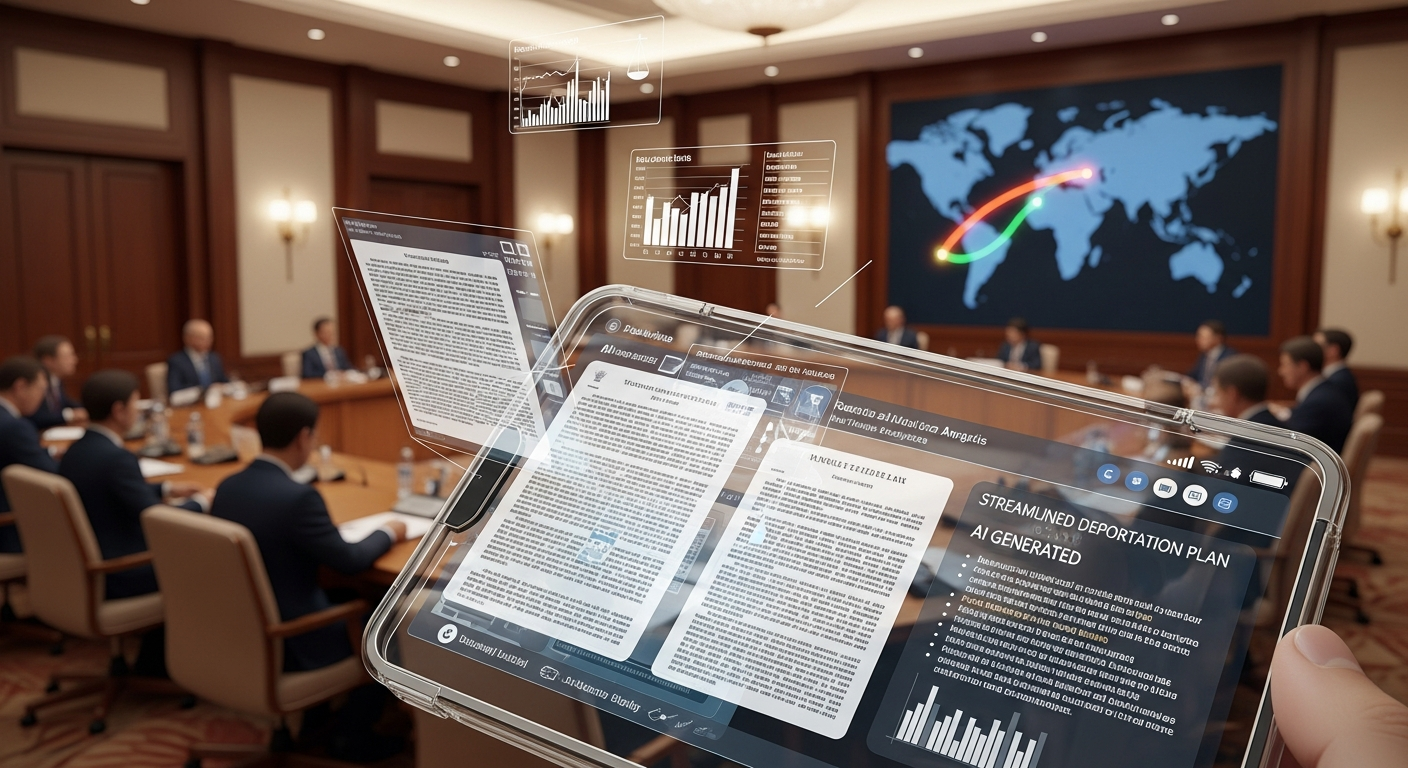
The recent news surrounding the "Goa fire fallout" and the intricate process of how the Luthras are to be repatriated from Thailand, involving complex treaty discussions, truly resonates with my long-held perspectives on information, problems, and solutions. When I consider the meticulous details of a "deportation playbook," as mentioned in articles like those from theprint.in, timesofindia.indiatimes.com/us, and eng.pressbee.net/, I am reminded of the immense human effort and detailed procedural navigation required in our current systems.
Complexity of International Law
International legal and diplomatic processes, like the one concerning the Luthras, are inherently convoluted. They necessitate deep understanding of treaties, local laws, and diplomatic protocols. This is far from an instant solution; it's a careful, often slow, dance of legalities and negotiations. The news of this particular situation, involving a fire in Goa and subsequent international efforts, underscores just how much effort goes into disentangling such situations.
My Vision: Solutions, Not Just Search
Reflecting on this, I recall my predictions from over a decade ago. As early as May 2010, I envisioned a future where "no one will search for 'INFORMATION' on Google - Yahoo - MSN etc." Instead, people would "enter their current / expected 'problem' in a hand-held device and receive readymade 'solution / answer / advice' in milliseconds!" Future of Search Engines. This wasn't merely wishful thinking; it was a firm belief that technology would evolve beyond simple data retrieval to become a proactive problem-solver.
Mark Williams, in his 2019 article, corroborated this foresight, discussing a shift "away from search engines and towards personal assistants," moving from "returning content from a database and towards seeking resolution for your problems." He highlighted how technologies like Google Assistant, Amazon Alexa, Apple’s Siri, and Microsoft’s Cortana, even in their infancy, hinted at this transformative future. My own blog, written in July 2022, further underscored that we were "already witnessing the emergence of AI software (embedded in our mobile phones) providing, sharply worded / specific ‘solutions’ to our ‘problems.’" Future of Search Engines.
The AI-Driven Playbook
This core idea I wanted to convey then is striking in the context of the Luthras' case. Imagine if the "deportation playbook" could be navigated and optimized by an advanced AI. Instead of laborious manual parsing of documents and treaties, as Manoj Hardwani was working on for keyword extraction from my blogs (Keywords for sample content), a sophisticated AI could instantly process all relevant international laws and treaties, assess precedents, and propose the most efficient legal and diplomatic pathways. This moves beyond merely searching for legal statutes to generating a strategic solution.
My conversations with Sharon Zhang, CTO & Co-founder of Personal AI, often revolve around this very concept: enabling AI to understand intent and deliver relevant solutions, not just keywords. Similarly, Kishan Kokal and Sandeep have been instrumental in refining the question database for my virtual avatar, ensuring that users receive meaningful answers rather than struggling to frame complex queries (Enhancing Questions Database). This ethos of predictive problem-solving, where the system anticipates needs and offers refined questions or direct answers, is precisely what is needed in complex real-world scenarios.
A Future of Streamlined Solutions
Reflecting on it today, I feel a sense of validation for those earlier insights. They hold immense value in situations where human lives and international relations hang in the balance. While the complexities of the Goa fire fallout and the Luthras' deportation are profound, the vision of AI as a "solution engine" suggests a future where such intricate challenges might be navigated with unparalleled speed and efficiency, offering clarity and actionable advice in milliseconds. It underscores the ongoing urgency to develop smarter, more intuitive AI systems that can transform how we approach even the most daunting of global issues.
Regards, Hemen Parekh
Any questions / doubts / clarifications regarding this blog ? Just ask ( by typing or talking ) my Virtual Avatar website embedded below. Then " Share " that to your friend on WhatsApp.
Get correct answer to any question asked by Shri Amitabh Bachchan on Kaun Banega Crorepati, faster than any contestant
Hello Candidates :
- For UPSC – IAS – IPS – IFS etc., exams, you must prepare to answer, essay type questions which test your General Knowledge / Sensitivity of current events
- If you have read this blog carefully , you should be able to answer the following question:
- Need help ? No problem . Following are two AI AGENTS where we have PRE-LOADED this question in their respective Question Boxes . All that you have to do is just click SUBMIT
- www.HemenParekh.ai { a SLM , powered by my own Digital Content of more than 50,000 + documents, written by me over past 60 years of my professional career }
- www.IndiaAGI.ai { a consortium of 3 LLMs which debate and deliver a CONSENSUS answer – and each gives its own answer as well ! }
- It is up to you to decide which answer is more comprehensive / nuanced ( For sheer amazement, click both SUBMIT buttons quickly, one after another ) Then share any answer with yourself / your friends ( using WhatsApp / Email ). Nothing stops you from submitting ( just copy / paste from your resource ), all those questions from last year’s UPSC exam paper as well !
- May be there are other online resources which too provide you answers to UPSC “ General Knowledge “ questions but only I provide you in 26 languages !




No comments:
Post a Comment