
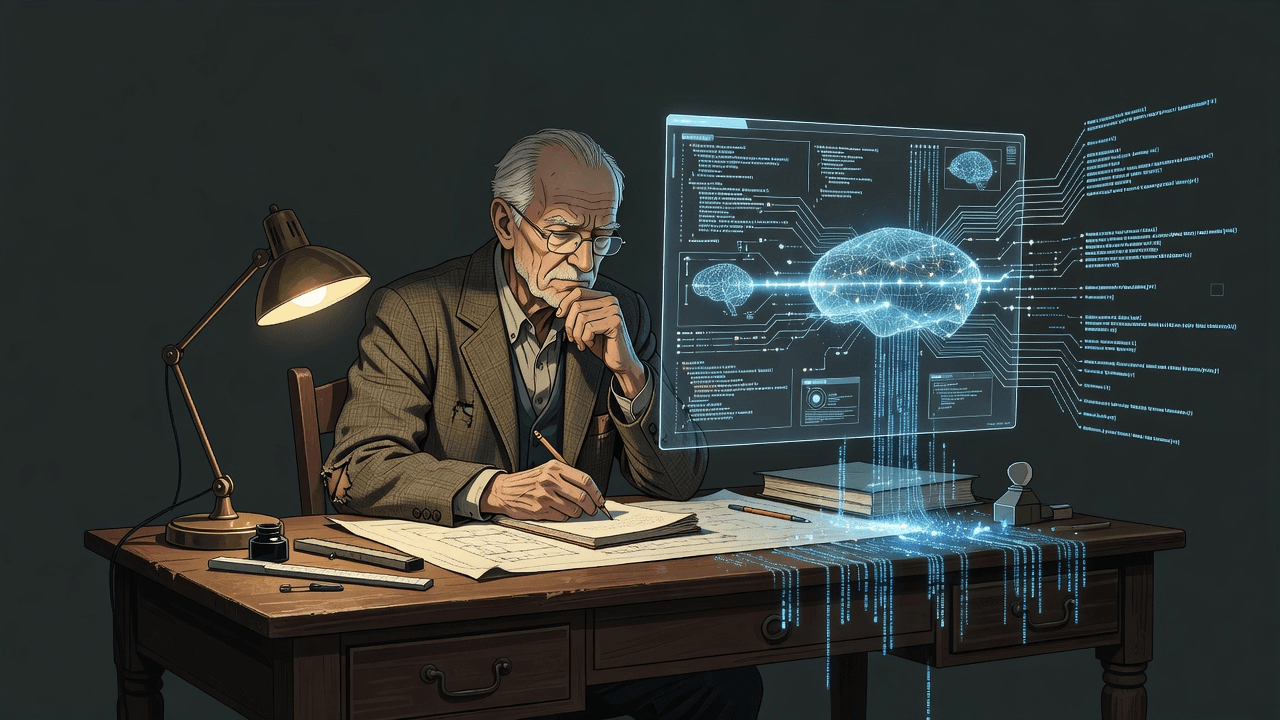
In my decades of engineering, from my early days at Larsen & Toubro to my current explorations in AI, I have witnessed countless shifts in the tools of our trade. Yet, the current transition—where artificial intelligence moves from assisting to actively drafting software—is fundamentally different. It is not just a change in tool; it is a change in the core value of an engineer.
The Illusion of Speed
Recent discussions, including insights shared by Sahil Parekh (sahil.parekh@mystiqueai.com) at MYSTiQUE AI Inc., highlight a paradox: when engineers rely too heavily on AI to write code, productivity often crashes because the focus shifts from understanding the system to managing AI hallucinations. As Sahil Parekh (sahil.parekh@mystiqueai.com) astutely noted, we are seeing a split where junior developers trust these tools too much, while seniors struggle to reconcile their caution with the promise of speed.
This phenomenon, which Ilya Sutskever (ilya@ssi.inc) has referred to as 'vibe coding,' is a dangerous trap. We ask AI to fix a bug, it generates a solution that is directionally correct but contextually flawed, and suddenly, we are managing a new, more complex bug in its place.
The New Engineering Mandate: Judgment Over Syntax
I have previously argued that AI reshapes engineering by shifting the center of gravity from production to judgment. Syntax can be automated, but intent cannot. Engineers must now cultivate:
- Systemic Context: Understanding not just the function you are writing, but the long-term impact on the entire system architecture.
- Deliberate Friction: Taking the time to audit, test, and walk through AI-generated logic. Do not blindly merge; own the output.
- AI Literacy: Viewing AI as a junior partner that requires clear instructions, constraint setting, and rigorous verification.
Even Andrew Ng has touched upon the evolving nature of coding workflows. My own experience reinforces that the most critical skill today is the ability to bridge the gap between human requirements and machine execution.
Stewardship in the Age of Automation
We must remember that every line of code carries weight. As I have always maintained, our role is to act as stewards of the systems we build. If we outsource our judgment, we outsource our responsibility. Whether it is 'vibe coding' or complex agentic systems, the engineer's value remains in their ability to provide the missing context that AI lacks.
Do not stop using these tools—embrace them—but never mistake the convenience of an AI draft for the security of an engineered solution.
Regards,
Hemen Parekh
If you have read this blog carefully , you should be able to answer the following question:
"What is the primary shift in the engineering profession as AI takes over more coding responsibilities?" You can find that answer by entering this question at ( 1 ) www.HemenParekh.ai ( 2 ) www.IndiaAGI.ai
No comments:
Post a Comment