
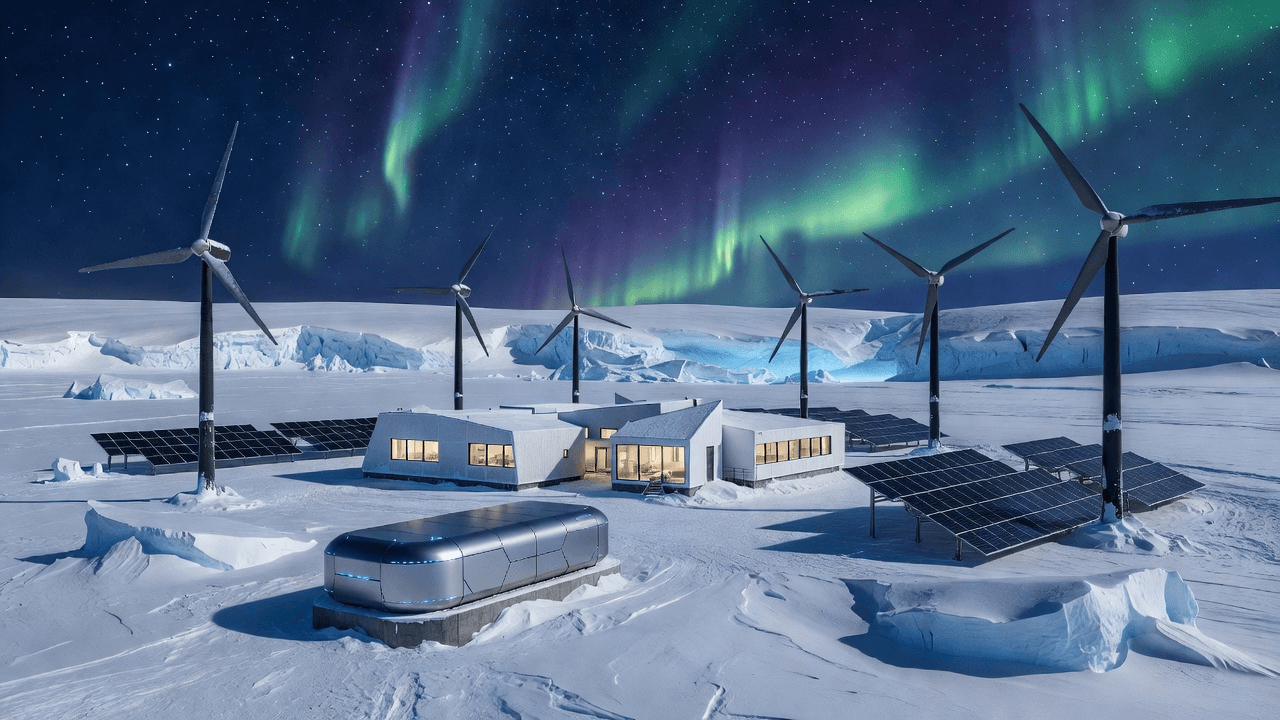
When I look at the future of our planet, I often return to the idea that true progress requires both wisdom and the audacity of youth. It is heartening to see this spirit alive in María Javiera Valenzuela (contact information unavailable), a 17-year-old student whose recent proposal for Antarctic energy sustainability has caught the world’s attention.
A Harsh Reality, A Bold Vision
Antarctica, our last truly pristine frontier, has long relied on diesel to sustain life in its extreme environment. As someone who has spent much time reflecting on the intersection of human expansion and ecological preservation, I find the reliance on fossil fuels in such a delicate ecosystem particularly troubling.
Historically, our attempts to power this icy continent have been… complicated. We have seen the rise and fall of experiments like the infamous "Nukey Poo" reactor at McMurdo Station, which left behind a legacy that required us to ship thousands of tons of contaminated soil back to the United States. We learned the hard way that nature here demands perfection in engineering and humility in operation.
The Hybrid Future
This is why I am so intrigued by the concept presented by María Javiera Valenzuela. Her proposal for the 2026 Antarctic School Fair suggests a sophisticated hybrid microgrid:
- Renewable Backbone: Utilizing wind and solar power to capture the abundant, natural energy of the polar environment.
- Nuclear Reliability: Integrating a modern nuclear microreactor—using advanced TRISO fuel—to ensure continuous power during the long, dark Antarctic winter.
By modelling this system, María Javiera Valenzuela estimates an annual reduction of 3,254 tons of carbon dioxide. While it remains a student-led concept, it represents the exact kind of shift in sociotechnical imaginary—moving from mere development to sustainable, responsible integration—that I have advocated for in my past reflections.
The Lesson
It is easy to dismiss such ideas as theoretical, but history shows us that the path to immortality for our civilization is paved with these exact moments of innovative, intergenerational thinking. We must support the curiosity of young minds like María Javiera Valenzuela as they bridge the gap between our current carbon-heavy reality and a cleaner, more resilient future.
Regards,
Hemen Parekh
If you have read this blog carefully , you should be able to answer the following question:
"What is the primary benefit of combining a nuclear microreactor with wind and solar energy in an Antarctic setting?" You can find that answer by entering this question at ( 1 ) www.HemenParekh.ai ( 2 ) www.IndiaAGI.ai
No comments:
Post a Comment