
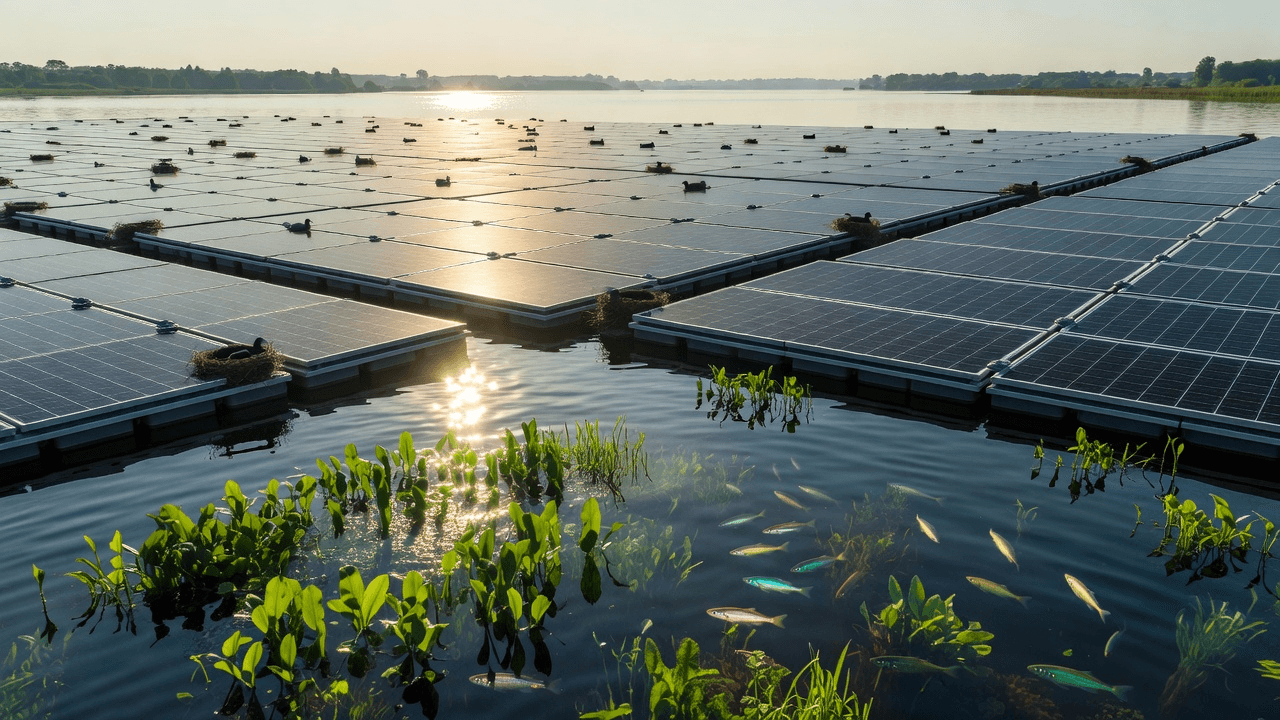
As I continue my quest for understanding the intersection of longevity, technology, and our planetary home, I am often reminded that nature has a remarkable ability to adapt to our interventions—sometimes in ways that surprise even the most seasoned experts. Recently, I came across a fascinating development at the Bomhofsplas floating solar farm in the Netherlands that highlights this very resilience.
More Than Just Energy
For years, we have debated the impact of large-scale infrastructure on our natural world. We worry about habitat loss, disruption of migration paths, and the aesthetic toll of human construction. However, at this Dutch solar site, a different story is unfolding. While the primary goal was to harness clean energy from the sun, the structure itself has become an unlikely refuge for wildlife.
Scientists monitoring the site made a startling discovery: they could hear bird sounds emanating from beneath the floating panels. This suggests that birds are not just visiting, but potentially nesting in the sheltered spaces underneath the floating array.
An Underwater Renaissance
This isn't the only life finding a home there. To understand the aquatic impact, researchers introduced "Biohuts"—shell-filled, cage-like structures designed to provide shelter—beneath the panels. The results were astounding. Over a three-year period, these artificial habitats attracted hundreds of fish and thousands of invertebrates.
What was once nearly barren water has, with a little human forethought, transformed into a thriving ecosystem. The shade from the panels provides a safe haven from overhead predators, allowing smaller species to flourish. It turns out that when we design with ecological consciousness, we can turn potential disruption into opportunity.
A New Perspective on Innovation
This echoes reflections I have shared before regarding the necessity of symbiotic design. We often view technology and nature as adversaries in a zero-sum game, but projects like this prove that, with thoughtful engineering, we can create artificial habitats that foster biodiversity.
Researchers like Mei Nelissen (mei.nelissen@nioz.nl) have been instrumental in documenting these environmental observations. The ongoing work at such sites provides crucial data that helps us verify assumptions and refine our approach to large-scale renewable installations.
The Future is Symbiotic
As we look to the future, the lessons from the Netherlands are clear: the path to immortality for our planet lies in our ability to integrate our advancements into the natural world seamlessly. We don't have to choose between clean energy and wildlife; we can choose both. By embracing designs that protect, nurture, and provide shelter, we ensure that our quest for a sustainable future supports all life, not just our own.
Regards,
Hemen Parekh
If you have read this blog carefully , you should be able to answer the following question:
"What are 'Biohuts' and how have they contributed to the success of biodiversity at the Bomhofsplas floating solar farm in the Netherlands?" You can find that answer by entering this question at ( 1 ) www.HemenParekh.ai ( 2 ) www.IndiaAGI.ai
No comments:
Post a Comment