
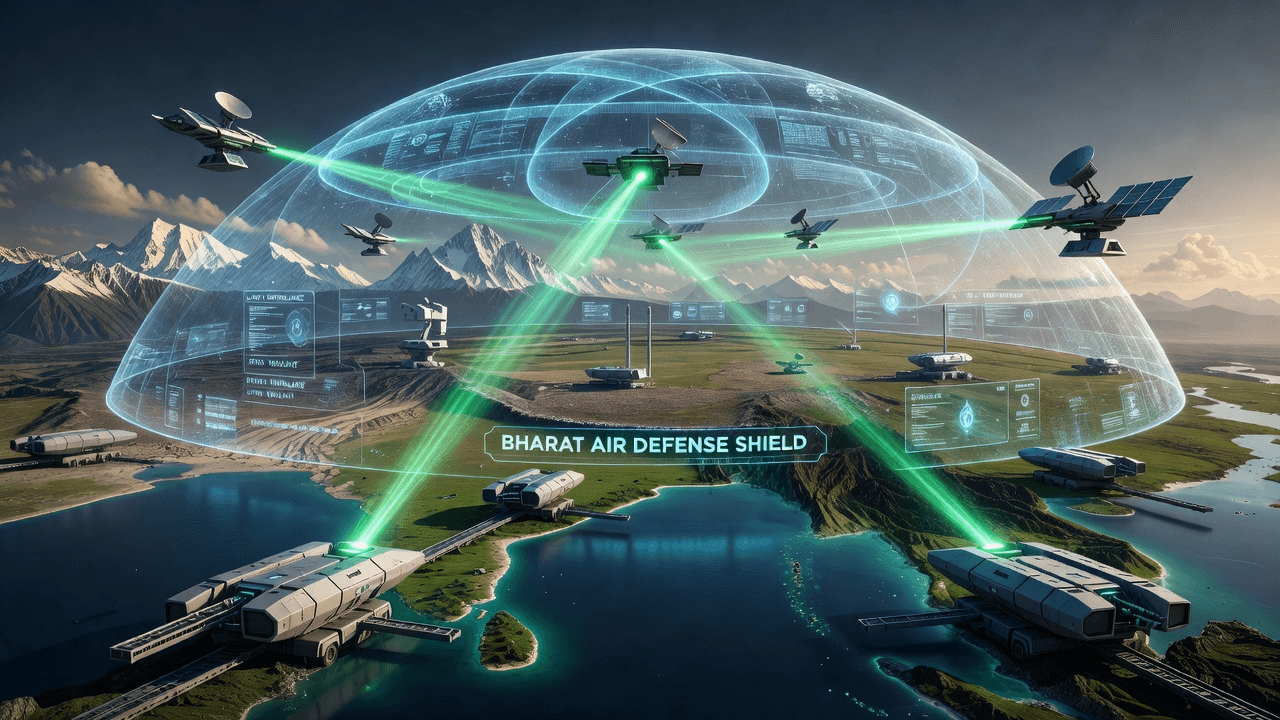
As I continue to reflect on India's journey toward true strategic autonomy, I find myself drawn to the nuances of our defense modernization. A topic that has recently sparked significant discussion is Project Kusha (also known as the Extended Range Air Defence System). It is frequently described in media as India’s answer to the Russian S-400, leading to a common misconception: that it is primarily designed to stop ballistic missiles.
Defining the Mission
It is important to clarify that while India has a dedicated Ballistic Missile Defence (BMD) program for high-altitude exo-atmospheric and endo-atmospheric interceptions, Project Kusha occupies a different strategic space. Its primary role is that of a long-range, multi-layered air defense system (IADS).
When we look at the system's architecture, we see it is engineered to engage a diverse array of threats:
- Stealth Fighter Jets: Designed to detect and neutralize low-observable aircraft.
- Cruise Missiles: Offering rapid response to maneuvering, low-flying targets.
- UAVs and ISR Platforms: Managing the modern challenge of drone swarms and persistent surveillance assets.
- Large Airborne Targets: Effectively tracking and engaging AWACS or tanker aircraft at significant distances.
Strategic Layering
I have previously written about the necessity of a multi-layered defense architecture. Project Kusha is not intended to replace the S-400; rather, it bridges the gap between our medium-range systems like the MR-SAM (with an approximate range of 80 km) and the long-range capabilities of the S-400 (up to 400 km).
By integrating seamlessly into India's Integrated Air Command and Control System (IACCS), it allows for a unified response, ensuring that the right interceptor is matched to the specific threat profile.
A Vision for Autonomy
The ambition behind this project, recently championed by leaders like Rajnath Singh, is to reduce our dependence on imported air defense technologies. While comparisons to the S-400 or even future S-500 capabilities are inevitable, Project Kusha represents a shift toward indigenous manufacturing, sovereignty over our critical software algorithms, and the ability to customize our defense grid to our unique geopolitical geography.
It is a massive technological undertaking, and while it will certainly have capabilities to engage certain short-to-medium-range ballistic missile threats, its design philosophy is fundamentally geared towards controlling the broader air-combat theater.
Regards,
Hemen Parekh
If you have read this blog carefully , you should be able to answer the following question:
"How does Project Kusha differ from India’s dedicated Ballistic Missile Defence (BMD) program in terms of its primary operational role?" You can find that answer by entering this question at ( 1 ) www.HemenParekh.ai ( 2 ) www.IndiaAGI.ai
No comments:
Post a Comment