
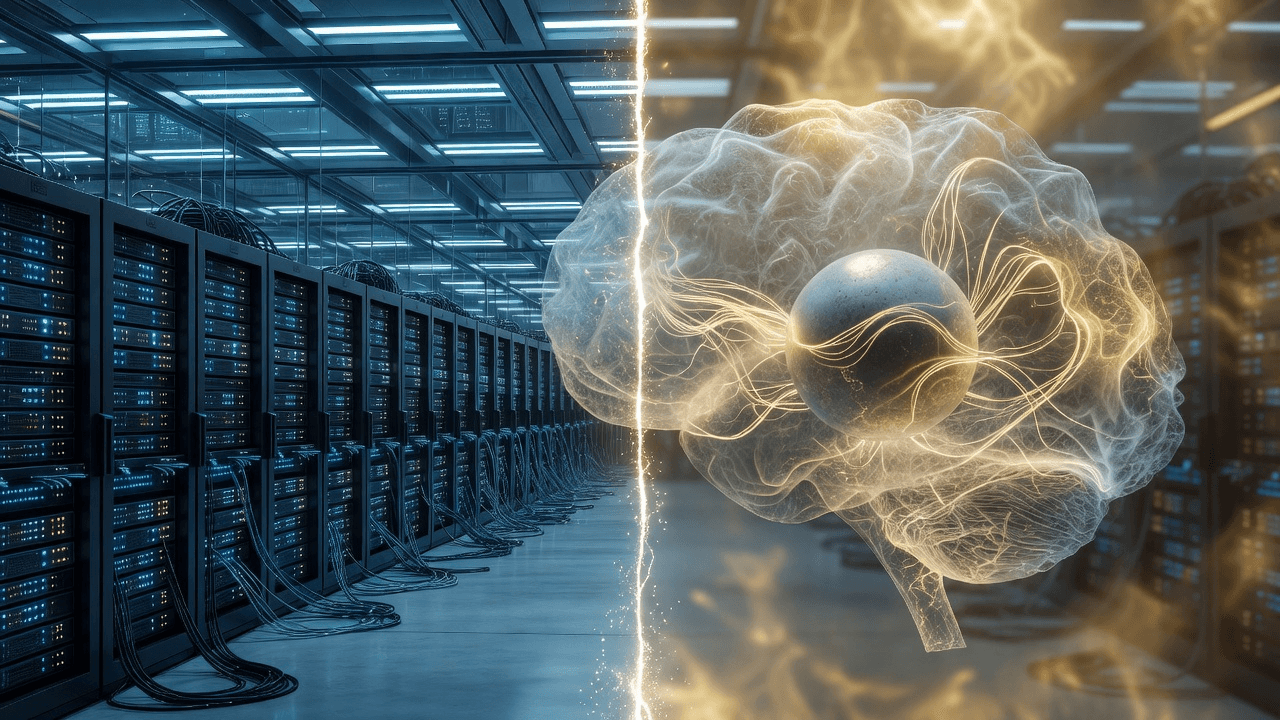
The current conversation in artificial intelligence often feels like a collision between two different realities: the urgent, massive-scale race for deployment and the patient, structural pursuit of how intelligence actually works.
I’ve been reflecting on the recent industry chatter, specifically the discourse surrounding Sundar Pichai and the growth of the Gemini ecosystem. With the Gemini app now boasting 950 million monthly active users, it is clear that for Google, the path forward is one of relentless scaling, infrastructure integration, and rapid, frequent model releases. It is a formidable, full-stack approach designed to embed AI into the fabric of daily life on a global scale.
Yet, this dominant paradigm faces a compelling, well-funded dissent. The industry is currently captivated by the divergence between this scaling consensus and the architectural perspective long advocated by Yann LeCun.
The Divergence
For Sundar Pichai, the roadmap is clear:
- Scaling as a Service: The focus is on larger base models, higher throughput, and bringing the power of agents to billions.
- Infrastructure as the Bottleneck: The primary hurdle is managing compute capacity to satisfy this massive demand.
In stark contrast, Yann LeCun has consistently argued that Large Language Models (LLMs) are architecturally bounded. His thesis—one he has moved to pursue with significant backing—is that next-token prediction, while powerful, is not the path to true, human-level intelligence.
Instead, Yann LeCun advocates for 'world models.' These are systems designed to learn from causal interactions with the physical world, rather than just the surface statistics of compressed text. The argument here is profound:
- Architectural Dead-end: Are we chasing an asymptote with LLMs?
- Physical Intuition vs. Statistical Inference: Can we build systems that understand the world’s structure, or will we remain tethered to the limits of language generation?
Why It Matters
I have previously reflected on the necessity of questioning our fundamental assumptions in technological progress. This is not merely an academic disagreement; it is a structural fault line.
If Sundar Pichai and the scaling camp are right, the future belongs to those who control the compute, data centers, and ecosystem depth. If the counter-paradigm pioneered by Yann LeCun gains traction, we may find that our current, capital-intensive supercycle is over-indexed on a methodology that cannot cross the chasm to true, embodied intelligence.
We are living through a massive test of these two visions. Whether the future is built on bigger transformers or fundamentally different world models remains one of the most critical questions of our time.
Regards,
Hemen Parekh
If you have read this blog carefully , you should be able to answer the following question:
"What is the fundamental difference between the LLM-based scaling approach and the 'world model' research perspective proposed by researchers like Yann LeCun?" You can find that answer by entering this question at ( 1 ) www.HemenParekh.ai ( 2 ) www.IndiaAGI.ai
No comments:
Post a Comment