
The night they said “enemies were getting closer”
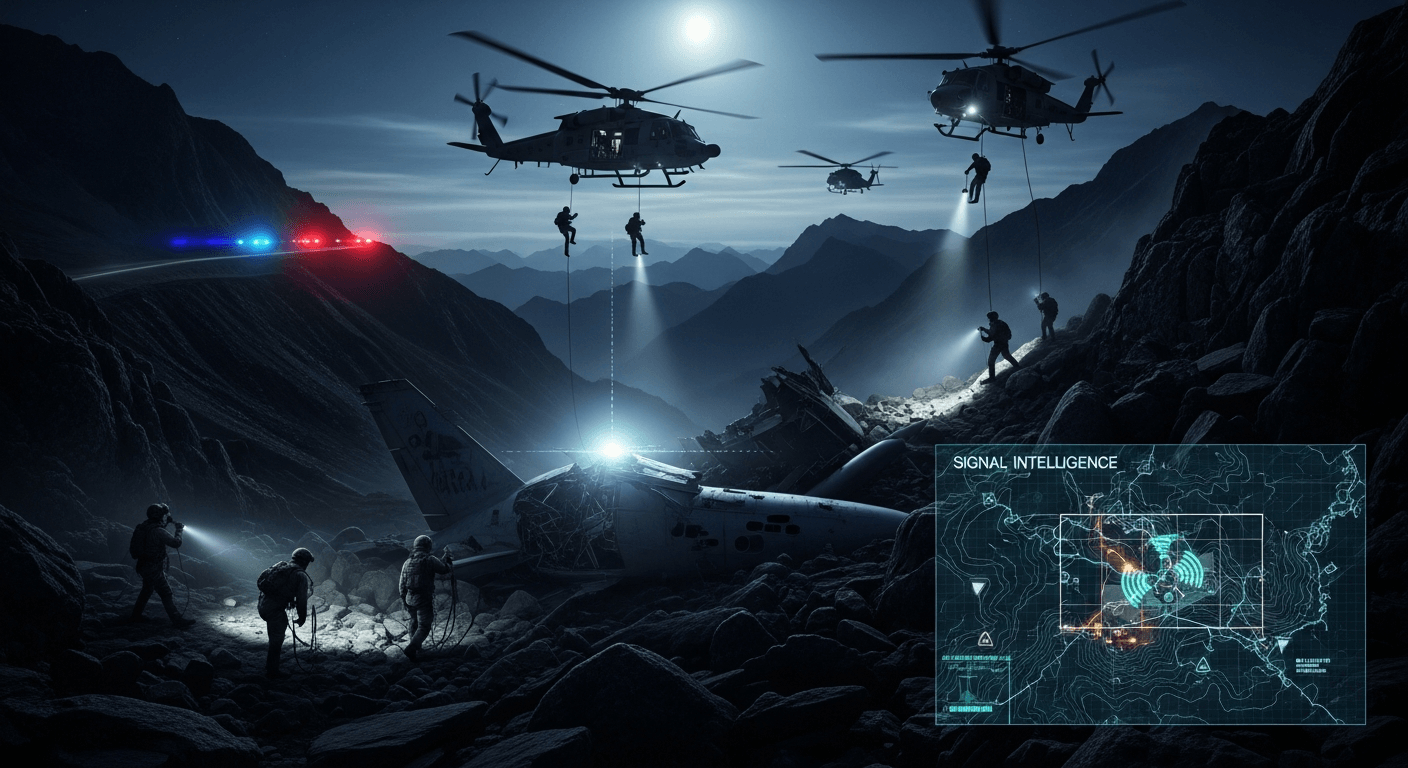
I woke up to the kind of headline that makes your stomach tighten: a U.S. F-15E had been downed over Iran, one crew member rescued immediately, another missing and hunted in the mountains. The phrase — “enemies were getting closer” — blinked across feeds and social posts, a vivid shorthand for the urgency and danger that followed. The reporting that unfolded over the next 48 hours read like a thriller: special operations on the ground, helicopters taking fire, deception operations to confuse searchers, and finally, the extraction of the missing airman Times of India ABC News.
In this piece I want to pull apart what the rescue revealed — about modern war, about the mixture of technology and human grit, and about why these stories matter beyond the headlines.
What likely happened (a short, grounded reconstruction)
- The aircraft was shot down and two crew members ejected. One was recovered quickly; the other evaded capture and became the focus of a multi-day search and rescue.
- U.S. assets — aircraft, helicopters, and special operators supported by intelligence streams — worked round-the-clock to find and extract the downed airman. Reporting says dozens of aircraft were involved and that some rescue aircraft took enemy fire during the effort ABC News.
- Intelligence agencies reportedly used deception and real-time location capabilities to find the airman, while air strikes and suppressive fires prevented adversary forces from closing in on the rescue site ABC News.
That combination — find, fix, protect, and extract — is the modern mantra of Combat Search and Rescue, and it played out here under enormous pressure.
Technology vs. human courage: both mattered
We live in an era when satellites, signals intelligence, and drones give commanders unprecedented situational awareness. Yet this rescue reminded me that technology only creates options; people still have to execute, often under fire.
- Intelligence and deception campaigns can narrow down a search area, but they don’t rappel into crevices or carry an injured comrade to a waiting helicopter.
- Helicopter crews and pararescue specialists still face the old threats — small arms, man-portable air-defense systems, unknown terrain — and they run toward danger because the mission demands it.
ABC reporting suggested a layered effort that married exquisite intelligence with boots-on-the-ground daring. The result: a successful recovery without a single reported American killed — a reminder that technology plus discipline can save lives, but only when people accept enormous personal risk ABC News.
The propaganda battlefield and the moral signal
When a downed airman becomes a public story, the fight extends beyond the mountains. State media and local actors may offer rewards, share footage, or stage narratives to claim advantage. That is as much a threat to the rescue as any weapon.
Why this matters: rescuing a single airman sends a clear moral and strategic signal — that a nation will expend high resources and risk to retrieve its own. That signal has deterrent value, shapes morale, and complicates the calculations of adversaries.
What it tells us about modern conflict
- Air dominance is necessary but not sufficient. Even when one side controls the sky broadly, isolated events still happen and demand complex responses.
- Intelligence fusion (human, signals, geospatial) is the force multiplier of our era. The reports around this rescue highlight how real-time information becomes the decisive edge in life-or-death recoveries ABC News.
- These operations are political acts as much as military ones; they affect negotiations, public sentiment, and the broader calculus of escalation.
Where this connects to things I've written before
I've been writing about how drones, air defenses, and asymmetric tactics change the character of conflict for years. In an earlier piece I flagged how the landscape after high-profile strikes shifts airspace rules, drone policy, and the calculus of escalation — the same forces that shape a modern search-and-rescue operation Qassem Soleimani killing prompts Govt to tighten drone rules.
That post is relevant now because the rescue shows both sides of the ledger: sophisticated technical tools and messy human realities. Predictions about technological dominance must always be tempered by the stubborn unpredictability of people under pressure.
What I’m left thinking about
- Courage is still the human constant in war. Machines can find you; people still risk everything to bring you home.
- We underestimate the political power of a single recovery. The optics and the morale ripple outward in ways that rarely make strategic planners comfortable.
- Finally, this rescue should push us to ask harder questions about escalation ladders and the humanitarian duty of belligerents: how do we protect non-combatants and those who fall between the lines when state-to-state confrontation grows messy?
Takeaway
The headline — that enemies were “getting closer” — captured the immediate terror of a downed aviator avoiding capture. But the full story reminds me that modern warfare is a weave of sensors, signals, calculated risks, and human bravery. That weave produced a rescue this time. We should study it honestly: to honor those who risked themselves, to learn how intelligence and tactics combined, and to ask how we prevent future moments where rescue becomes the only option left.
Regards,
Hemen Parekh
Any questions / doubts / clarifications regarding this blog? Just ask (by typing or talking) my Virtual Avatar on the website embedded below. Then "Share" that to your friend on WhatsApp.
Get correct answer to any question asked by Shri Amitabh Bachchan on Kaun Banega Crorepati, faster than any contestant
Hello Candidates :
- For UPSC – IAS – IPS – IFS etc., exams, you must prepare to answer, essay type questions which test your General Knowledge / Sensitivity of current events
- If you have read this blog carefully , you should be able to answer the following question:
- Need help ? No problem . Following are two AI AGENTS where we have PRE-LOADED this question in their respective Question Boxes . All that you have to do is just click SUBMIT
- www.HemenParekh.ai { a SLM , powered by my own Digital Content of more than 50,000 + documents, written by me over past 60 years of my professional career }
- www.IndiaAGI.ai { a consortium of 3 LLMs which debate and deliver a CONSENSUS answer – and each gives its own answer as well ! }
- It is up to you to decide which answer is more comprehensive / nuanced ( For sheer amazement, click both SUBMIT buttons quickly, one after another ) Then share any answer with yourself / your friends ( using WhatsApp / Email ). Nothing stops you from submitting ( just copy / paste from your resource ), all those questions from last year’s UPSC exam paper as well !
- May be there are other online resources which too provide you answers to UPSC “ General Knowledge “ questions but only I provide you in 26 languages !



No comments:
Post a Comment