
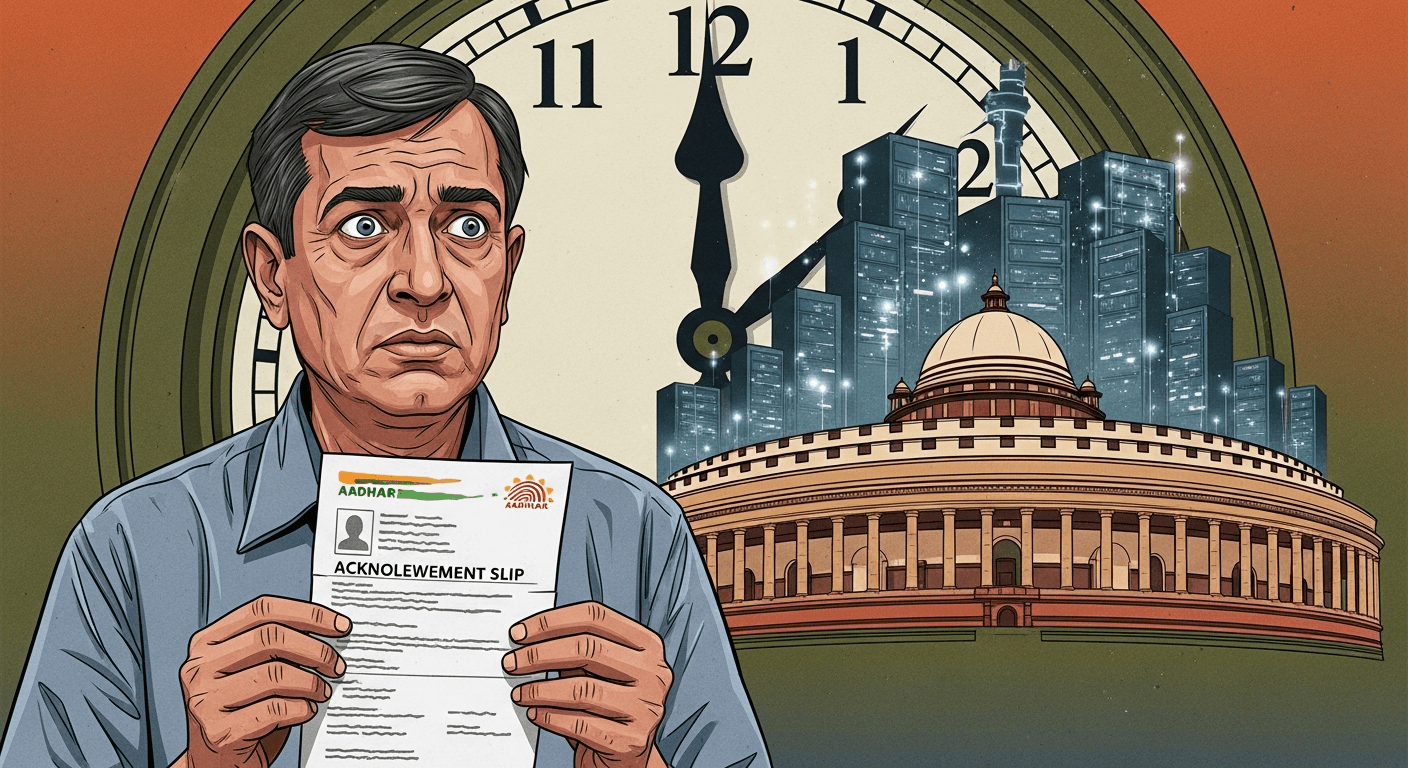
Why the CIC's nudge matters
The Central Information Commission (CIC) has once again shone a light on a problem many of us experience quietly: Aadhaar update requests stuck "in process" for weeks or months. The CIC's ask is simple and rational — ask the Unique Identification Authority of India (UIDAI) to set clear, time-bound timelines and strengthen grievance redressal. I find that observation both practical and necessary.
The immediate story reported that a woman had to escalate a delayed date-of-birth correction through the courts after long administrative delay; the CIC noted similar patterns in cases about name spellings, gender corrections and other demographic fixes and urged UIDAI to be more transparent and time‑bound (Telegraph India).
What this reveals about digital governance
I write a lot about digital identity and policy. Years ago I warned that Aadhaar had become inescapable in our lives, and that the system must keep improving to preserve public trust (Aadhar-the-Irreversible). When basic operational functions — like timely demographic updates — falter, the consequence is not only inconvenience: it chips away at confidence in the entire infrastructure.
Delays in a national ID system expose three linked weaknesses:
- Service design that treats citizens like passive inputs rather than users with deadlines and needs.
- Opaque operational SLAs (service-level agreements) that leave people uncertain about when they will get resolution.
- A grievance process that nudges citizens to use RTI or courts — costly avenues that should be last resorts.
Practical fixes UIDAI and administrators can adopt
If we treat this as a systems problem, there are pragmatic steps that make huge difference:
- Define and publish clear SLAs: e.g., simple demographic edits resolved within 30 days, complex ones within 60–90 days, with automated status updates at milestones.
- Make the status machine-readable and shareable: allow a secure tracking URL, SMS updates, and a printable acknowledgement that institutions (colleges, banks) can accept provisionally.
- Strengthen regional escalation paths: a transparent escalation matrix (helpline → regional officer → nodal desk) with guaranteed response timelines.
- Audit and publish backlog metrics monthly so the public sees improvement or identifies bottlenecks.
- Provide interim remedies: where institutions need proof (for admissions, government benefits), accept the update acknowledgement and a short UIDAI-issued provisional note.
These are not rocket science. They are governance basics that protect citizens and preserve trust in a digital ID program.
The human cost — why timeliness matters
Behind every delayed URN (Update Request Number) is a person losing an opportunity — an exam registration, a job joining, a subsidy, or a college admission. When a system forces citizens to seek RTI answers or go to court, it means the system failed to meet its basic duty. Good technology without predictable operations is still a broken public service.
What citizens can do — a short checklist
- Keep your Update Acknowledgement Slip (URN) safe and note dates.
- Check status online and save the tracking URL / screenshots.
- If delay passes the published SLA (or 90 days where SLA is absent), escalate through the regional office and file a formal grievance on the UIDAI portal.
- If there is immediate institutional urgency (college, employer), request a provisional acceptance based on the acknowledgement slip and escalate with supporting letters.
UIDAI's own FAQ already acknowledges that some updates can take up to 90 days; the CIC's intervention is a reminder that the target must be shorter and enforced (UIDAI FAQ).
A broader lesson: infrastructure needs both tech and process
Technology often gets credit for transformation; but infrastructure lives in the seams between code and process. A national ID program succeeds only when code, operations, communication and grievance mechanisms work together. I've argued before that Aadhaar is inescapable and must continuously evolve; this moment is another call to action for operational maturity (Aadhar: Dawn of Realism).
The CIC's nudge is small but important. Deadlines, transparency, and humane grievance redressal are the simplest, highest-leverage reforms we can make to protect citizens who depend on this ID every day.
Final thought
I want systems that behave like good neighbors: timely, predictable, and helpful. National digital identity is too central to be opaque or slow. The law and policy frameworks are necessary, but they are not sufficient. Operations, published timelines, and the humility to improve — those will deliver the trust that an identity system must earn.
—
Connect with me: Hemen Parekh hcp@recruitguru.com
Regards,
Hemen Parekh hcp@recruitguru.com
Any questions / doubts / clarifications regarding this blog? Just ask (by typing or talking) my Virtual Avatar on the website embedded below. Then "Share" that to your friend on WhatsApp.
Get correct answer to any question asked by Shri Amitabh Bachchan on Kaun Banega Crorepati, faster than any contestant
Hello Candidates :
- For UPSC – IAS – IPS – IFS etc., exams, you must prepare to answer, essay type questions which test your General Knowledge / Sensitivity of current events
- If you have read this blog carefully , you should be able to answer the following question:
- Need help ? No problem . Following are two AI AGENTS where we have PRE-LOADED this question in their respective Question Boxes . All that you have to do is just click SUBMIT
- www.HemenParekh.ai { a SLM , powered by my own Digital Content of more than 50,000 + documents, written by me over past 60 years of my professional career }
- www.IndiaAGI.ai { a consortium of 3 LLMs which debate and deliver a CONSENSUS answer – and each gives its own answer as well ! }
- It is up to you to decide which answer is more comprehensive / nuanced ( For sheer amazement, click both SUBMIT buttons quickly, one after another ) Then share any answer with yourself / your friends ( using WhatsApp / Email ). Nothing stops you from submitting ( just copy / paste from your resource ), all those questions from last year’s UPSC exam paper as well !
- May be there are other online resources which too provide you answers to UPSC “ General Knowledge “ questions but only I provide you in 26 languages !



No comments:
Post a Comment