
Background
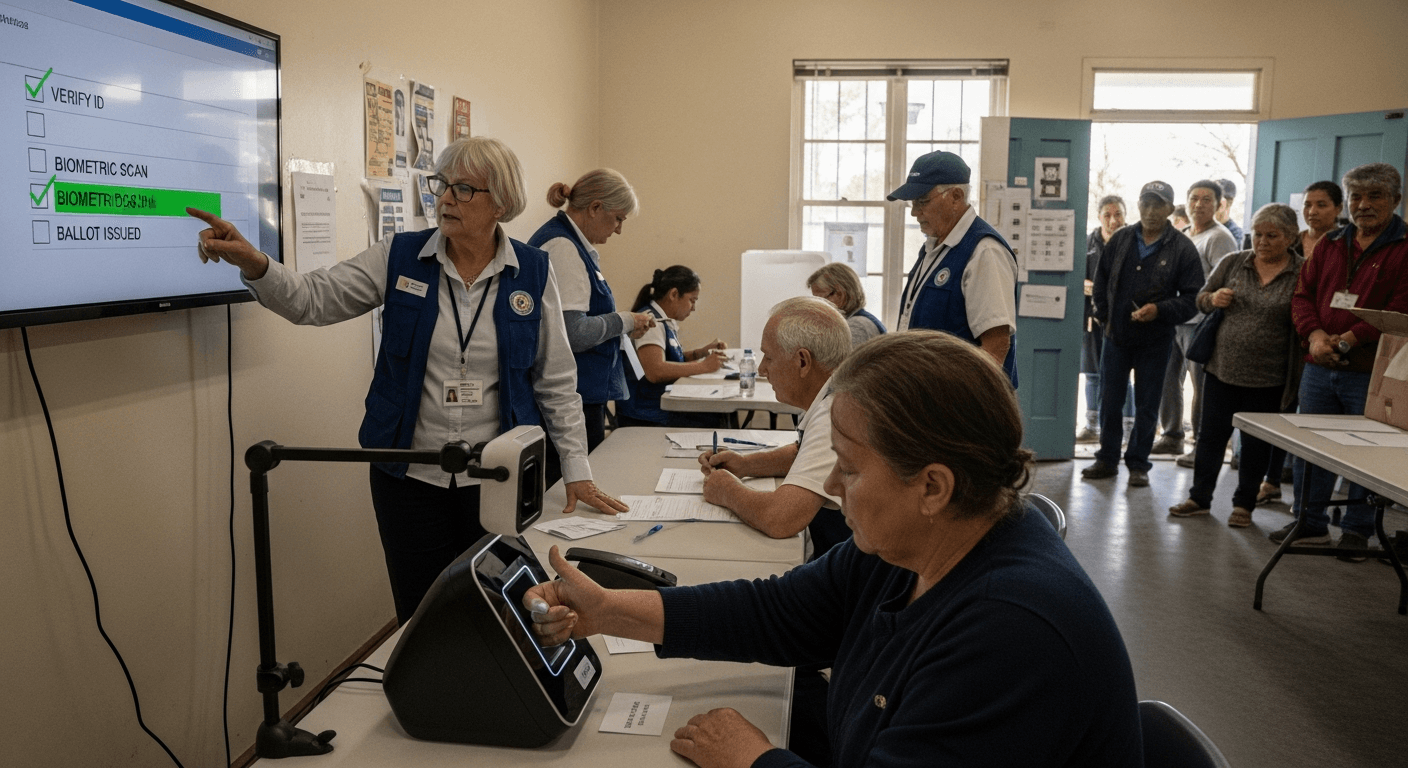
A recent public interest petition asked the Supreme Court to consider mandatory biometric checks — fingerprints, iris scans and facial recognition — at polling booths before a voter is allowed to cast a ballot. The petition argues that conventional identity checks (voter ID cards, manual verification) remain vulnerable to impersonation, proxy or duplicate voting and so-called "ghost" entries on rolls. The Court has issued notice to the Election Commission of India (ECI), the central government and states to respond while indicating that any immediate large-scale change would need time, rule amendments and funding ANI.
What the PIL asks for
The petition seeks direction for biometric authentication at polling stations so that the person presenting to vote is verified by one or more biometrics — typically fingerprints and iris, with facial recognition also mentioned as an option. The goal, as framed in the petition, is to reduce impersonation and duplicate voting and to create a tamper-evident audit trail that supports the constitutional principle of "one citizen, one vote." The petitioner asked the Court to examine deployment timelines, feasibility and legal framing.
Supreme Court action
The Court has not ordered any immediate operational change. It issued notice to the ECI and government and asked for their responses, while signalling that the relief sought cannot be imposed for imminent elections without due process. The bench highlighted practical constraints: rule-making under electoral law, budgetary implications and the logistics of rolling out biometric systems nationwide. The Court indicated it will consider whether such measures deserve to be pursued for future parliamentary or state polls, not the current electoral cycle ANI.
ECI and government positions (observations)
- The ECI has statutory responsibility for administering elections and is likely to emphasise tested, incremental pilots and statutory clarity before adopting a new identification regime. Earlier experimental uses of biometrics in local pilots and proposals have shown ECI and state bodies prefer staged testing.
- The central government and finance agencies will need to evaluate the fiscal impact of procurement, maintenance and training for biometric kits and connectivity. The Court itself noted financial burden and rule changes as hurdles.
Legal, privacy and technical concerns
- Any deployment colliding with biometric authentication raises constitutional privacy questions. India’s jurisprudence recognises a robust right to privacy and requires that intrusive identification measures be backed by law, necessary and proportionate. That legal test affects whether biometric checks can be mandated at polling booths.
- Technical reliability matters: false rejects (legitimate voters unable to authenticate) and false accepts (incorrect matches) can both disenfranchise voters or fail to prevent fraud. Networks, power, device calibration, and environment (dust, lighting, wet fingers) affect real-world performance.
- Data governance is crucial: who stores raw biometric templates, for how long, and under what safeguards? Centralised retention without clear legal and oversight mechanisms risks mission creep and misuse.
International precedents
Many countries have experimented with biometric voter registration and on-day verification — Kenya is a notable example. Kenya’s biometric voter registration and verification systems helped expand and clean rolls, but high-profile failures (device glitches, contested result transmission) and privacy gaps showed technology alone is not a panacea; weak legal safeguards and opaque procurement created operational and trust problems [IEBC; Le Monde; Privacy International research]. Other jurisdictions show that biometrics can improve roll integrity but demand strong legal frameworks, auditor independence and contingency plans when equipment fails.
Possible implementation challenges
- Scale and cost: procuring, distributing and maintaining tens of thousands of biometric kits and spares is expensive and logistically complex.
- Training and human factors: polling staff must be trained to operate devices quickly and fairly; queue management becomes critical if devices slow throughput.
- Connectivity and offline modes: many booths operate with poor connectivity — systems must be resilient offline while preventing replay or duplication attacks.
- Vendor dependence and procurement transparency: past international cases show that lock-in to a single vendor or opaque procurement can undermine trust and create brittle systems.
Human-rights and inclusion considerations
Biometric systems can unintentionally exclude people: worn fingerprints, certain disabilities, poor camera lighting for facial recognition, or incomplete enrolment can deny voters their franchise. Marginalised groups, elderly voters and those in remote areas are especially vulnerable to false rejections. Any system must preserve the right to vote by providing reliable fallbacks and robust grievance and appeals processes.
Recommendations (practical, incremental)
- Pilot first, before wide rollout: conduct time-limited, independently evaluated pilots across varied geographies and electorates; publish transparent results.
- Legal clarity: Parliament or a clear delegated-rule process must specify scope, retention, oversight, redress and penalties for misuse before mandatory adoption.
- Technical standards and audits: require open standards, independent external security and accuracy audits, and multi-vendor procurement to avoid lock-in.
- Maintain alternative voting pathways: ensure that biometric verification is not the sole method to vote; a fast, transparent fallback must preserve the right to vote on the same day.
- Public engagement and privacy safeguards: publish data flow diagrams, impact assessments and create an independent oversight body for electoral biometric data.
Conclusion
Biometric authentication at polling booths promises stronger checks against impersonation and duplicate voting, but it is neither legally nor operationally trivial. The Supreme Court’s decision to seek responses from the ECI and the government is appropriate: a democratic, privacy-respecting approach requires careful pilots, clear law, transparent procurement and robust fallback measures so that technology strengthens, rather than jeopardises, democratic participation. I have written previously about the promise and limits of facial recognition and related technologies in public administration, and the same cautions apply here: technology must serve trust, not substitute for it From facial recognition to QR code.
Regards,
Hemen Parekh
Any questions / doubts / clarifications regarding this blog? Just ask (by typing or talking) my Virtual Avatar on the website embedded below. Then "Share" that to your friend on WhatsApp.
Get correct answer to any question asked by Shri Amitabh Bachchan on Kaun Banega Crorepati, faster than any contestant
Hello Candidates :
- For UPSC – IAS – IPS – IFS etc., exams, you must prepare to answer, essay type questions which test your General Knowledge / Sensitivity of current events
- If you have read this blog carefully , you should be able to answer the following question:
- Need help ? No problem . Following are two AI AGENTS where we have PRE-LOADED this question in their respective Question Boxes . All that you have to do is just click SUBMIT
- www.HemenParekh.ai { a SLM , powered by my own Digital Content of more than 50,000 + documents, written by me over past 60 years of my professional career }
- www.IndiaAGI.ai { a consortium of 3 LLMs which debate and deliver a CONSENSUS answer – and each gives its own answer as well ! }
- It is up to you to decide which answer is more comprehensive / nuanced ( For sheer amazement, click both SUBMIT buttons quickly, one after another ) Then share any answer with yourself / your friends ( using WhatsApp / Email ). Nothing stops you from submitting ( just copy / paste from your resource ), all those questions from last year’s UPSC exam paper as well !
- May be there are other online resources which too provide you answers to UPSC “ General Knowledge “ questions but only I provide you in 26 languages !





No comments:
Post a Comment