
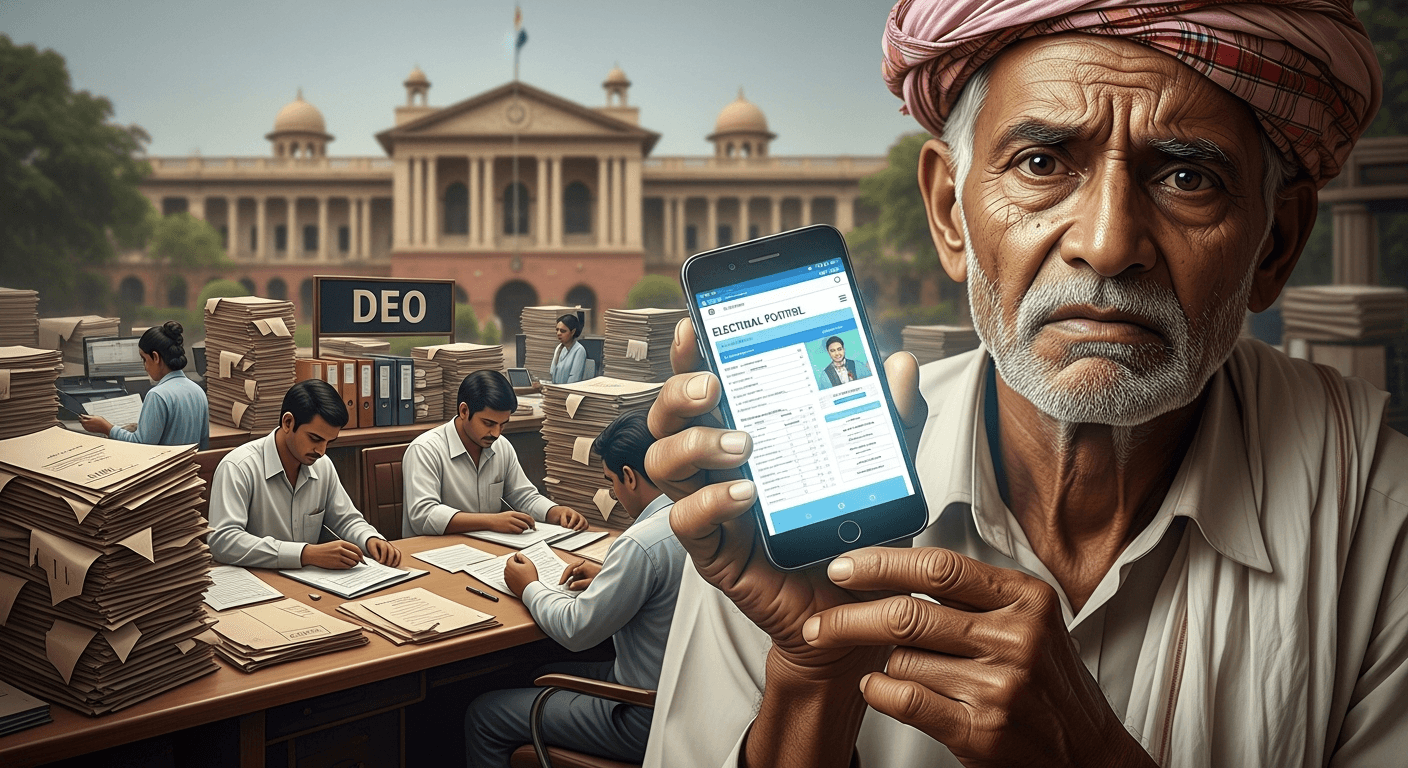
SIR Portal: Who's Left Out?
I have watched India try to bring democracy into the digital age for years — from proposals for a VotesApp to experiments in mobile-enabled election services — always hopeful about the promise and wary of the pitfalls. The Election Commission’s recent move to open an online portal for voter appeals under West Bengal’s Special Intensive Revision (SIR) is the kind of step that should make participation easier. But the way it has been rolled out — with scant clarity on an offline alternative — risks turning a modernising impulse into a new barrier for many voters.[^1]
What SIR is, and why this matters
Special Intensive Revision (SIR) is a door-to-door, full-scale verification of electoral rolls in West Bengal, meant to ensure the rolls are accurate before assembly polls.[^2] It’s a big, labour-intensive exercise: tens of lakhs of entries were flagged for adjudication after the SIR enumeration. The Election Commission has published several supplementary lists and set up appellate tribunals to hear challenges to deletions.
The portal that went live allows voters to submit appeals online if their names were excluded from the supplementary lists. That is welcome — an online option should make redress faster and more trackable. But the portal is only half of a fair solution if the Election Commission does not simultaneously and comprehensively operationalise offline routes.
The gap: no clear offline route
Media reporting makes the problem stark: while the portal is live, there is little clarity about how or when offline appeals will be accepted at district or subdivision offices, how they will be acknowledged, or which offices will process them.[^1][^3] Supplementary lists carry a 15-day appeal window, but it’s not always clear when that clock starts for individual voters. In practice, this confusion is creating frantic scenes at DEO and DM offices and leaving vulnerable voters unsure of their rights.
A voter quoted in coverage captured the human side plainly: “I don’t know anything about technology to file an appeal online by myself… we are yet to know when the offline mode will be activated.”[^1]
Who’s likely to be harmed?
- Elderly voters who are not digitally literate and who rely on in-person help.
- Residents of remote or hilly areas with poor internet connectivity or long distances to DEO/DM offices.
- People who lack an Aadhaar–EPIC link or mobile OTP capability required by some online systems.
- Illiterate voters and those with limited language access to online forms.
Numbers matter: reports indicate that millions of names were under adjudication after SIR, with many supplementary lists published and a significant fraction of appeals already decided.[^3] Where the process is opaque, the risk is not just inconvenience — it’s disenfranchisement on a large scale.
Legal and commission obligations
The Election Commission has a duty to ensure that electoral processes are accessible and non-discriminatory. Administrative fairness here implies:
- Clear public guidance on timelines (a single, published Day 0 or a clear rule for start of the 15‑day window).
- Reasonable and well-publicised offline filing facilities that do not require repeated trips or extra documentation beyond what was already provided in SIR.
- Acknowledgement receipts for all physical submissions and an explicit timeline for digitisation and tribunal adjudication.
If these are not provided, affected voters can argue that procedural defects have effectively denied them a forum to be heard — a serious democratic failing.
Possible remedies — what the EC and state can do now
- Publish a uniform rule for the starting point of the 15‑day appeal window and widely communicate it.
- Immediately issue a directive listing specific offices (DM, SDM, SDO/DEO desks) that will accept physical appeals and a simple checklist of required documents (ideally none beyond what was already submitted during SIR).
- Set up mobile/temporary camps in rural and remote locations where BLOs/BLO teams help submit offline appeals and issue acknowledgements on the spot.
- Waive the requirement for Aadhaar‑OTP authentication for the purpose of filing appeals, and accept assisted filings where necessary.
- Extend appeal deadlines where digital or administrative failures are documented.
- Ensure tribunals have functioning infrastructure and publish schedules so appellants know when and how they can be heard (including remote hearing options where appropriate).
What citizens and civil society can do now
- Insist on written or stamped acknowledgement for any physical submission; take a photograph of the submission and the receiving office signboard.
- Approach local BLOs, ward councillors, or district helplines for assistance and documentation of refusals if offices decline to accept petitions.
- Use district and CEO helplines and the ECI’s online grievance channels if physical routes are blocked; preserve call logs and screenshots as evidence.
- Organise or join local legal‑aid clinics and civil‑society drives that help fill forms, collect signatures, and escort elderly voters to submission points.
- Where systemic denial is visible, affected groups should consider coordinated petitions or fast-track legal remedies (courts have in the past intervened where electoral rights face practical obstruction).
A balanced view
I am not blind to the benefits of digitisation: an online portal can speed processing, reduce paperwork and allow better tracking of appeals. The problem here is one of sequencing and inclusivity. Technology should supplement, not replace, physical access — especially in a high‑stakes, time‑bound context like SIR appeals. We have to get the combination right.
This is also a moment to remember that digital reform is often gradual. I have long argued for safe, inclusive experimentation with mobile and online voting tools; my earlier writing on a VotesApp and e‑voting sandboxes emphasised both the promise and the need for trust-building and assistance.[^4] The current SIR rollout is a reminder that good intentions require operational detail: without that, rights on paper can become rights in peril.
If the Election Commission can pair the portal with a robust and publicised offline network, and if the state ensures tribunals begin work with adequate infrastructure, the problem can be solved quickly. Until then, citizens, civil society and officials must push for those commonsense fixes that protect the most vulnerable and keep democracy truly universal.
Regards,
Hemen Parekh
Any questions / doubts / clarifications regarding this blog? Just ask (by typing or talking) my Virtual Avatar on the website embedded below. Then "Share" that to your friend on WhatsApp.
[^1]: "Portal for voter appeals live, but no word on offline route", The Times of India. https://timesofindia.indiatimes.com/india/bengal-sir-portal-for-voter-appeals-live-but-no-word-on-offline-route/articleshow/129886937.cms
[^2]: Summary description of SIR (Special Intensive Revision) and related reporting: see Patras Law Chambers Q&A and related coverage.
[^3]: Coverage of adjudication volumes and tribunal delays: The Telegraph / National Herald reporting (March–April 2026).
[^4]: My earlier reflections on mobile voting and VotesApp: "VotesApp" (Hemen Parekh blog). http://www.hemenparekh.in/2013/08/votesapp.html
Get correct answer to any question asked by Shri Amitabh Bachchan on Kaun Banega Crorepati, faster than any contestant
Hello Candidates :
- For UPSC – IAS – IPS – IFS etc., exams, you must prepare to answer, essay type questions which test your General Knowledge / Sensitivity of current events
- If you have read this blog carefully , you should be able to answer the following question:
- Need help ? No problem . Following are two AI AGENTS where we have PRE-LOADED this question in their respective Question Boxes . All that you have to do is just click SUBMIT
- www.HemenParekh.ai { a SLM , powered by my own Digital Content of more than 50,000 + documents, written by me over past 60 years of my professional career }
- www.IndiaAGI.ai { a consortium of 3 LLMs which debate and deliver a CONSENSUS answer – and each gives its own answer as well ! }
- It is up to you to decide which answer is more comprehensive / nuanced ( For sheer amazement, click both SUBMIT buttons quickly, one after another ) Then share any answer with yourself / your friends ( using WhatsApp / Email ). Nothing stops you from submitting ( just copy / paste from your resource ), all those questions from last year’s UPSC exam paper as well !
- May be there are other online resources which too provide you answers to UPSC “ General Knowledge “ questions but only I provide you in 26 languages !


No comments:
Post a Comment