
What MeitY has proposed — in plain terms
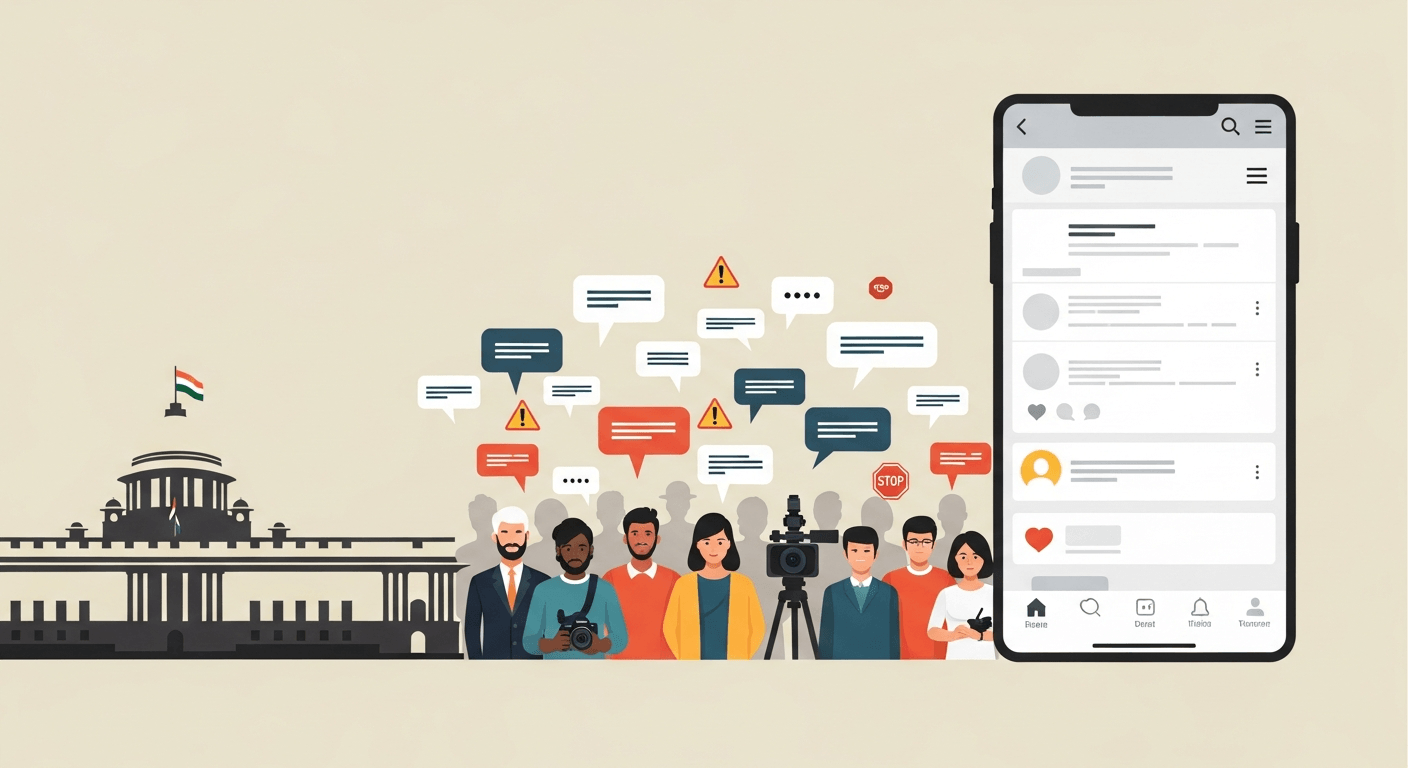
I wrote this while watching the draft amendments that the Ministry of Electronics and Information Technology (MeitY) released in late March 2026. In plain language, the draft would bring “news and current affairs” content posted by ordinary users on platforms into the procedural framework that currently applies to registered digital publishers. That does not convert every user into a legally recognised publisher. Rather, it allows government review and publisher-style remedies — takedowns, reclassification, warnings or disclaimers — to be applied to user-posted news-like content hosted on intermediaries (social platforms, video sites, etc.).
Two other changes in the draft are important: platforms would be required to comply with MeitY advisories, SOPs and directions as part of their due‑diligence duties, and existing inter-departmental review processes would be allowed to examine user-generated matters (not just complaints about licensed publishers).
Legal and technical background
Section 79 of the Information Technology Act (the so-called “safe harbour”) has long protected intermediaries from liability for user content provided they follow due diligence and act on actual knowledge of unlawful material. The draft reinterprets due diligence to include mandatory compliance with MeitY-issued advisories.
The existing Rules already create a framework for licensed digital publishers (a Code of Ethics, grievance redressal and an Inter-Departmental Committee for blocking). The draft extends the procedural reach of that machinery to the technical spaces where users post news-like content.
On the technical front, the state has already signalled interest in tackling synthetic and AI-generated misinformation with separate changes earlier in 2026 (labelling obligations, expedited takedowns for deepfakes, and so on). The current move builds on an expanding regulatory toolkit that mixes legal duties and technical compliance requirements.
What this could mean for platforms and users
For platforms
- Increased operational responsibilities: platforms may need to detect, classify and escalate “news-like” user content into grievance workflows previously designed for publishers.
- Greater legal exposure: failure to follow an advisory that MeitY treats as part of due diligence could threaten safe-harbour protection and expose intermediaries to legal risk.
- Cost and complexity: publisher-grade oversight at the scale of billions of posts is expensive and error-prone; platforms may choose conservative, automated removals to limit downstream liability.
For users and creators
- A chilling effect is possible: when ordinary posts can be reviewed under publisher-style procedures, creators and citizen journalists may self-censor, especially on politically sensitive topics.
- Ambiguity over what counts as “news”: the line between personal opinion, commentary and informational reporting is porous online. Ambiguous thresholds will create uncertainty for everyday users.
- Compliance burden for influencers and creators who regularly share current affairs could increase if platforms require registration or additional identity checks to reduce enforcement friction.
Free-speech and implementation concerns
Vague boundaries: The draft relies on functional tests (is the main purpose to inform a larger audience?) that are inherently subjective. That subjectivity is where discretion — and uneven enforcement — will emerge.
Procedural safeguards: Applying publisher-style remedies to user content raises questions about notice, appeal and transparency. The original digital publisher regime itself has faced judicial and civil‑society scrutiny for opacity.
Surveillance and retention: Proposed retention and traceability requirements for intermediaries, combined with expanded review powers, raise privacy and surveillance risks. Data retention without clear limits becomes a tempting vector for misuse or leaks.
Technical scalability: Automated classifiers make mistakes. False positives can remove legitimate speech; false negatives leave harm unmitigated. Relying on automation to scale publisher-like oversight is risky unless accompanied by human review and strong auditing.
Practical implementation challenges
Definition and detection: How will platforms reliably identify “news and current affairs” among millions of posts? Keyword heuristics and engagement signals are blunt tools.
Attribution and provenance: Many problematic posts come from anonymous or fake accounts. Enforcement against the content is straightforward; enforcement against the creator is not.
Inter-agency overlap: The draft sits at the intersection of MeitY (technical/intermediary rules) and the Ministry of Information & Broadcasting (code of ethics for media). Clear jurisdictional roles and appeal routes will be necessary to avoid inconsistent directives.
My perspective and what I’ve said before
I have long worried about the hard trade-offs between managing online harms and protecting civic freedoms. Years ago I flagged similar concerns about a centralized “social media hub” and the risks of mission creep when the government sets up wide listening or command-and-control capabilities for online content (Social Media Hub? Where is the need?). That earlier reflection resonates with the present debate: technical controls without precise legal constraints tend to expand in scope.
Recommendations — a practical way forward
- Clarify definitions: Narrow, objective criteria for what counts as “news and current affairs” will reduce discretionary enforcement.
- Stronger due process: Any extension of blocking or takedown powers should come with fast, independent appeal mechanisms and public reporting of actions taken.
- Proportionality in retention: Data retention rules must be narrowly tailored, time‑bound and subject to oversight to limit surveillance risks.
- Co-regulatory design: Involve platforms, civil‑society experts, journalists and technologists in designing workable detection and grievance systems that balance harms and rights.
- Pilot and audit: Roll out procedural changes as pilots with independent audits to measure accuracy, errors, and harms before national scale deployment.
Conclusion
MeitY’s draft seeks to solve real problems: misinformation, deepfakes and the blurring of journalism and social media. But translating publisher-style oversight to the chaotic, decentralized world of user posts risks collateral damage to free expression and innovation if implemented without clearer definitions, procedural safeguards and independent oversight. Policymakers and platforms should slow down, test interventions, and build transparent appeal and audit systems before a one-size-fits-all regime is finalised.
Regards,
Hemen Parekh
Any questions / doubts / clarifications regarding this blog? Just ask (by typing or talking) my Virtual Avatar on the website embedded below. Then "Share" that to your friend on WhatsApp.
Get correct answer to any question asked by Shri Amitabh Bachchan on Kaun Banega Crorepati, faster than any contestant
Hello Candidates :
- For UPSC – IAS – IPS – IFS etc., exams, you must prepare to answer, essay type questions which test your General Knowledge / Sensitivity of current events
- If you have read this blog carefully , you should be able to answer the following question:
- Need help ? No problem . Following are two AI AGENTS where we have PRE-LOADED this question in their respective Question Boxes . All that you have to do is just click SUBMIT
- www.HemenParekh.ai { a SLM , powered by my own Digital Content of more than 50,000 + documents, written by me over past 60 years of my professional career }
- www.IndiaAGI.ai { a consortium of 3 LLMs which debate and deliver a CONSENSUS answer – and each gives its own answer as well ! }
- It is up to you to decide which answer is more comprehensive / nuanced ( For sheer amazement, click both SUBMIT buttons quickly, one after another ) Then share any answer with yourself / your friends ( using WhatsApp / Email ). Nothing stops you from submitting ( just copy / paste from your resource ), all those questions from last year’s UPSC exam paper as well !
- May be there are other online resources which too provide you answers to UPSC “ General Knowledge “ questions but only I provide you in 26 languages !



No comments:
Post a Comment