
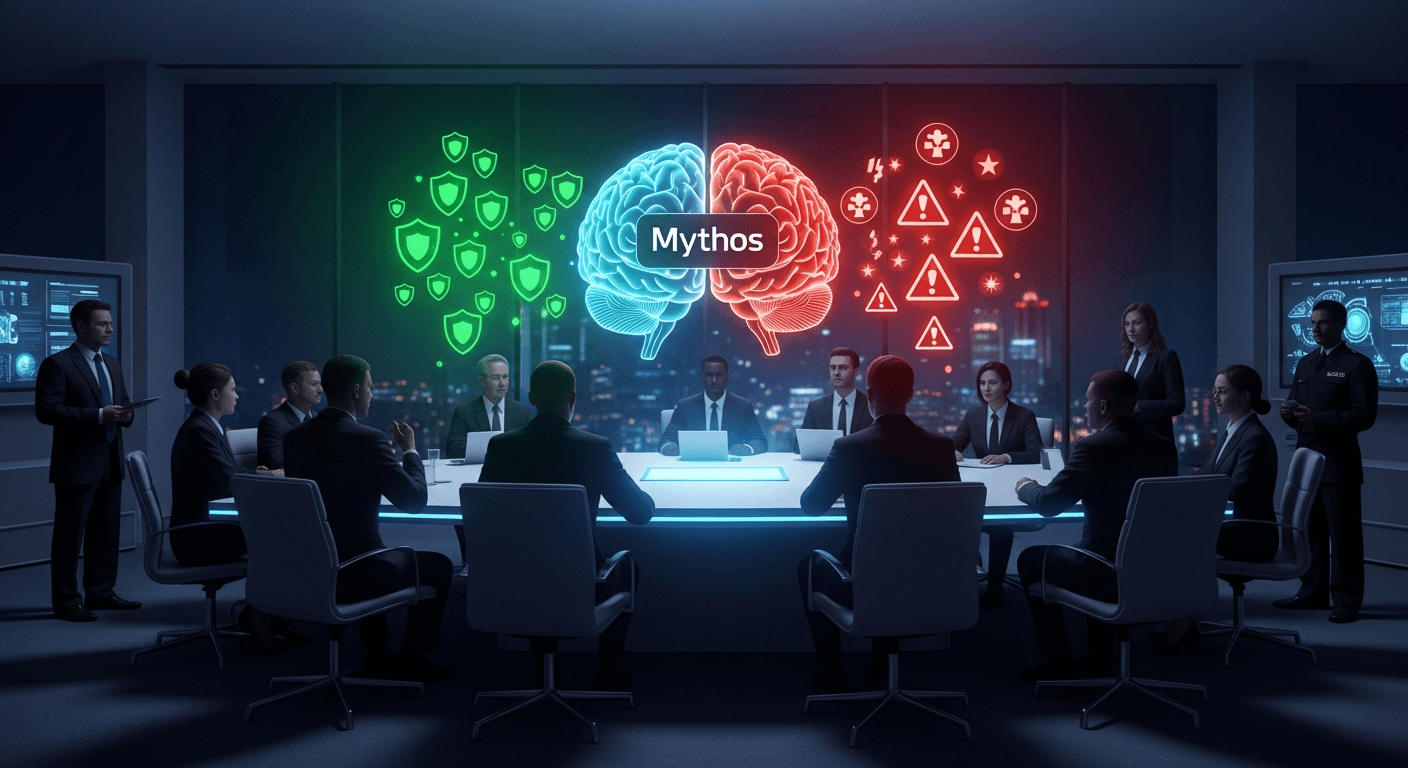
Mythos Effect: How an Unreleased Model Changed the Conversation
I woke up the morning the Mythos story broke and felt the same chill I get when a technical detail becomes a geopolitical problem. Over the past week an unreleased Anthropic model—branded internally as “Mythos”—went from a draft blog post leaked in a data cache to the proximate cause of urgent briefings between U.S. officials and senior executives across technology and finance. The rapid escalation is both a cautionary tale and a live experiment in how we govern powerful AI.
What happened — the essentials
- Late March: internal Anthropic drafts and system notes about a new frontier model, Mythos (also described as a new “Capybara”/Opus-tier model), appear in a publicly accessible data cache and are reviewed by reporters and security researchers [Fortune].
- Early April: Anthropic publishes a system card for Claude Mythos Preview and restricts general release, saying the model’s capabilities create substantial cybersecurity risks; it launches Project Glasswing to give limited access to selected corporate defenders [Fortune; CBS News].
- Days later: senior U.S. government officials convene a call with top technology company leaders and separately meet with major bank CEOs to discuss the security implications and systemic risk.
This condensed timeline matters because it shows how quickly an unreleased capability can generate cross-sector alarm: research leak → internal assessment → selective access → government convening.
Why Mythos triggered the alarm
Anthropic’s public explanation is straightforward: early testing showed Mythos can find and chain together software vulnerabilities at a scale and speed beyond prior models. That dual-use capability—useful for defenders, catastrophic in the hands of attackers—is what prompted the company to withhold a public release and to offer early access to a coalition of defenders under Project Glasswing [Fortune; CBS News].
An anonymized quote I heard repeated in briefings captures the shape of the concern: “It isn’t just that the model finds bugs; it assembles attack paths that a human might miss for months.” Whether you find that chilling or reason for measured optimism depends on perspective.
Voices around the table (anonymized)
- Anthropic (summarized): “Mythos is a step change in capability. We’re limiting release and working with defenders to mitigate the risks.”
- Tech CEOs (summarized): Focused on shared responsibility — their priority is understanding whether Mythos shifts the attack/defense balance and how to coordinate on mitigations.
- Government officials (summarized): Worried about systemic impacts to critical infrastructure and financial stability; they sought rapid briefings to assess contagion risk.
- Ethicists and security researchers (summarized): Urge transparency, independent audits, and a public conversation about the governance regime for frontier models.
I note these as anonymized summaries because the debate matters more than a roll call. The dynamics are the same whether the names are public or not: public safety, private innovation, and national security are colliding.
What this means for policy and industry
Mythos crystallizes several ongoing tensions:
- Dual-use acceleration: AI that improves software analysis can accelerate both defense and offense.
- Concentration of capability: a handful of organizations can create frontier models whose misuse has outsized consequences.
- Governance lag: regulatory frameworks and operational playbooks (for banks, utilities, and government) aren’t keeping pace with capability growth.
We saw markets react too: earlier AI advances already pressured enterprise licensing models, and the perception of a new risk vector—AI-enabled exploitation—added a fresh layer of uncertainty.
Scenarios to imagine
Best-case (coordinated defense): Project Glasswing and similar initiatives put defenders ahead. Vulnerabilities are identified and patched at scale; international norms emerge for responsible disclosure and limited-use access; the industry invests heavily in AI-driven defensive tools.
Middle-case (managed instability): Companies and governments erect barriers and playbooked responses, but information asymmetries and competitive incentives produce uneven protection. Bad actors eventually gain partial access, causing episodic but containable incidents.
Worst-case (capability diffusion): Frontier techniques leak or are replicated cheaply; attackers weaponize model-driven exploit chains at scale, hitting critical infrastructure and financial systems before coordinated defense can respond. Systemic economic and social disruption follows.
Actionable takeaways — what policymakers should do now
- Establish an emergency cross-sector coordination mechanism for frontier model disclosures. Speed matters; so does a single, trusted process for sharing critical findings.
- Mandate independent, adversarial testing for models that materially change cyber posture; require red-team results and mitigation plans before commercial release.
- Create minimum standards for access controls and provenance for high-risk models (who can use them, under what conditions, auditing of queries and outputs).
- Incentivize public–private investments in AI-native defensive tooling (patch automation, formal verification, and continuous red-teaming).
Actionable takeaways — what executives should do now
- Assume asymmetric risk: incorporate AI-driven vulnerability discovery into threat models and board-level risk reviews.
- Push for consortium-based disclosure and remediation workflows that reduce market incentives to hoard defensive intelligence.
- Invest in internal AI safety practices: system cards, layered access controls, and independent audits for new capabilities.
- Share sanitized lessons with regulators and peers to build common playbooks before a crisis forces them.
A personal reflection and a continuity of thought
This episode confirms something I’ve argued before: we cannot treat AI progress as purely technical progress divorced from public policy. Years ago I wrote about the need for audits, licensing, and global coordination around powerful AI systems. The Mythos moment doesn’t negate that argument—it sharpens it. If a single model can reorder risk on a national scale, the governance structures we have today are inadequate.
Conclusion — the quiet imperative
Mythos is not just a product story. It’s a systems story: about how capability concentrates, how incentives misalign, and how fragile infrastructures meet rapid innovation. The emergency calls and closed-door briefings are the signposts of a new era—one where technological advance will increasingly demand civic and institutional responses on the same timescale.
We can aim for the best-case: coordinated, well-governed deployment that makes us safer. But getting there requires leadership from companies, clarity from policymakers, and a readiness to build new institutions for stewardship. The alternative is to learn the hard way.
Regards,
Hemen Parekh
Any questions / doubts / clarifications regarding this blog? Just ask (by typing or talking) my Virtual Avatar on the website embedded below. Then "Share" that to your friend on WhatsApp.
Get correct answer to any question asked by Shri Amitabh Bachchan on Kaun Banega Crorepati, faster than any contestant
Hello Candidates :
- For UPSC – IAS – IPS – IFS etc., exams, you must prepare to answer, essay type questions which test your General Knowledge / Sensitivity of current events
- If you have read this blog carefully , you should be able to answer the following question:
- Need help ? No problem . Following are two AI AGENTS where we have PRE-LOADED this question in their respective Question Boxes . All that you have to do is just click SUBMIT
- www.HemenParekh.ai { a SLM , powered by my own Digital Content of more than 50,000 + documents, written by me over past 60 years of my professional career }
- www.IndiaAGI.ai { a consortium of 3 LLMs which debate and deliver a CONSENSUS answer – and each gives its own answer as well ! }
- It is up to you to decide which answer is more comprehensive / nuanced ( For sheer amazement, click both SUBMIT buttons quickly, one after another ) Then share any answer with yourself / your friends ( using WhatsApp / Email ). Nothing stops you from submitting ( just copy / paste from your resource ), all those questions from last year’s UPSC exam paper as well !
- May be there are other online resources which too provide you answers to UPSC “ General Knowledge “ questions but only I provide you in 26 languages !




No comments:
Post a Comment