
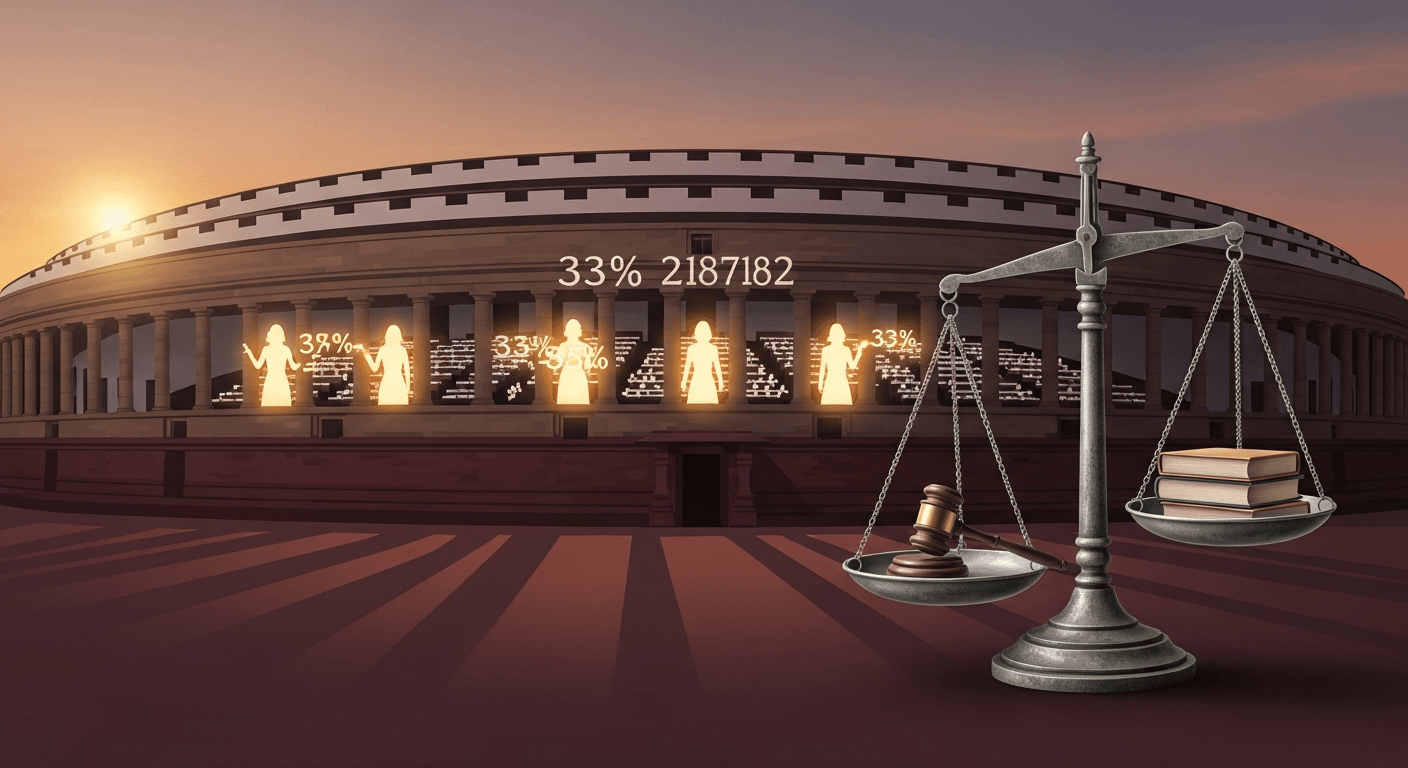
Special Parliament sitting to push women’s Lok Sabha reservation: PM Narendra Modi
Lead
I write this as someone who has followed the long arc of the women’s reservation debate in India for more than a decade. A recent announcement that Parliament would be called into a special sitting to fast-track measures to operationalise a 33% reservation for women in the Lok Sabha and state assemblies is an important, concrete moment in that arc. My aim here is to summarise the facts, the immediate political response, and the possible legislative and social implications in a neutral, evidence-based way.
Background
The Women’s Reservation legislation—often referred to as the Nari Shakti Vandan Adhiniyam—has a long history of introduction, debate and delay. The central idea is straightforward: reserve one-third of seats in the Lok Sabha and state legislative assemblies for women. The law was passed in an earlier form but its implementation has been dependent on delimitation and the census, which complicated operationalisation. The debate has included long-standing questions about sub-quotas (for women from OBCs and other groups), rotation of reserved constituencies, and the technical mechanics that delimitation imposes.
Announcement
The government announced a three-day special sitting of Parliament with the explicit objective of introducing and debating amendments needed to ensure the 33% reservation can be implemented in time for the 2029 general election cycle. The measures under discussion include constitutional amendments to allow reserved seats to be created without reducing existing state representation—by increasing the total number of Lok Sabha and assembly seats where necessary—and statutory provisions to set out the mechanics of rotation and delimitation.
Political context / reactions
Political reactions were mixed and predictable along party lines. Supporters emphasised the democratic deficit created by low female representation and framed the move as overdue corrective action. Critics welcomed the objective of increasing women’s representation, but expressed concern about the linkage to delimitation and the proposed increase in total seats—arguing that the two processes, if combined, could have substantive political consequences beyond women’s representation.
Some opposition figures raised questions about whether the amendment’s timing and attached measures would privilege certain political interests or alter the balance of regional representation; others urged clearer guarantees on sub-quotas for socially disadvantaged women. The debates in the House were sustained and intense, reflecting the complexity and high political salience of the package.
Legislative process / timeline
The package under consideration comprised three principal elements: (1) an amendment to the Nari Shakti Vandan Adhiniyam to operationalise 33% reservation; (2) associated amendments to union territory and state laws to extend the reservation scheme; and (3) a delimitation bill to redraw and increase the number of parliamentary constituencies as needed. Because constitutional amendments are required, the bills would need to be passed by both Houses and then ratified by state legislatures where applicable.
The government’s stated timeline aims to ensure the structural changes are in place well before the 2029 Lok Sabha elections. That timeline requires swift passage through Parliament, followed by a delimitation exercise based on the latest available census data the government chooses to use for the redraw.
Implications
If implemented as described, the package would increase female representation in legislatures significantly. Increasing the overall number of seats so that reserved seats are additional (rather than carved out of existing allocations) would be intended to protect states that have successfully reduced fertility rates from losing representation. Practically, the changes would reshape candidate selection strategies for all parties, require administrative preparation for new constituencies, and present opportunities and challenges for political mobilisation among women voters and prospective women candidates.
There are also knock-on effects to consider: changes in seat counts would alter campaign logistics, funding allocations, and intra-party seat negotiations. The long-term impact on policy priorities and governance will depend heavily on whether the reserved seats translate into substantive power for women legislators and whether sub-quotas are included to ensure representational diversity.
Quotes (paraphrase)
- The government argued that this is a chance to correct a long-standing democratic deficit and urged members to consider the rights and expectations of women across the country.
- Critics cautioned that linking reservation with delimitation could transform a salutary reform into a broader redrawing of political advantage, and they asked for safeguards to ensure fairness.
Challenges
Several practical and political obstacles remain. Legally, the package requires a two-thirds majority in Parliament for constitutional amendment. Politically, consensus is uncertain: while many parties support the objective of increasing women’s representation, they differ on the mechanisms. Operationally, delimitation is technically complex and can be contested in courts and legislatures. Finally, if sub-quotas for OBC, SC, and ST women are not clearly defined, the distributional benefits of reservation could be concentrated among socially advantaged women.
Outlook
The special sitting signals that the government is prioritising a concrete timetable for women’s reservation. Whether it results in durable reform will depend on parliamentary arithmetic, the detail of the implementing measures, and the degree to which the final package addresses concerns of representational fairness and inclusion. For observers and participants alike, the key test will be whether the law produces not just numerical representation but meaningful, diverse political participation and influence for women across India.
For continuity: I have written about the structural challenges of the Women’s Reservation Bill in earlier posts, drawing attention to the need for careful safeguards and political mobilisation to make the promise meaningful My earlier reflections on the Women’s Reservation Bill.
Regards,
Hemen Parekh
Any questions / doubts / clarifications regarding this blog? Just ask (by typing or talking) my Virtual Avatar on the website embedded below. Then "Share" that to your friend on WhatsApp.
Get correct answer to any question asked by Shri Amitabh Bachchan on Kaun Banega Crorepati, faster than any contestant
Hello Candidates :
- For UPSC – IAS – IPS – IFS etc., exams, you must prepare to answer, essay type questions which test your General Knowledge / Sensitivity of current events
- If you have read this blog carefully , you should be able to answer the following question:
- Need help ? No problem . Following are two AI AGENTS where we have PRE-LOADED this question in their respective Question Boxes . All that you have to do is just click SUBMIT
- www.HemenParekh.ai { a SLM , powered by my own Digital Content of more than 50,000 + documents, written by me over past 60 years of my professional career }
- www.IndiaAGI.ai { a consortium of 3 LLMs which debate and deliver a CONSENSUS answer – and each gives its own answer as well ! }
- It is up to you to decide which answer is more comprehensive / nuanced ( For sheer amazement, click both SUBMIT buttons quickly, one after another ) Then share any answer with yourself / your friends ( using WhatsApp / Email ). Nothing stops you from submitting ( just copy / paste from your resource ), all those questions from last year’s UPSC exam paper as well !
- May be there are other online resources which too provide you answers to UPSC “ General Knowledge “ questions but only I provide you in 26 languages !




No comments:
Post a Comment