
Summary
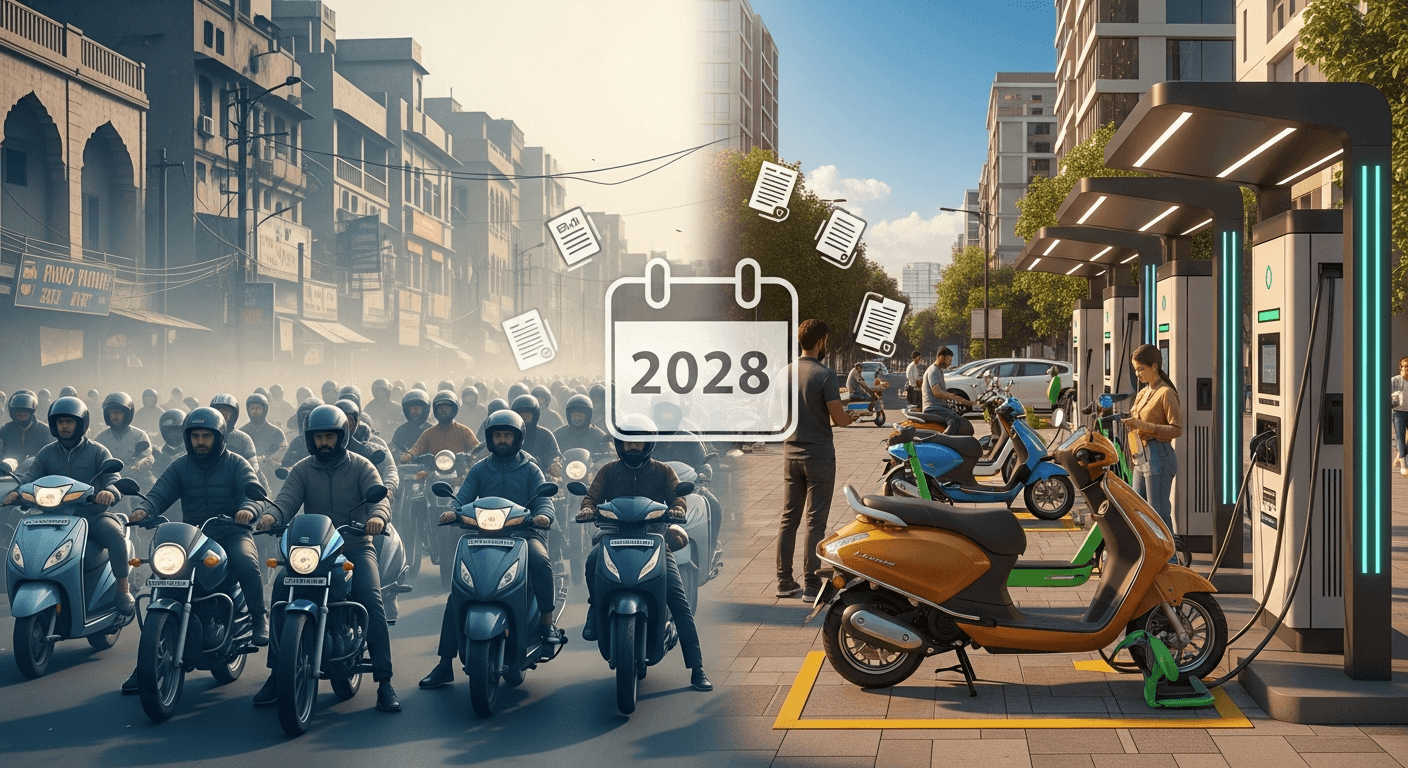
I want to walk you through the draft of Delhi’s new Electric Vehicle (EV) Policy 2026–2030 and what it would mean if approved. The headline that has drawn most attention is a proposed cutoff for new registrations of internal-combustion two-wheelers: from April 1, 2028, only electric two-wheelers would be eligible for new registration in Delhi. The draft is currently open for public comment and is being reported widely in national outlets Times of India and others (summaries at Hindustan Times and NDTV linked below).
The exact proposal (what the draft proposes)
- From April 1, 2028: only electric two-wheelers allowed for new registrations in Delhi.
- From January 1, 2027: only electric three-wheelers allowed for new registrations (already part of the draft).
- The policy is presented as the Delhi Electric Vehicle Policy 2026–2030 and includes deadlines, purchase incentives, scrappage bonuses and tax exemptions to support the transition.
These are registration cutoffs in the draft; they are not retroactive bans on existing vehicles but would stop fresh registrations of petrol/diesel two- and three-wheelers after the dates above [Times of India].
Timeline and implementation steps (as reported)
- Draft uploaded and open for 30 days of stakeholder/public feedback.
- After consultation, the government may finalise and notify the policy; final wording and timelines could change before notification.
- Departments named in the draft would handle implementation steps such as charging infrastructure approvals, scrappage incentives and fleet electrification targets.
Exemptions and clarifications mentioned in public reporting
- The draft frames the rules as applying to new registrations — existing petrol two-wheelers would remain legal to use.
- Some categories (e.g., certain commercial or specialised vehicles) may have specific timelines or transitional arrangements in the final policy; the draft includes targeted exemptions and phased targets (for example, for school buses and government fleets).
- Commercial aggregator/delivery fleets face earlier restrictions for adding new ICE vehicles in some categories (reported timelines vary) [Hindustan Times].
Incentives and disincentives in the draft
- Purchase incentives for two-wheelers: sliding subsidies linked to battery capacity (higher in year one, tapering over years two and three), with eligibility caps by ex-factory price.
- Scrappage incentives to encourage phasing out older vehicles (fixed amounts proposed for each vehicle class).
- Tax benefits: proposed 100% exemption on road tax and registration fees for eligible EVs (with caps for higher-priced cars).
- A budgetary outlay has been reported to support incentives and charging infrastructure development.
Impact on consumers
- Costs and transition: buyers who prefer petrol two-wheelers would lose the option to buy new ICE bikes in Delhi after the cutoff if the policy is finalised. Incentives reduce the upfront gap for many electric models, but affordability remains a concern for lower-cost segments.
- Used market: demand for used petrol two-wheelers could hold up initially (because existing vehicles remain legal) but resale values may change over time as EVs penetrate and registration rules shift.
- Choice and confidence: consumers considering purchase now must weigh resale risk, evolving incentives, and infrastructure improvements.
Impact on manufacturers and dealers
- Manufacturers will need to accelerate EV model rollouts for the two-wheeler segment or risk losing market share in Delhi.
- Dealers and service networks may need to re-skill technicians and modify inventory strategies.
- Firms producing ICE models for local sale may face demand compression in Delhi; but national sales outside Delhi will still matter.
Charging, swapping and fuel-infrastructure plans
- The draft proposes large-scale expansion of public chargers and battery swapping stations, with a single-window clearance mechanism to speed approvals.
- Public agencies and utilities are named to lead infrastructure rollouts and battery collection/disposal arrangements.
- Successful rollout will be crucial: adoption hinges not just on vehicle cost but on reliable, convenient charging and swapping options.
Environmental and air-quality benefits
- Two-wheelers are numerically dominant in Delhi’s fleet and contribute to local pollution; electrifying new two-wheelers could help reduce tailpipe emissions and improve winter smog outcomes over time.
- The draft links the policy to the right to clean air and aims to quantify emission reductions through monitoring mechanisms.
Challenges and criticisms (reported concerns)
- Affordability: EV two-wheelers remain more expensive upfront for many buyers, even with incentives.
- Charging logistics and grid impacts: ramping up charging infrastructure and managing demand on the power system are technical and planning challenges.
- Enforcement and compliance: ensuring that new-registration rules are enforced and that informal markets don’t circumvent rules will require administrative capacity.
- Pace vs readiness: critics have warned that hard cutoffs can create consumer anxiety if the market, charging network and financing options are not ready in time.
Comparisons to other jurisdictions
- The draft is more directive than many earlier incentive-driven Indian state policies; it sets fixed registration deadlines rather than only offering subsidies.
- Globally, several cities and countries have set phase-out dates for new ICE vehicle sales; Delhi’s focus on two-wheelers is notable because they form a large share of the capital’s vehicle stock.
What next: consultation, approval, rollout
- The draft is open for 30 days of comments; stakeholders (residents, industry, experts) can submit feedback as per the government’s notice.
- After consultation the policy could be revised and then notified; implementation would follow departmental guidelines and budget allocations.
- Timelines reported in the draft are subject to change until the policy is formally notified.
Actionable advice for Delhi residents considering a two-wheeler now
- If you need a vehicle immediately: buying a petrol two-wheeler now still gives you legal use of the vehicle after 2028, but consider future resale value and running costs.
- If you can wait: consider electric models if they meet your range, charging and budget needs — incentives and lower operating costs can make EVs attractive.
- Understand charging options: check for home charging feasibility, nearby public chargers or swapping stations, and employer charging availability.
- Financing and incentives: factor in available subsidies, scrappage benefits and tax exemptions if you are eligible.
- For fleet operators and delivery drivers: plan fleet transition timelines now to access incentives and avoid future procurement restrictions.
Sources and caveats
This blog synthesises reporting on the draft Delhi EV Policy 2026–2030 as published in public outlets (notably the Times of India coverage of the draft) and other national reports Times of India, Hindustan Times and NDTV. The measures discussed are those in the draft and are subject to change before final notification; where certainty is lacking I have used cautious phrasing such as "the draft proposes" or "if approved." I have avoided reproducing any single news article verbatim and instead aimed to synthesise the publicly reported elements for a general audience.
Regards,
Hemen Parekh
Any questions / doubts / clarifications regarding this blog? Just ask (by typing or talking) my Virtual Avatar on the website embedded below. Then "Share" that to your friend on WhatsApp.
Get correct answer to any question asked by Shri Amitabh Bachchan on Kaun Banega Crorepati, faster than any contestant
Hello Candidates :
- For UPSC – IAS – IPS – IFS etc., exams, you must prepare to answer, essay type questions which test your General Knowledge / Sensitivity of current events
- If you have read this blog carefully , you should be able to answer the following question:
- Need help ? No problem . Following are two AI AGENTS where we have PRE-LOADED this question in their respective Question Boxes . All that you have to do is just click SUBMIT
- www.HemenParekh.ai { a SLM , powered by my own Digital Content of more than 50,000 + documents, written by me over past 60 years of my professional career }
- www.IndiaAGI.ai { a consortium of 3 LLMs which debate and deliver a CONSENSUS answer – and each gives its own answer as well ! }
- It is up to you to decide which answer is more comprehensive / nuanced ( For sheer amazement, click both SUBMIT buttons quickly, one after another ) Then share any answer with yourself / your friends ( using WhatsApp / Email ). Nothing stops you from submitting ( just copy / paste from your resource ), all those questions from last year’s UPSC exam paper as well !
- May be there are other online resources which too provide you answers to UPSC “ General Knowledge “ questions but only I provide you in 26 languages !



No comments:
Post a Comment