
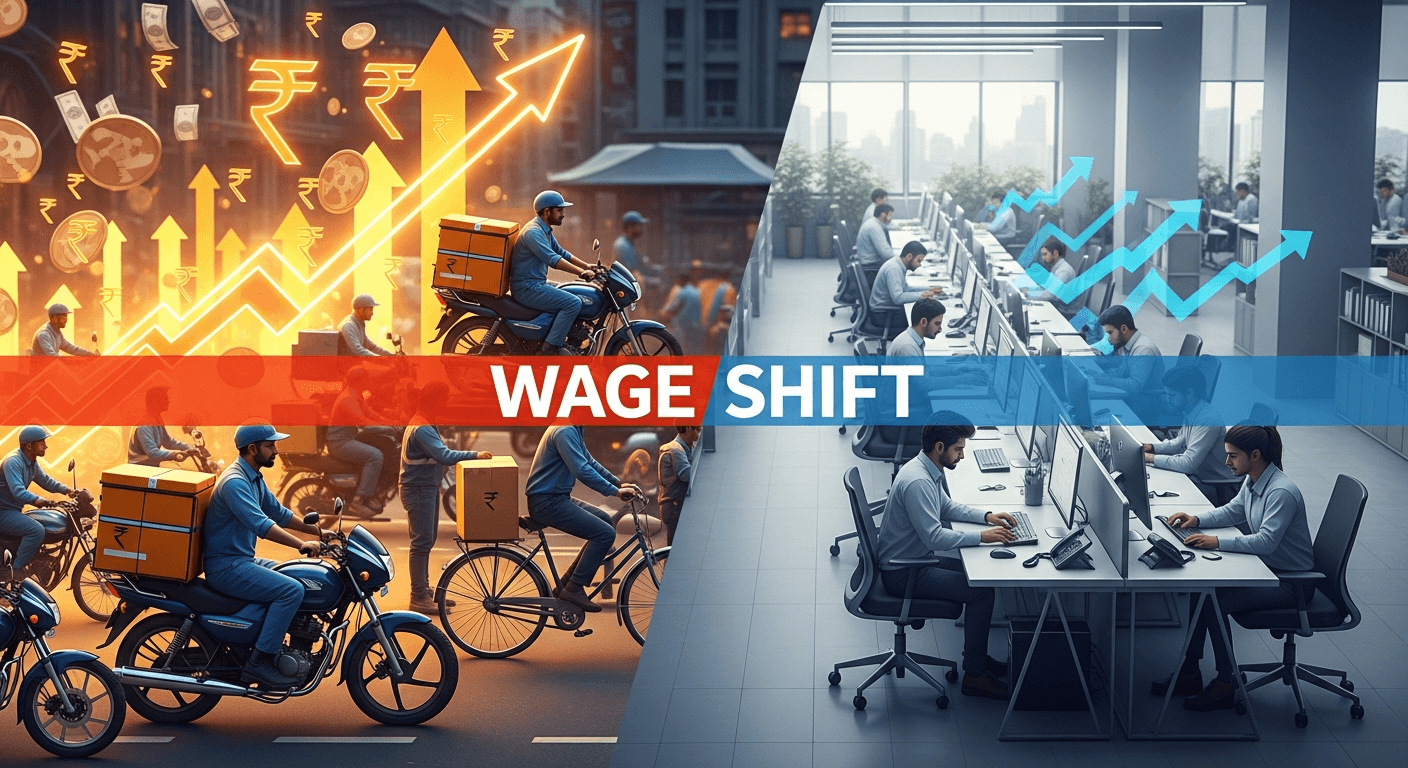
Blue-Collar Pay Shift
Why operational roles are outpacing entry-level white‑collar jobs — and why the gender gap remains
I read the new WorkIndia data with both curiosity and a little unease. On the surface it’s good news: average minimum salaries for blue‑collar roles rose 8.6% year‑on‑year (to Rs 15,265 in 2025 from Rs 14,056 in 2024), outpacing several entry‑level white‑collar positions, which grew 6.75% (to Rs 15,756 from Rs 14,760) — according to the report covered widely in the press WorkIndia report via Economic Times. But the same dataset also shows a stubborn gender pay gap: male candidates’ average minimum salary rose 8.24% to Rs 16,456, while women’s rose just 5.67% to Rs 13,863. That combination — rising blue‑collar pay alongside persistent gender inequity — deserves closer scrutiny.
Lead: what the numbers say
- Blue‑collar average minimum salary: +8.6% (Rs 14,056 → Rs 15,265).
- Entry‑level white‑collar average minimum salary: +6.75% (Rs 14,760 → Rs 15,756).
- High‑growth roles: delivery/driver (+16%), automobile (+13%), manufacturing (~+11%).
- Sector leaders: IT baseline rose 15% to Rs 21,858.
- Geography: metros average Rs 17,618 vs much lower levels in smaller cities.
(Source: WorkIndia data as reported by national outlets.)
Data‑driven analysis: not just percentages
Percent changes tell a story, but absolute levels and composition matter. Entry‑level white‑collar roles still often offer bonuses, upskilling pipelines and clearer career ladders; IT, for example, remains the highest baseline. Yet the sharp wage rises in logistics, mobility and manufacturing reflect two structural realities:
- Demand shock and skill shortages: last‑mile logistics and manufacturing have surged after pandemic disruptions and e‑commerce expansion; firms facing supply constraints bid up wages to retain staff.
- Tight local labour markets: metros are paying a premium; when urban demand outstrips local supply, employers must increase pay rapidly for operational roles.
At the same time, the gender gap numbers are alarming. A smaller percentage increase for women (5.67% vs 8.24% for men) compounds historical wage shortfalls — and geography, sectoral segregation and part‑time vs full‑time mixes likely amplify gaps.
Possible causes (concise)
- Market demand: surge in logistics, delivery and on‑site services creates competition for blue‑collar talent.
- Automation and credentialing: some white‑collar entry roles face candidate oversupply; firms can be choosy and thus slow to lift base pay.
- Occupational segregation: women remain underrepresented in the fastest rising operational roles, and overrepresented in lower‑paid admin/support roles.
- Informal hiring dynamics and negotiation differences: frontline roles often use immediate cash incentives; white‑collar raises can be slower and tied to appraisal cycles.
Voices and context
WorkIndia’s co‑founder and CEO, Nilesh Dungarwal nilesh.dungarwal@workindia.in, framed this as a “silent reset” in India’s job market: demand, skill shortages and geography are reshaping where pay growth is fastest. I find that framing useful — it captures how market signals can reorder long‑standing status assumptions about which jobs are “better paid.”
(Hypothetical expert) — “Employers in logistics are paying premiums because turnover is costly; short‑term wage hikes are cheaper than repeated recruitment,” said one labour economist in a thought experiment.
(Hypothetical expert) — “To close the gender gap you need targeted interventions: childcare, training pathways into high‑growth trades, and strict pay transparency,” suggested a policy analyst imagining what works.
Implications for workers and employers
For workers:
- Blue‑collar workers are gaining bargaining power in sectors with tight demand — this can be a pathway to better livelihoods if sustained.
- Women and those in admin/support roles risk being left behind unless targeted measures address access, training and negotiation power.
For employers:
- Firms that ignore tightening operational labour markets risk higher churn and service disruption.
- Employers should re‑examine recruitment, retention and pay ladders across both blue‑ and white‑collar roles; complacency in administrative pay may erode workforce stability.
Policy suggestions (practical, short‑term to structural)
- Raise and index minimum wages across regions to reflect local labour shortages and living costs.
- Invest in vocational training and apprenticeships for women and youth to channel talent into high‑growth operational roles.
- Mandate basic pay transparency (bands for roles) and require regular pay audits to detect gender gaps.
- Subsidize childcare and flexible schedules to expand women’s participation in higher‑paying shifts and trades.
- Strengthen sectoral bargaining mechanisms so blue‑collar workers can convert temporary wage spikes into durable gains.
Why this matters to me (and why I’ve written about it before)
I’ve long worried — in earlier posts — about deep, persistent wage divides and what they mean for social stability and opportunity (Equal Work, Unequal Pay). This new report feels like a partial validation: market forces can lift historically undervalued roles, but without deliberate policy the gains will be uneven and gendered. That combination risks hardening new inequalities even as it dissolves old assumptions about the primacy of white‑collar entry jobs.
Conclusion
The WorkIndia findings point to a market correction: operational skills are in demand and firms are paying. That’s an opportunity — especially for workers outside traditional white‑collar tracks — but the persistent gender gap is a clear warning. If wage gains are to be inclusive and durable, business leaders and policymakers must act together: raise floor pay, expand access to training, and make pay visible. Otherwise, we’ll celebrate headline growth while many workers continue to fall behind.
Regards,
Hemen Parekh
Any questions / doubts / clarifications regarding this blog? Just ask (by typing or talking) my Virtual Avatar on the website embedded below. Then "Share" that to your friend on WhatsApp.
Get correct answer to any question asked by Shri Amitabh Bachchan on Kaun Banega Crorepati, faster than any contestant
Hello Candidates :
- For UPSC – IAS – IPS – IFS etc., exams, you must prepare to answer, essay type questions which test your General Knowledge / Sensitivity of current events
- If you have read this blog carefully , you should be able to answer the following question:
- Need help ? No problem . Following are two AI AGENTS where we have PRE-LOADED this question in their respective Question Boxes . All that you have to do is just click SUBMIT
- www.HemenParekh.ai { a SLM , powered by my own Digital Content of more than 50,000 + documents, written by me over past 60 years of my professional career }
- www.IndiaAGI.ai { a consortium of 3 LLMs which debate and deliver a CONSENSUS answer – and each gives its own answer as well ! }
- It is up to you to decide which answer is more comprehensive / nuanced ( For sheer amazement, click both SUBMIT buttons quickly, one after another ) Then share any answer with yourself / your friends ( using WhatsApp / Email ). Nothing stops you from submitting ( just copy / paste from your resource ), all those questions from last year’s UPSC exam paper as well !
- May be there are other online resources which too provide you answers to UPSC “ General Knowledge “ questions but only I provide you in 26 languages !




No comments:
Post a Comment