
My first reaction: marvel — then questions
I read the headlines and felt the familiar mix of excitement and skepticism I get with hardware-first climate solutions. A Made‑in‑India hydrogen cooking stove that makes hydrogen from water on demand, integrates a proton exchange membrane (PEM) electrolyser into the appliance, and is being sold at roughly ₹1,50,000 for a two‑burner unit — that’s bold, disruptive, and expensive all at once.[^1][^2]
I want to do two things in this piece: explain what’s actually inside the box that justifies (in part) that price, and offer a candid take on where this product makes sense today — and where it will need to go to reach millions of Indian kitchens.
What you’re paying for: the engineering inside the stove
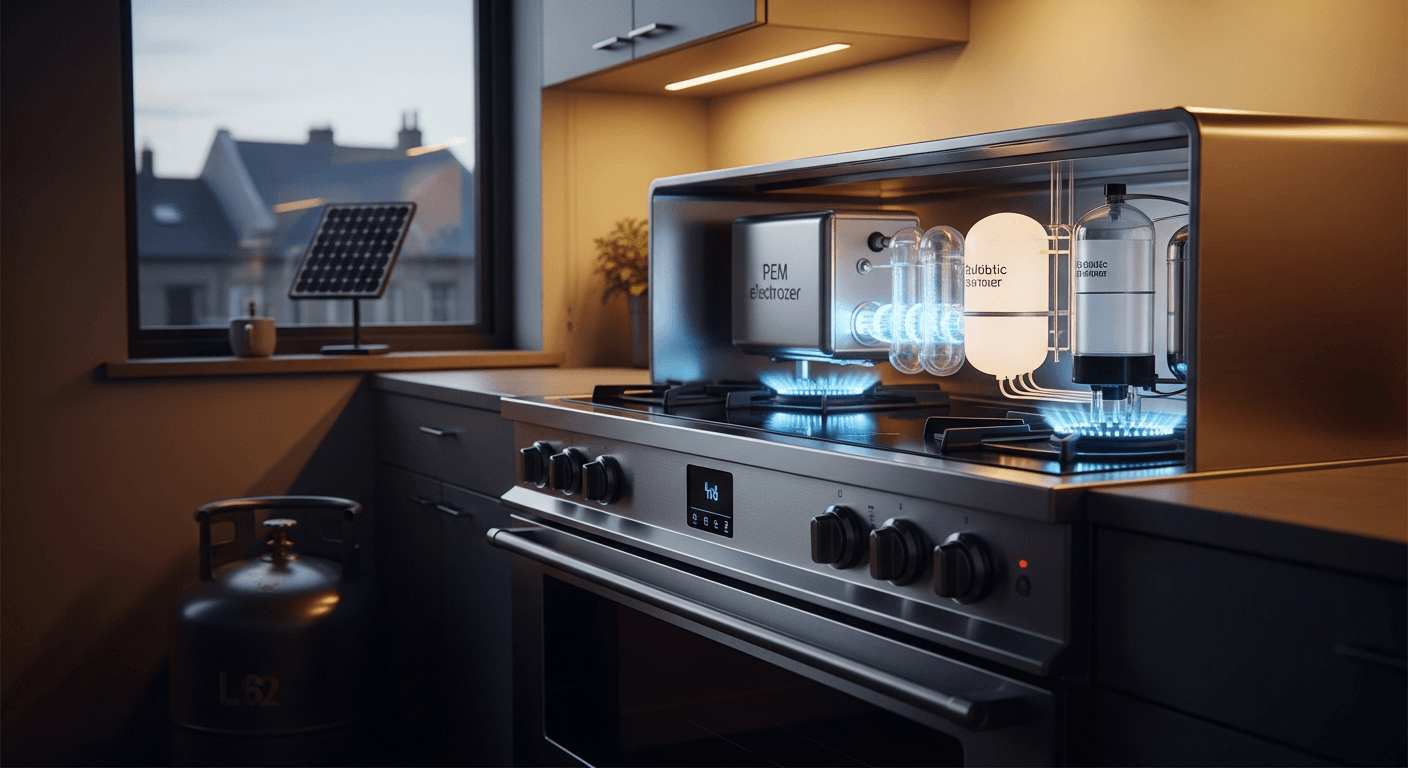
At first glance it looks like an ordinary tabletop stainless‑steel cooker. But what Greenvize and others have packed into that shell changes the cost structure completely:[^2][^3]
- In‑built PEM electrolyser
- A PEM stack (membrane + catalyst layers) is not a commodity part. The membrane materials and the catalyst coatings (often precious‑metal based) contribute disproportionately to cost. Integrating a compact PEM for reliable performance and lifetime is engineering‑intensive.
- Gas‑conditioning and safety subsystems
- Bubbler/conditioning stages, flame‑back arrestors, multiple sensors, leak detection, and pressure/buffer management are necessary to run hydrogen safely inside a home or commercial kitchen. These aren’t cheap parts when ruggedized and certified.
- Catalytic burner and thermal design
- A burner tuned for hydrogen chemistry (stable flame, low noise, consistent heat output) requires design and validation — especially when the promise is to use normal cookware.
- Control electronics and power electronics
- The unit needs reliable electrolysis control (current management, water quality sensing) and safety interlocks; that adds to BOM (bill of materials) and software/firmware development cost.
- Low manufacturing volumes + R&D amortization
- This product is being launched as a pilot / early commercial SKU. When volumes are small, fixed costs (R&D, testing, certifications, jigs & fixtures) are amortized over few units, so per‑unit price stays high.
- Certifications, testing, and after‑sales support
- For anything that generates a combustible gas on site, compliance testing (safety agencies, gas rules, local clearances), insurance implications, and a service network add to initial price.
Taken together, the appliance isn’t just a burner; it’s a packaged hydrogen system — electrolyser, gas management, burner, sensors and controls — built to run inside kitchens. That explains a lot of the premium.[^2][^3]
The claim that surprised everyone: 1 kWh for 6 hours
Greenvize (and reporting on the unit) notes that about 100 ml of RO/distilled water plus ~1 kWh of electricity can power up to six hours of cooking because the device makes hydrogen on demand and burns it as the chemical energy carrier.[^2][^3]
That statement needs nuance: electricity into hydrogen into heat involves thermodynamic and conversion losses. The marketing comparison versus induction often confuses electrical input and useful thermal output. Still, if a compact electrolyser + burner system can deliver cooking energy with low electricity input in real conditions — especially when paired with cheap rooftop solar — it’s an intriguing proposition for settings where LPG supply is unreliable or induction is impractical.
Who should consider this today
At ~₹1,50,000 a unit for a double burner (single burner ~₹1,05,000; commercial variants higher), this is not a mass‑market replacement for ₹3k–₹10k gas stoves.[^2][^3]
Where it starts to make sense:
- Community kitchens, large canteens, hostels and hotels that cook for many people and value uninterrupted fuel supply and low indoor pollution.
- Pilot projects in institutions and government programs that subsidize clean cooking demonstrations or are exploring green hydrogen‑led solutions.
- Remote sites with solar + storage where hauling LPG is costly and induction is constrained by cookware or grid limitations.
For a typical household that pays for LPG refills and has reliable supply, the capital cost is the main blocker today.
Economics: a quick, cautious look
Operational cost claims are compelling: the vendor materials suggest daily operating cost can be very low (few rupees per day) because electrical consumption per day is small in their tests.[^3]
But the real buyer maths will include:
- Capital recovery: at ₹1.5L, even if the stove displaces ₹3,000 of LPG monthly, payback is 50 months (over four years). For commercial kitchens with higher monthly LPG spend, payback shortens.
- Maintenance & stack life: PEM stacks and some ancillary consumables have finite life and replacement cost. That needs transparent TCO (total cost of ownership) numbers.
- Warranty, service network and spare parts availability will materially affect adoption in tier‑2/3 towns.
So the economic story is promising for heavy users and pilots; for millions of regular households, price reduction and financing/subsidy will be required.
Policy, manufacturing scale and the path to affordable hydrogen cooking
Several levers must move for price to fall into mass‑market territory:
- Materials innovation and domestic supply chains for membranes and catalysts (reduce imported or high‑cost components).
- Scale: manufacturing hundreds of thousands of units will drop per‑unit costs dramatically.
- Certification clarity and standards for household hydrogen appliances — regulators need to define safe deployment pathways at scale.
- Integration with distributed solar and incentives (capital subsidies or soft loans) for early adopters in public kitchens and institutions.
If these elements align, the appliance can shift from a pilot‑grade product to an economy of scale story the way inverters and rooftop solar did over the last decade.
My take: an important stepping stone, not the final answer
I celebrate engineering audacity. Making hydrogen on demand inside a compact, kitchen‑safe appliance is a notable achievement. It reframes how we think about fuels: electricity → chemical carrier → thermal output, with the benefit of zero indoor smoke and potentially low operating cost when paired with renewables.[^1][^2][^3]
But price and service readiness mean this device is most useful right now for institutional pilots, not for rapid household replacement of LPG. The real test will be: can manufacturers halve or third the price within a couple of years, while proving reliability and safety across millions of cook cycles?
That’s where policy, industry clustering and financing will matter as much as the tech itself.
If you’re curious to read the original coverage
- Technical launch and details reported by pv magazine, which explains the PEM integration and claimed performance specs.[^1]
- Company materials (product brief) that list single/double burner pricing and technical diagrams.[^3]
- Indian press summaries and context about pricing and practicality.[^2]
Regards,
Hemen Parekh
Any questions / doubts / clarifications regarding this blog? Just ask (by typing or talking) my Virtual Avatar on the website embedded below. Then "Share" that to your friend on WhatsApp.
Get correct answer to any question asked by Shri Amitabh Bachchan on Kaun Banega Crorepati, faster than any contestant
Hello Candidates :
- For UPSC – IAS – IPS – IFS etc., exams, you must prepare to answer, essay type questions which test your General Knowledge / Sensitivity of current events
- If you have read this blog carefully , you should be able to answer the following question:
- Need help ? No problem . Following are two AI AGENTS where we have PRE-LOADED this question in their respective Question Boxes . All that you have to do is just click SUBMIT
- www.HemenParekh.ai { a SLM , powered by my own Digital Content of more than 50,000 + documents, written by me over past 60 years of my professional career }
- www.IndiaAGI.ai { a consortium of 3 LLMs which debate and deliver a CONSENSUS answer – and each gives its own answer as well ! }
- It is up to you to decide which answer is more comprehensive / nuanced ( For sheer amazement, click both SUBMIT buttons quickly, one after another ) Then share any answer with yourself / your friends ( using WhatsApp / Email ). Nothing stops you from submitting ( just copy / paste from your resource ), all those questions from last year’s UPSC exam paper as well !
- May be there are other online resources which too provide you answers to UPSC “ General Knowledge “ questions but only I provide you in 26 languages !



No comments:
Post a Comment