
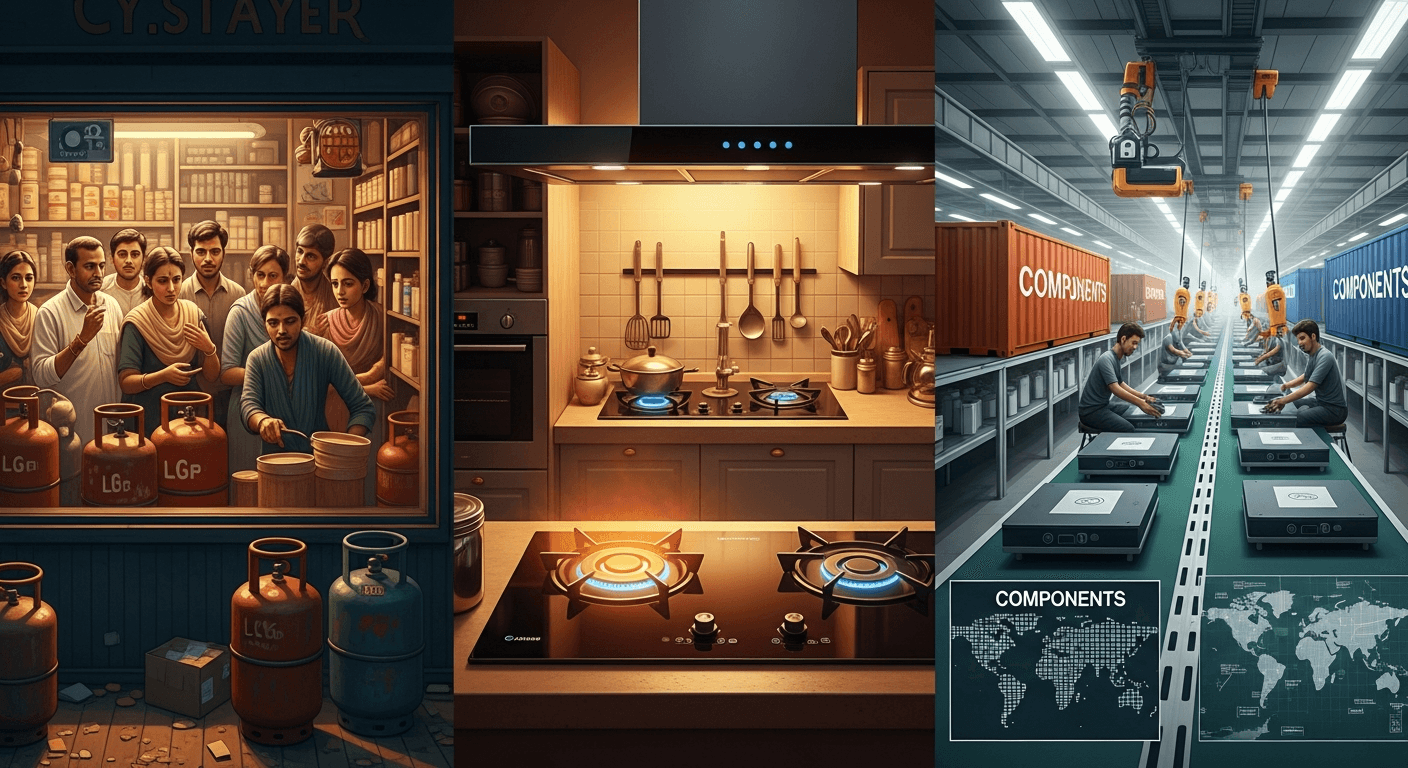
I watched the recent industry push for short-term sops with a mix of sympathy and impatience. The news is plain: demand for induction cooktops and small electric cookers has leapt, supply chains are strained, and manufacturers are asking the Centre for time-bound relief — GST cuts, faster component imports, and easier quality approvals — so they can ramp up production quickly (Cooking Appliance Cos May Seek Sops to Boost Production).
As someone who’s been arguing for an accelerated shift to electric and solar cooking for years, I see three linked realities in this moment: the consumer shock of disrupted fuel markets, the structural fragility of appliance supply chains, and a policy window where short-term fixes can be shaped into long-term industrial transformation.
The short-term problem
- Demand has surged dramatically — retailers are reporting spikes for induction cooktops and kettles that created initial shortages. Manufacturers are, understandably, asking for fast relief on taxes and component rules so they can increase output now.
- The current regime (18% GST on many small electric cooking appliances and BIS rules that limit some component imports to certified vendors) slows rapid scale-up.
- Many critical parts are certified vendors in a small group abroad, which means India’s capacity to expand quickly is limited unless imports and certifications are eased temporarily.
If you need more context on the immediate reporting, read the coverage linked above.
Why I’m not satisfied with only temporary sops
Short-term tax cuts or relaxed import norms will help factories run fuller shifts and retailers restock shelves. But they do not address the deeper weakness: India still imports the critical components that make induction controllers, power modules, and efficient heating elements work reliably at scale.
I’ve written before about systemic approaches to electrifying cooking and the role of swappable batteries and distributed retail networks in making electric cooking practical and affordable — see my essays on solar-electric cookers and battery-swapping frameworks (No Solar Cookers yet ? Clear as Daylight ? and A Battery Swapping Policy for Battery-Powered Solar Cookers). These ideas explain why short-term relief must be married to medium- and long-term industrial strategy.
A three-horizon approach I’d push for
- Short-term (weeks to months): rapid, targeted relief
- Temporary GST reduction or a rebate for essential electric cooking appliances to improve affordability and clear inventory bottlenecks.
- Fast-track, time-bound relaxations for importing specific electronic components with strict traceability and safety checks so factories can airlift parts if needed.
- A clear, transparent timeline for these relaxations so industry plans capacity rather than gaming the system.
- Medium-term (6–24 months): build domestic supplier ecosystems
- A PLI-style incentive for manufacture of critical power-electronics, induction coils, and semiconductor modules used in cooking appliances. Not every appliance maker should get the same subsidy — focus on upstream components where dependence is highest.
- Time-bound, simplified BIS certification pathways for new domestic vendors that meet safety standards, with dedicated test labs and accelerated accreditation.
- Support for capital investment (machinery, test equipment) and skills training so local vendors can meet volume and quality demands.
- Long-term (2–7 years): reimagine cooking as a systems challenge
- Integrate appliance policy with distributed energy solutions: rooftop solar incentives, home battery programs, and swappable-battery ecosystems so cooking electrification reduces LPG import dependence and benefits from renewables.
- Use carbon-market thinking to reward low-carbon cooking paths (solar + storage + efficient induction). I’ve explored how carbon credits and system thinking could create very different economics for solar-electric cookers in previous posts.
- Strengthen consumer finance and retail channels (hire-purchase, bundled battery plans through large retail chains) so uptake isn’t constrained by upfront cost.
A few hard trade-offs we must accept
- Speed vs. sovereignty: airlifting components and temporary imports buys time — but it risks locking in foreign dependencies unless paired with a domestic build-up.
- Affordability vs. industrial returns: a GST cut helps demand immediately, but without PLI and supply-side investment, we’ll simply import more finished goods rather than create local jobs and capabilities.
- Safety vs. speed: BIS standards protect consumers. Fast-tracking must not relax safety checks; it should expand testing capacity and temporary reciprocal recognition with strict conditions.
What keeps me optimistic
Policy windows open rarely. When consumers suddenly choose electric alternatives — because LPG shrank or because prices shifted — adoption curves that looked theoretical become real. If policymakers use this momentum to combine short-run demand support with medium-term industrial incentives and long-term systems thinking, India can capture manufacturing value, reduce import bills, and move millions to cleaner kitchens.
I’ve argued for linked battery and solar strategies precisely because they let us think beyond a single appliance and imagine a resilient, lower-carbon cooking ecosystem. The current debate about sops is necessary; my plea is that we design those sops so they seed capability, not just consumption.
If you’re interested in the practical policy levers I’d prioritize first — and how retailers, manufacturers and ministries can coordinate on a 90-day action plan — I can lay that out in a follow-up. For now, I’ll watch as the meeting rooms fill and hope that urgency leads to durable change rather than a temporary patch.
Regards,
Hemen Parekh
Any questions / doubts / clarifications regarding this blog? Just ask (by typing or talking) my Virtual Avatar on the website embedded below. Then "Share" that to your friend on WhatsApp.
Get correct answer to any question asked by Shri Amitabh Bachchan on Kaun Banega Crorepati, faster than any contestant
Hello Candidates :
- For UPSC – IAS – IPS – IFS etc., exams, you must prepare to answer, essay type questions which test your General Knowledge / Sensitivity of current events
- If you have read this blog carefully , you should be able to answer the following question:
- Need help ? No problem . Following are two AI AGENTS where we have PRE-LOADED this question in their respective Question Boxes . All that you have to do is just click SUBMIT
- www.HemenParekh.ai { a SLM , powered by my own Digital Content of more than 50,000 + documents, written by me over past 60 years of my professional career }
- www.IndiaAGI.ai { a consortium of 3 LLMs which debate and deliver a CONSENSUS answer – and each gives its own answer as well ! }
- It is up to you to decide which answer is more comprehensive / nuanced ( For sheer amazement, click both SUBMIT buttons quickly, one after another ) Then share any answer with yourself / your friends ( using WhatsApp / Email ). Nothing stops you from submitting ( just copy / paste from your resource ), all those questions from last year’s UPSC exam paper as well !
- May be there are other online resources which too provide you answers to UPSC “ General Knowledge “ questions but only I provide you in 26 languages !



No comments:
Post a Comment