
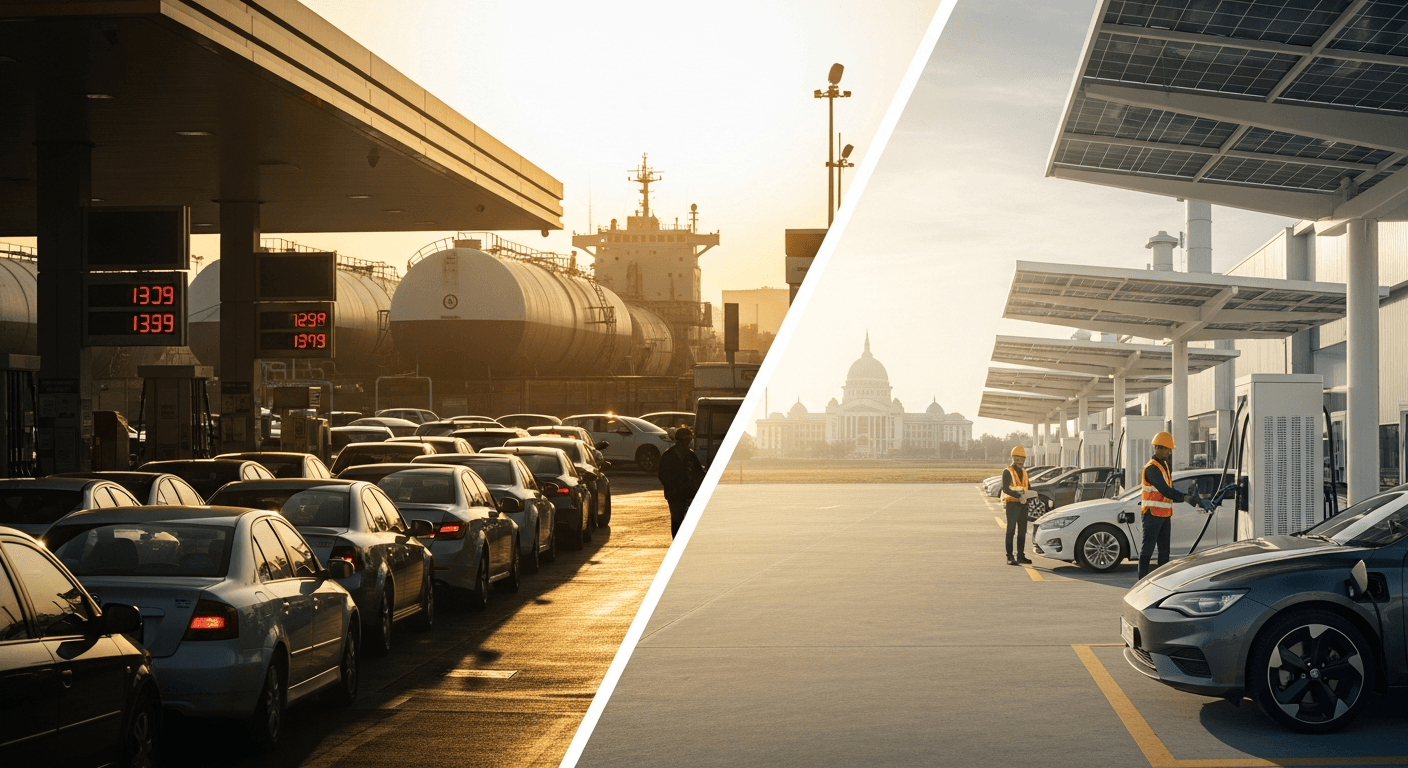
Why an Iran war matters to my garage
The news that the Iran conflict has rattled global energy markets is not just geopolitics — it is a practical shock to how we move, make and power things. Over the past few weeks the Centre has quietly urged the auto industry to reduce reliance on oil and, wherever technically feasible, shift factory operations and product plans toward electricity.[^1][^2]
I write this as someone who has followed the electric transition for years and who believes the present moment will accelerate choices that were already inevitable. My earlier pieces on the promise and limits of electrification anticipated many of the policy trade-offs we now face.[^3]
What's changed: from supply route risk to national policy nudge
- The immediate trigger is disruption to oil and gas flows from the Gulf — shipping route risks (including the Strait of Hormuz) and sanctions- or conflict-driven supply squeezes — that push crude and gas price risk upward and expose import dependence.[^1]
- The Centre’s advisory (issued in late March) asks automakers and suppliers to: shift industrial fuel use from oil-based fuels to electricity where feasible; optimise production schedules to cut idle fuel use; and explore use of recycled aluminium and alternative materials to ease raw-material pressure.[^1][^2]
These are blunt, pragmatic nudges. They are not an overnight ban on internal-combustion vehicles (ICEs), but they are a clear signal: energy security now sits with climate and industrial policy on the same table.
The auto sector’s current reality
Most vehicle kilometres today in India are powered by petrol, diesel or CNG. Automakers’ value chains — foundries, paint ovens, heat treatment, captive power — still run heavily on fossil fuels or gas. For parts suppliers that rely on industrial gas, shortages are already affecting production runs. At the same time, consumer interest in EVs has risen in showroom inquiries as buyers worry about future fuel costs and volatility.[^4]
But two structural facts remain:
- EVs still carry a higher upfront price for many buyers. Running-cost math is favorable for EVs, but sticker shock matters.
- Charging infrastructure and grid readiness vary wildly across states and cities; the system-level shift is more than swapping powertrains, it’s about electricity delivery and clean electricity supply.
Policy measures and incentives being deployed (and needed)
The government’s immediate measures in the advisory are operational (shift factory fuels, prioritise household gas) and materials-focused (use recycled aluminium). Beyond that, the long-term levers that matter are familiar:
- Purchase incentives, tax concessions and lower GST rates for EVs to close the upfront-cost gap.[^5]
- Capital support and soft loans for fast-charging networks and for vehicle makers building EV platforms.
- Local content and battery-manufacturing incentives to reduce import exposure.
- Demand-side measures: fleet electrification (buses, taxis, last-mile delivery) to create scale.
A recent analysis stresses that while higher oil prices make EVs more attractive, sustained incentives — at least through the scaling phase to 2030 — will be needed for a smooth transition.[^5]
Infrastructure and grid challenges during an energy crunch
Switching vehicle energy from imported oil to domestic electricity reduces exposure to foreign supply shocks — but it transfers stress to the power system. Key issues:
- Peak charging demand: uncoordinated overnight charging can raise peak loads in distribution networks.
- Clean supply mix: if additional electricity comes from coal-heavy sources, the net climate benefit weakens.
- Distribution and last-mile charging gaps: apartment complexes, small towns and intercity corridors need targeted investment.
Practical steps include smart tariffs and managed charging, accelerated renewables build-out tied to charging hubs, and targeted grid upgrades in manufacturing belts that will electrify production lines.
What this means for consumers and manufacturers
For consumers:
Running costs for EVs remain attractive and more predictable as oil prices swing; total cost of ownership improves with higher petrol/diesel prices.
Upfront costs and charging access remain the two biggest hurdles.
For manufacturers and suppliers:
- Investment choices accelerate: EV platforms, battery supply contracts, and retooling of plants for electric drivetrains become urgent decisions.
- Supply-chain stress (gas, aluminium) forces re-routing, recycling and design choices that reduce raw-material exposure.
Environmental and economic consequences
The hoped-for upside is clear: lower oil imports, reduced exposure to geopolitical price shocks, and faster local decarbonisation if electricity is increasingly renewable. Economically, every rupee saved on oil imports helps the current account and fiscal room. But the caveat is important: the climate gain depends on decarbonising the grid and avoiding a knee-jerk move to higher-emissions power to meet EV load.
Obstacles and the steps I recommend
Obstacles:
- High upfront EV prices for many buyers.
- Uneven charging infrastructure and weak distribution networks in many regions.
- Battery supply concentration and raw-material vulnerabilities.
- Short-term industrial fuel shortages that disrupt production before electrification scales.
Recommendations:
- Pair demand incentives with supply-side investments: fund chargers and grid upgrades where EV adoption is imminent.
- Use smart charging and time-of-use tariffs to shift load and avoid costly peaker investments.
- Accelerate domestic battery and cell manufacturing through clear, long-term purchase commitments from public fleets.
- Encourage circular material practices: recycled aluminium and battery recycling to reduce import pressure and environmental costs (already part of the Centre’s advisory).[^{1}]
- Support low-income and urban rental/ride-hailing segments with targeted subsidies — where electrification yields the fastest oil-displacement per rupee.
Takeaway
The Iran war has done what price trends and policy goals could not do quickly enough: it made energy security an urgent economic conversation and pushed electrification from long-term ambition to short-term strategy. The road ahead will be bumpy, but if the nation pairs those industry nudges with charging investments, clean power expansion and targeted incentives, this crisis could accelerate a durable, lower-carbon mobility system.
[^1]: "Iran war: Centre pushes auto sector to shift to EVs amid energy crunch," Economic Times. https://economictimes.com/industry/auto/auto-news/iran-war-centre-pushes-auto-sector-to-shift-to-evs-amid-energy-crunch/articleshow/129829508.cms
[^2]: "India asks auto industry to optimise production as Iran war hurts energy supplies," Reuters coverage (via Marketscreener). https://in.marketscreener.com/news/india-asks-auto-industry-to-optimise-production-as-iran-war-hurts-energy-supplies-13872772.html
[^3]: My earlier reflection, "Battle of Electric Vehicles," where I explored the trade-offs of electrification and grid impacts. http://mylinkedinposting.blogspot.com/2024/09/battle-of-electric-vehicles.html
[^4]: Coverage and dealer reports noting higher EV inquiries after crude price rise. https://www.business-standard.com/amp/economy/news/iran-war-oil-prices-boost-ev-adoption-incentives-till-2030-study-126040500561_1.html
[^5]: Analysis on incentives and tax changes shaping EV competitiveness (Business Standard). https://www.business-standard.com/amp/economy/news/iran-war-oil-prices-boost-ev-adoption-incentives-till-2030-study-126040500561_1.html
Regards,
Hemen Parekh (hcp@recruitguru.com)
Any questions / doubts / clarifications regarding this blog? Just ask (by typing or talking) my Virtual Avatar on the website embedded below. Then "Share" that to your friend on WhatsApp.
Get correct answer to any question asked by Shri Amitabh Bachchan on Kaun Banega Crorepati, faster than any contestant
Hello Candidates :
- For UPSC – IAS – IPS – IFS etc., exams, you must prepare to answer, essay type questions which test your General Knowledge / Sensitivity of current events
- If you have read this blog carefully , you should be able to answer the following question:
- Need help ? No problem . Following are two AI AGENTS where we have PRE-LOADED this question in their respective Question Boxes . All that you have to do is just click SUBMIT
- www.HemenParekh.ai { a SLM , powered by my own Digital Content of more than 50,000 + documents, written by me over past 60 years of my professional career }
- www.IndiaAGI.ai { a consortium of 3 LLMs which debate and deliver a CONSENSUS answer – and each gives its own answer as well ! }
- It is up to you to decide which answer is more comprehensive / nuanced ( For sheer amazement, click both SUBMIT buttons quickly, one after another ) Then share any answer with yourself / your friends ( using WhatsApp / Email ). Nothing stops you from submitting ( just copy / paste from your resource ), all those questions from last year’s UPSC exam paper as well !
- May be there are other online resources which too provide you answers to UPSC “ General Knowledge “ questions but only I provide you in 26 languages !


No comments:
Post a Comment