
Why a "double-check" matters
I write this as someone who has long argued for pragmatic, digitally-enabled interventions to protect children from preventable malnutrition. A recent state initiative to introduce a “double-check” screening system — a joint, periodic screening conducted by health and ICDS teams at anganwadi centres — is precisely the kind of course correction we need [1]. The idea is simple but powerful: add a second, standardized check by trained medical staff to the routine monitoring already done by frontline nutrition workers.
What the double-check screening system is
The double-check screening system combines two complementary elements:
- Routine community screening done by anganwadi workers/ASHA (monthly or as-is), and
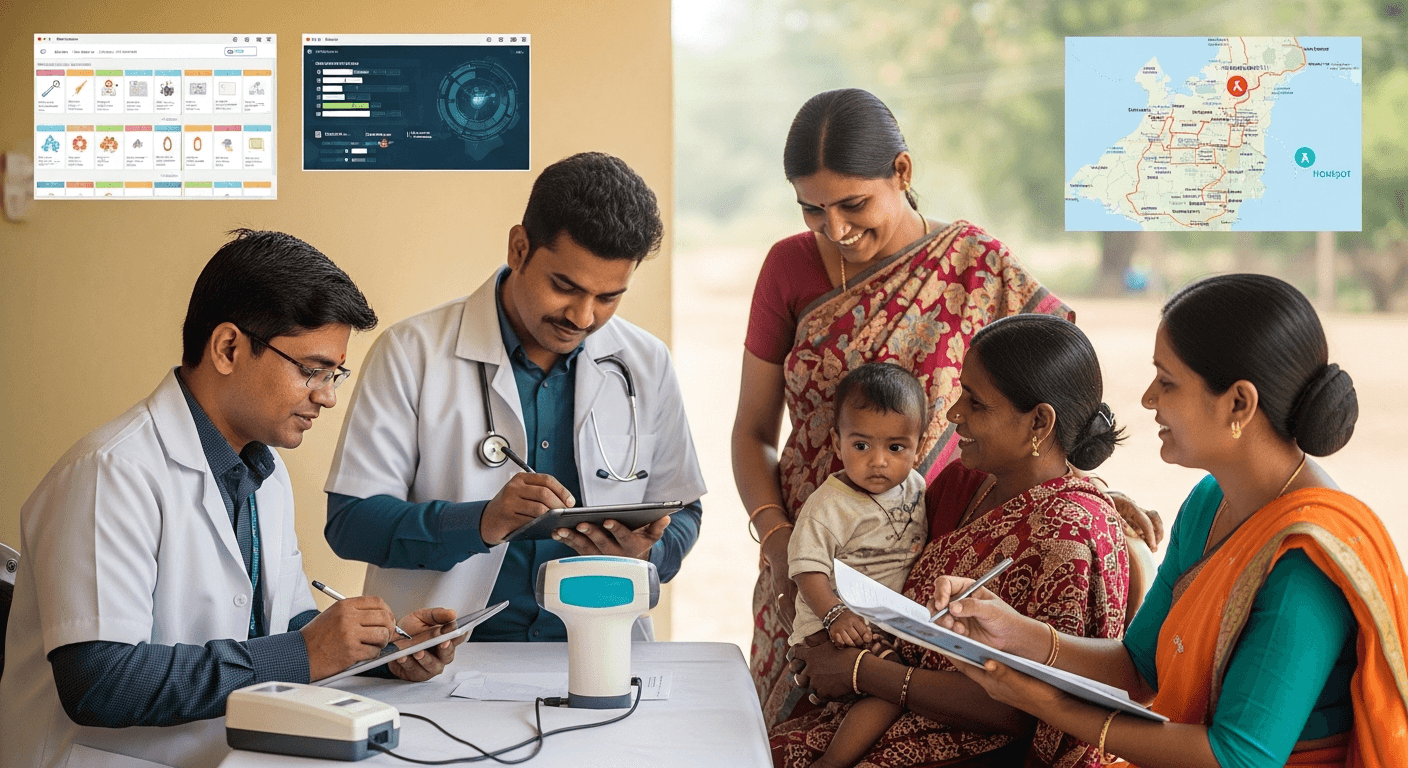
- A periodic (e.g., once every six months) joint screening team that includes a medical officer, a supervisor and a health worker using standardized Growth Monitoring Devices (GMDs) and a shared digital tracker.
The joint exercise is not a replacement but a validation and amplification: it aims to reduce measurement error, reach missed children, identify severe acute malnutrition (SAM) reliably, and trigger referrals and nutrition rehabilitation where needed [1].
Why it's needed — evidence and rationale
There are four persistent problems that justify a double-check:
- Measurement and reporting gaps: front‑line workers do vital work but may lack standardized devices and refresher training, causing false negatives/positives.
- Missed or irregular coverage: monthly checks can miss children who are absent, migrated, or otherwise disconnected from regular services.
- Data fragmentation: multiple registers and manual records obstruct timely identification of geographic or facility-level hotspots.
- High burden and slow progress: states with stubborn rates of stunting, wasting and underweight need more rigorous detection-to-action cascades to reduce morbidity and mortality [1],[2].
There is also a strong methodological foundation: global guidance and reviews show that validated screening tools (MUST, NRS-2002, MNA-SF, and pediatric tools) and repeat screenings improve detection and downstream outcomes when linked to clear care pathways [2],[3].
How it works in practice — steps and stakeholders
Operational model (practical steps):
- Planning and scheduling: state/ district nutrition teams publish a six-month calendar grouping anganwadi centres by geography to optimize teams and travel.
- Pre-visit mobilisation: ASHA and anganwadi workers conduct door-to-door reminders and note absent children for follow-up.
- Joint screening day: team (medical officer + supervisor + health worker) visits the anganwadi with calibrated Growth Monitoring Devices and record-keeping tablets/phones.
- Measurement and triage: every child 0–6 years receives anthropometry (weight, length/height, MUAC where relevant), measurement is entered into the Nutrition Tracker app, and SAM/moderate acute malnutrition (MAM) cases are flagged immediately.
- Immediate action: SAM children are counselled and referred to NRCs/health facilities; MAM cases receive fortified foods and counseling; caregivers receive tailored behaviour-change messages.
- Follow-up and migration tracking: absent children are visited at home; families who migrated are recorded in a Migration Tracking System for continuity of care.
- Data consolidation and response: district teams receive dashboards showing hotspots; targeted action plans (supply of therapeutic food, outreach camps, capacity building) are launched.
Key stakeholders: state women & child development department; state public health department; anganwadi workers and helpers; ASHA workers; medical officers; nutrition rehabilitation centres; district monitoring units.
Expected benefits
- Improved detection accuracy and earlier identification of SAM and MAM.
- Faster referrals and higher treatment uptake for severe cases.
- Better programmatic targeting: hotspots, low-performing anganwadis, and supply gaps become visible.
- Strengthened community trust when health teams visibly join local workers.
- Richer data for policy decisions and resource allocation.
Potential challenges and mitigation
- Workforce constraints: medical teams are already stretched. Mitigation: phase rollout, use mobile medical teams, and engage private/NGO partners for outreach.
- Measurement variability: different devices and skill levels create noise. Mitigation: use calibrated GMDs, standardized protocols, and short competency-based trainings.
- Data quality and integration: multiple apps/registers = fragmentation. Mitigation: adopt one interoperable Nutrition Tracker with offline capability and routine audits.
- Logistics and costs: transport, devices, and staff time add budget pressure. Mitigation: leverage existing visit days (e.g., immunization outreach), and reallocate resources from low-impact activities.
- Privacy and consent: digital records must protect families. Mitigation: clear privacy policies, limited-access dashboards, and community consent processes.
A short hypothetical scenario
In a village anganwadi, a 14‑month-old child with slow weight gain has been visited monthly but shows borderline numbers on the local register. During the double-check visit, the medical team uses a calibrated scale and SAM criteria to classify the child as MAM with concurrent illness. The Nutrition Tracker flags the child; the medical officer prescribes therapeutic feeding and refers the child to the nearest NRC for clinical evaluation. ASHA conducts home visits, ensures treatment adherence, and the child’s growth trajectory is followed monthly. Within three months, the child moves from MAM to normal growth percentiles — a case that would otherwise likely have been missed or delayed.
Policy recommendations for scaling and sustaining
- Phase implementation: pilot in high-burden districts, evaluate, then scale.
- Standardize tools: procure calibrated GMDs and a single Nutrition Tracker platform that integrates with health management information systems.
- Invest in capacity: short, practical competency trainings for measurement, counseling, and digital recording.
- Fund clear care pathways: ensure availability of therapeutic foods, NRC capacity, and referral transport.
- Build accountability: public dashboards for coverage and outcomes at district and state levels.
- Evaluate impact: implement regular process and outcome evaluations (coverage, referrals completed, recovery rates).
- Leverage existing ideas: integrate digital registration and benefit links I have proposed in earlier writings (for example, my work on digital nutrition workflows and BANMALI-style integration) to reduce leakage and improve continuity of care [3].
Conclusion
The double-check screening system is a low‑complexity, high‑value intervention. It addresses detection gaps, strengthens linkages between community workers and clinical teams, and creates the data-driven feedback loops policymakers need to act decisively. If rolled out thoughtfully — with standard devices, digital integration, training, and accountability — this system can convert identification into recovery at scale.
State initiative and reporting [1]
On screening tools and evidence [2]
My earlier proposals on digital integration and community nutrition delivery (BANMALI) [3]
Regards,
Hemen Parekh
Any questions / doubts / clarifications regarding this blog? Just ask (by typing or talking) my Virtual Avatar on the website embedded below. Then "Share" that to your friend on WhatsApp.
Get correct answer to any question asked by Shri Amitabh Bachchan on Kaun Banega Crorepati, faster than any contestant
Hello Candidates :
- For UPSC – IAS – IPS – IFS etc., exams, you must prepare to answer, essay type questions which test your General Knowledge / Sensitivity of current events
- If you have read this blog carefully , you should be able to answer the following question:
- Need help ? No problem . Following are two AI AGENTS where we have PRE-LOADED this question in their respective Question Boxes . All that you have to do is just click SUBMIT
- www.HemenParekh.ai { a SLM , powered by my own Digital Content of more than 50,000 + documents, written by me over past 60 years of my professional career }
- www.IndiaAGI.ai { a consortium of 3 LLMs which debate and deliver a CONSENSUS answer – and each gives its own answer as well ! }
- It is up to you to decide which answer is more comprehensive / nuanced ( For sheer amazement, click both SUBMIT buttons quickly, one after another ) Then share any answer with yourself / your friends ( using WhatsApp / Email ). Nothing stops you from submitting ( just copy / paste from your resource ), all those questions from last year’s UPSC exam paper as well !
- May be there are other online resources which too provide you answers to UPSC “ General Knowledge “ questions but only I provide you in 26 languages !




No comments:
Post a Comment