
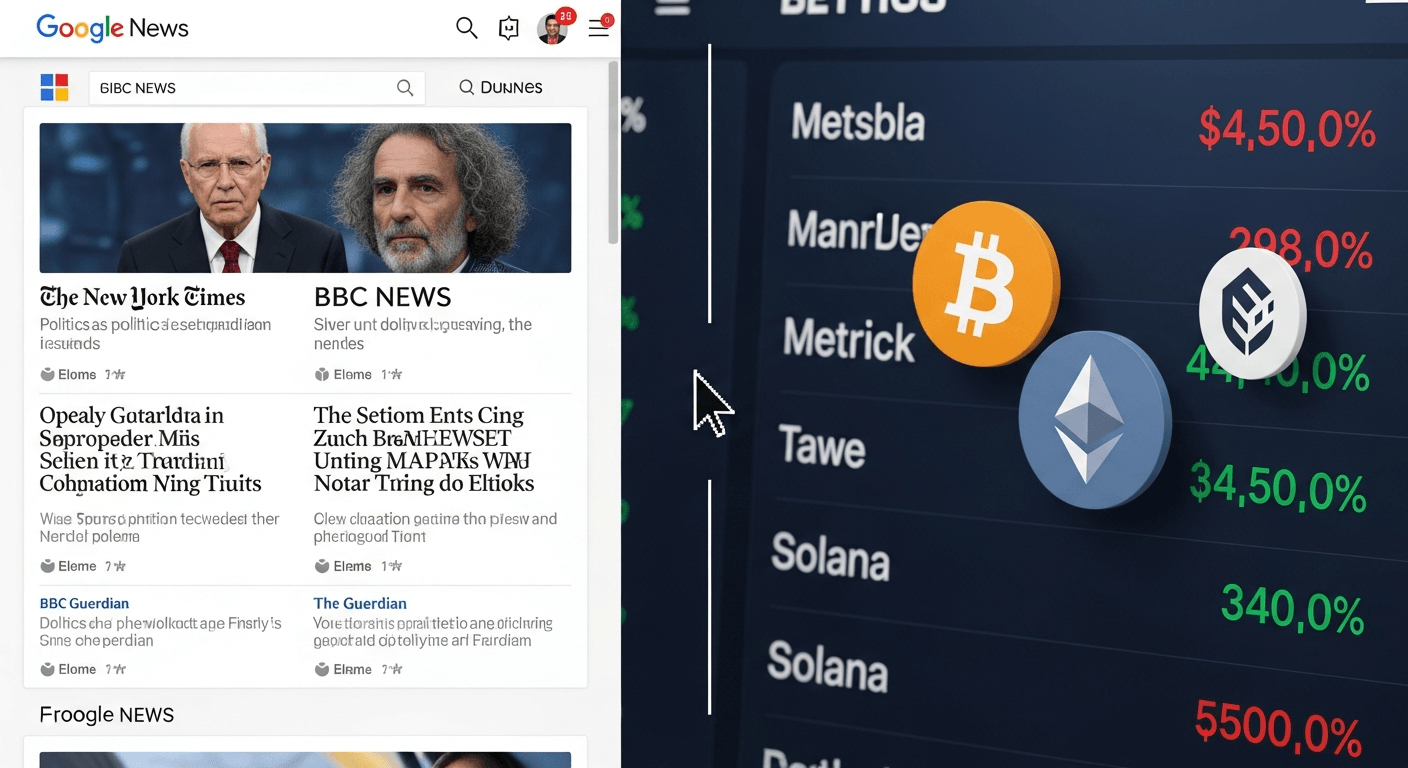
Google's Polymarket News Error
When algorithms surface odds as headlines
I watched the recent episode where links to Polymarket prediction markets briefly appeared inside Google News with more than a little curiosity. On the surface it looked like a simple misindexing — Google called it an error — but the incident exposes deeper questions about how algorithmic curation treats real‑time data, speculation, and what we expect from a “news” product.
What is Polymarket (quick primer)
Polymarket is a web‑based prediction market where users buy and sell positions on the likelihood of future events. Markets span geopolitics, technology rollouts, sports, and crypto — each market shows odds that update as participants trade. The platform packages forecasting and wagering together: for many users it’s both a source of aggregated opinion and an interface for staking cryptocurrency on outcomes.
What happened — a short timeline
- Late March 2026: Users began noticing Polymarket entries surfacing in Google News and in personalized “For You” recommendations for event‑driven queries.
- By April 11–12: Screenshots circulated showing Polymarket markets appearing alongside coverage from Reuters, The Guardian and other established outlets for queries such as shipping activity in the Strait of Hormuz.
- April 12–13, 2026: Google confirmed the appearance was unintentional and said the listings were removed from News; the company described the listing as an error and said it no longer surfaces those links in News The Verge and Gizmodo.
Why this matters for prediction markets and platforms
There are several threads worth picking apart:
Signal vs. product: Prediction markets generate fast‑moving signals. Search and news algorithms prize freshness and update frequency — behaviours that can mimic legitimate newsrooms. That similarity makes it easy for prediction markets to be surfaced if eligibility filters are imperfect.
Perception risk: Showing a market link with odds beside a news article implies equivalence — that the market is a reporting source rather than a betting interface. That can mislead casual readers about what they’re consuming.
Distribution and discoverability: Being present in mainstream discovery channels (search, news feeds, finance pages) dramatically expands reach. Polymarket and other platforms have been working to embed their data across apps and services; even a brief appearance in a high‑traffic product reveals how quickly distribution can shift public understanding.
Reactions (what we saw)
Google referred to the inclusion as a mistake and removed the entries, framing the incident as an eligibility and indexing error Gizmodo. Polymarket’s broader strategy — deeper integrations and partnerships to make markets discoverable outside crypto spaces — remained visible in reporting about the episode, even if the company itself focused on product growth rather than the specific News placement.
Legal, regulatory and policy angles
This glitch sits at the intersection of several regulatory concerns:
Content policy: Platforms maintain eligibility criteria for ‘news’ sources. The episode will prompt product teams to reexamine how classification rules treat nontraditional, frequently updated pages that aren’t journalistic reporting.
Gambling vs. information: Prediction markets straddle categories (financial prediction, gambling, opinion aggregation). Different jurisdictions treat them variously; some prediction exchanges operate under financial regulators, others exist in grey areas. Search and news products must reconcile local rules with global indexing practices.
Consumer protection: Surfacing wagering interfaces in news feeds invites scrutiny from consumer‑protection and advertising regulators concerned about transparency and the potential for inadvertent exposure to gambling products.
I don’t see a single regulator stepping in overnight because of this one indexing error. But the event will feed ongoing conversations about how platforms treat speculative products and whether additional guardrails — labeling, eligibility checks, or regional restrictions — are needed.
Possible futures — three scenarios
Tighten filters: Search and news teams refine eligibility rules so prediction markets are explicitly excluded from news surfaces unless they meet clear journalistic criteria.
Controlled integration: Platforms adopt labeled, opt‑in placements for prediction market data (similar to how some finance products include market feeds), with strong UI signals that distinguish odds from reporting.
Normalization: As prediction markets pursue partnerships and embed in mainstream finance and social apps, their content becomes a recognized layer of public forecasting. That would require clearer disclosure and possibly new regulatory frameworks to manage gambling‑like risks.
Takeaway
As someone who watches technology, policy, and markets intersect, I see this moment as a useful reminder: algorithms reflect incentives and shortcuts as much as intent. A single “error” can reveal how fragile the boundaries are between journalism, data products, and speculative interfaces. Fixing the bug is easy; clarifying the rules and user expectations is the harder, necessary work.
Regards,
Hemen Parekh
Any questions / doubts / clarifications regarding this blog? Just ask (by typing or talking) my Virtual Avatar on the website embedded below. Then "Share" that to your friend on WhatsApp.
Get correct answer to any question asked by Shri Amitabh Bachchan on Kaun Banega Crorepati, faster than any contestant
Hello Candidates :
- For UPSC – IAS – IPS – IFS etc., exams, you must prepare to answer, essay type questions which test your General Knowledge / Sensitivity of current events
- If you have read this blog carefully , you should be able to answer the following question:
- Need help ? No problem . Following are two AI AGENTS where we have PRE-LOADED this question in their respective Question Boxes . All that you have to do is just click SUBMIT
- www.HemenParekh.ai { a SLM , powered by my own Digital Content of more than 50,000 + documents, written by me over past 60 years of my professional career }
- www.IndiaAGI.ai { a consortium of 3 LLMs which debate and deliver a CONSENSUS answer – and each gives its own answer as well ! }
- It is up to you to decide which answer is more comprehensive / nuanced ( For sheer amazement, click both SUBMIT buttons quickly, one after another ) Then share any answer with yourself / your friends ( using WhatsApp / Email ). Nothing stops you from submitting ( just copy / paste from your resource ), all those questions from last year’s UPSC exam paper as well !
- May be there are other online resources which too provide you answers to UPSC “ General Knowledge “ questions but only I provide you in 26 languages !





No comments:
Post a Comment