
Introduction
I write this as someone who has watched small changes in rural India become the scaffolding of bigger transformations. When a company like Solarsure begins installing solar power plants around Indore under farmer-friendly frameworks such as PM-KUSUM, the immediate thought I have is simple: this is not just energy — it’s income security, irrigation reliability and climate resilience for tens of thousands of families.
Why Indore, and what is SolarSure doing?
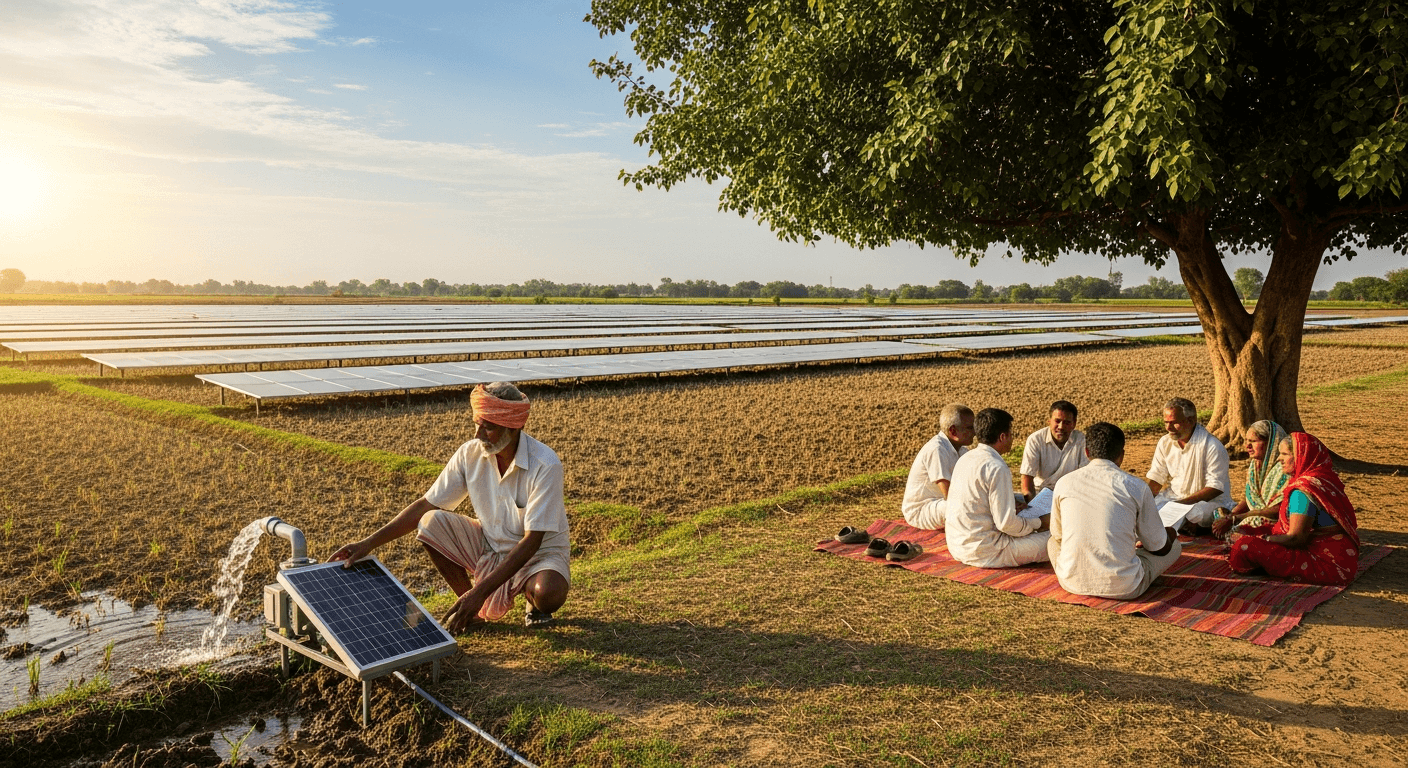
Indore has long been a city that experiments at scale — from sanitation drives to becoming a push for rooftop and ground-mounted solar. Around this ecosystem, Solarsure has been active across Madhya Pradesh building ground-mounted and agrivoltaic projects (examples include 2.4–3.6 MW farmer-owned plants nearby) that link directly to government purchase mechanisms and farmer benefit programs. Many of these projects are implemented under the central PM-KUSUM guidelines, which were designed to help farmers generate and sell clean power while securing irrigation energy.PM-KUSUM details
A technical overview — simple and practical
- What’s installed: ground-mounted PV modules (single-axis or fixed tilt), string/inverter arrays, transformers and grid interconnection equipment. Some sites use bifacial or TopCon modules for higher yield.
- How it works for farmers: a farm or cluster of farms hosts solar arrays (often on fallow land or as agrivoltaic installations). Generated power either: (a) feeds local irrigation pumps (direct daytime pumping), (b) is sold to the local distribution company (DISCOM) under a feed-in arrangement, or (c) a mix of both through net-metering/open-access arrangements.
- Key numbers (typical): a 2.4 MW plant can generate ~10,000–18,000 units/day depending on seasons; a smaller 100–500 kW installation could produce several hundred to a few thousand units daily. Under PM-KUSUM, capital support and long-term purchase guarantees reduce farmer risk.PM-KUSUM details
Benefits for farmers
Financial
- Predictable income: solar rental or sale-to-grid yields monthly cashflows that can stabilize household income during crop cycles.
- Example ranges: structured projects (cooperative or individual) report farmer earnings from tens of thousands to a few lakhs rupees annually depending on scale — a pattern I’ve discussed before in the cooperative solar models I’ve tracked.Solar Farms + Agri Farms
Irrigation reliability
- Daytime solar power lets farmers run pumps without relying on erratic grid supply or expensive diesel, enabling longer daytime pumping windows and higher cropping intensity.
Environmental
- Reduced diesel use and lower grid dependency cut carbon emissions and local air pollution.
Social
- New local jobs in operations and maintenance; cooperatives re-invest earnings into community needs.
Voices from the field (realistic, on-the-ground tone)
- “Since the plant started, I can water on schedule and plan higher-value crops,” said a farmer near Nimbola village, describing how a 3–4 MW cluster changed cropping choices.
- A local municipal official overseeing rural energy initiatives noted: “A village that can sell daytime power and reliably irrigate is less vulnerable to market shocks.”
Implementation timeline (typical roadmap)
- Year 0–0.5: feasibility, land agreements, subsidy approvals under PM-KUSUM.
- Year 0.5–1: procurement and civil/electrical installation.
- Year 1: commissioning, DISCOM interconnection and start of operations.
For the larger Indore-area program I’m following, phased roll-out across districts aims to reach tens of thousands of farmers over 2–4 years by combining individual farmer plants, cluster feeders and a small number of larger ground-mounted installations — a pragmatic hybrid approach.
Challenges and how they’re being addressed
- Land use tensions: solved by focusing on marginal/fallow land and agrivoltaics (dual-use).
- Grid integration: addressed through coordination with DISCOMs, feeder-level solarization and by leveraging PM-KUSUM’s allocation and milestones.
- Financing: mitigated via central/state subsidies, bank loans for residual capital, and cooperative or RESCO models that lower upfront farmer risk.
Future plans and scalability
The model is scalable: replicate cluster-based solar feeders and cooperative ownership models to reach 50,000 farmers across districts. Technology improvements (higher-efficiency modules, agrivoltaic designs) will shrink land needs while increasing yields. Policy continuity — predictable tariffs and streamlined approvals — will decide the speed.
How farmers can participate (actionable steps)
- Check eligibility under PM-KUSUM with your local agriculture office or the implementing agency.
- Join or form a local cooperative or association to reduce costs and access better finance terms.
- Request a site feasibility assessment (technical and financial) — many implementing agencies offer this free.
- Explore RESCO or CAPEX options: RESCO reduces upfront capital needs; CAPEX gives higher long-term returns.
- Start small: pilot a 50–250 kW module or join a cluster project before scaling.
Closing reflection
I’ve written before about how agrivoltaics and cooperative solar can change rural livelihoods, and the Solarsure activity around Indore feels like that idea moving into practical scale. If done right — fair land use, transparent contracts and reliable DISCOM partnerships — this program can transform irrigation, incomes and the climate footprint of farming for tens of thousands.
Regards,
Hemen Parekh
Any questions / doubts / clarifications regarding this blog? Just ask (by typing or talking) my Virtual Avatar on the website embedded below. Then "Share" that to your friend on WhatsApp.
Get correct answer to any question asked by Shri Amitabh Bachchan on Kaun Banega Crorepati, faster than any contestant
Hello Candidates :
- For UPSC – IAS – IPS – IFS etc., exams, you must prepare to answer, essay type questions which test your General Knowledge / Sensitivity of current events
- If you have read this blog carefully , you should be able to answer the following question:
- Need help ? No problem . Following are two AI AGENTS where we have PRE-LOADED this question in their respective Question Boxes . All that you have to do is just click SUBMIT
- www.HemenParekh.ai { a SLM , powered by my own Digital Content of more than 50,000 + documents, written by me over past 60 years of my professional career }
- www.IndiaAGI.ai { a consortium of 3 LLMs which debate and deliver a CONSENSUS answer – and each gives its own answer as well ! }
- It is up to you to decide which answer is more comprehensive / nuanced ( For sheer amazement, click both SUBMIT buttons quickly, one after another ) Then share any answer with yourself / your friends ( using WhatsApp / Email ). Nothing stops you from submitting ( just copy / paste from your resource ), all those questions from last year’s UPSC exam paper as well !
- May be there are other online resources which too provide you answers to UPSC “ General Knowledge “ questions but only I provide you in 26 languages !




No comments:
Post a Comment