
Background and context
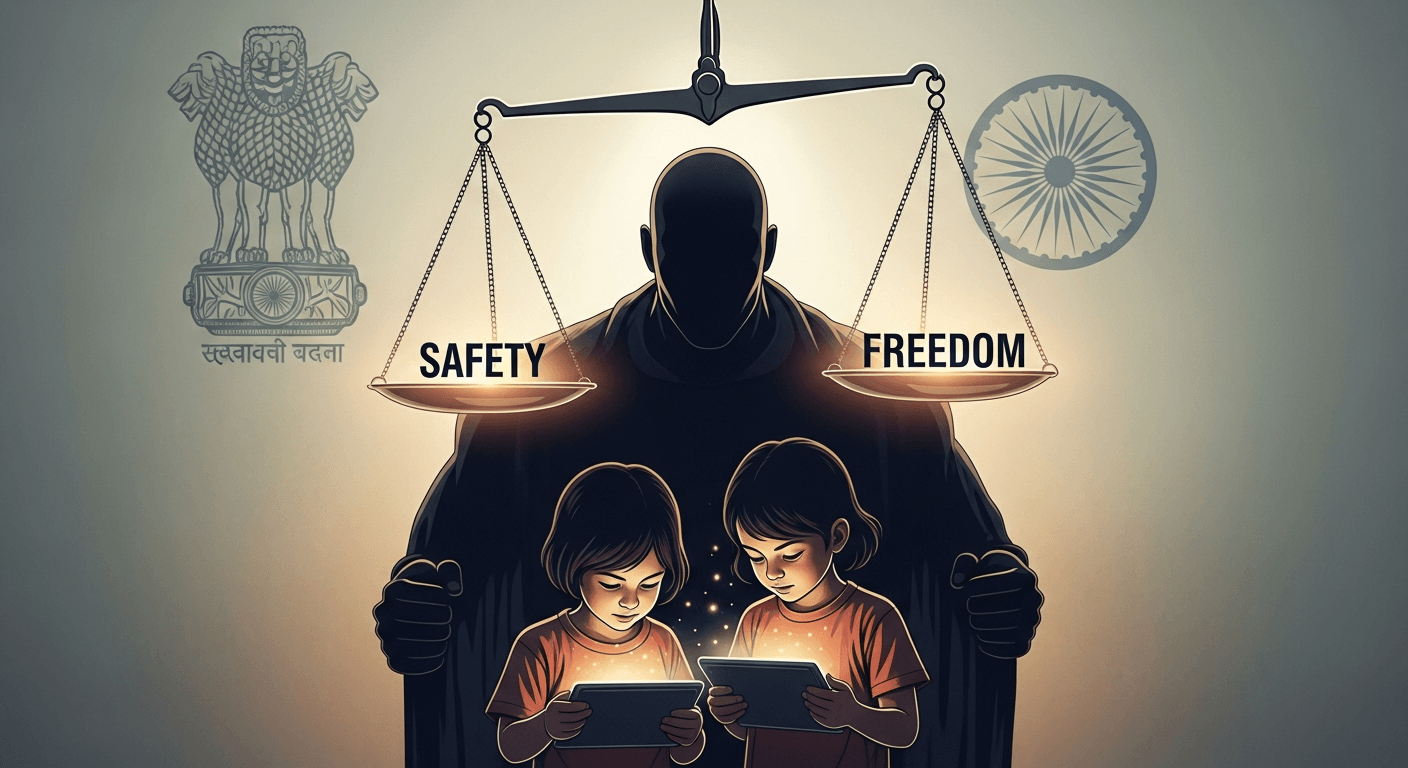
I have been watching the national debate about children, screens and social media with both concern and curiosity. Recently, Maharashtra announced that it will frame a policy to regulate social media use by minors, guided by an expert task force charged with studying psychological, educational and advertising-related impacts and recommending legal, technical and administrative measures Hindustan Times, NDTV. The state emphasizes a balanced approach rather than a blanket ban, and plans to consider measures such as age verification, screen-time guidance, and digital safety education.
Why Maharashtra is framing this policy
As a state with millions of children and an expanding digital footprint, Maharashtra faces a real policy choice: how to protect minors from demonstrable harms of unmoderated online exposure, while preserving access to educational and social opportunities. The task force model recognizes that this is not purely a technical problem but a social one—it spans education, health, child protection and platform governance. The aim is to turn scattered interventions into a coherent policy framework that is proportionate, evidence-based and implementable at scale.
Key proposed measures (what policymakers are considering)
- Age limits and graded access
- Introduce clear age thresholds for different platform features (e.g., accounts, live streaming, monetization) with graduated permissions rather than a single ban.
- Parental controls and consent models
- Strengthen parental verification and consent tools, while ensuring they are usable and privacy-preserving.
- Platform responsibilities
- Require platforms to implement age-appropriate defaults, transparent algorithms for content moderation, and advertising limits aimed at minors.
- Digital literacy and school curricula
- Integrate age-tailored digital safety, media literacy and well-being modules into schools for students, teachers and parents.
- Reporting and grievance mechanisms
- Establish fast-track reporting channels for harms against minors and a clear escalation path between platforms, schools, and child protection services.
Legal and ethical considerations
Any policy must negotiate hard trade-offs:
- Free speech and expression
- Restricting features or visibility for minors can be seen as limiting expression; safeguards and appeal mechanisms are essential.
- Privacy and data protection
- Age verification often relies on personal data; policies must minimize intrusive collection and comply with data protection norms.
- Enforceability and jurisdiction
- Platforms operate across borders and minors can use workarounds (shared accounts, VPNs). The policy must be realistic about what state-level measures can achieve and focus on incentivizing compliance.
Potential benefits and criticisms
Benefits:
- Reduced exposure to harmful content, predatory marketing and addictive design patterns.
- Better support for mental health and academic focus through screen-time guidance and education.
- Clearer responsibilities for platforms and institutions.
Criticisms and risks:
- Overreach: poorly designed rules can infantilize adolescents or curb legitimate civic and creative expression.
- Privacy trade-offs: heavy-handed age checks can create new data-collection risks.
- Implementation burden: small platforms and schools may struggle to adapt quickly.
Implementation challenges
- Technical feasibility: reliable, privacy-preserving age verification at scale is hard. Biometrics or intrusive checks are neither desirable nor necessary.
- Equity: rural and low-income families may lack access to parental controls or digital literacy programs, risking uneven protection.
- Coordination: effective policy needs alignment between state departments (education, health, IT) and collaboration with platforms, civil society and researchers.
Recommendations for a balanced policy
I believe a successful Maharashtra policy should be:
- Rights-based: Start from children’s rights to safety, education and expression. Any restriction must be the least intrusive necessary to achieve a legitimate aim.
- Child-centered: Differentiate measures by age and developmental stage; prioritize education and empowerment over prohibition.
- Technology-neutral: Avoid tying rules to a particular platform or technique; focus on outcomes (reduced harms, informed use) so the policy remains durable.
- Evidence-led and iterative: Pilot measures, collect data, and revise. Build evaluation and sunset clauses into the policy so adjustments are routine.
- Multi-stakeholder: Include educators, mental-health professionals, parents, youth representatives and platform engineers in design and oversight.
Conclusion and call to action
Maharashtra’s move to craft a policy is timely. My hope is that the state will resist reactionary fixes and instead construct a balanced framework that protects children while preserving their ability to learn and participate online. Policymakers should focus on measurable safeguards—age-appropriate defaults, robust grievance redressal, privacy-preserving verification and scaled digital literacy—while committing to regular review and public accountability. I encourage officials, educators and platform leaders to engage transparently with citizens and children themselves as the task force translates evidence into policy.
Regards,
Hemen Parekh
Any questions / doubts / clarifications regarding this blog? Just ask (by typing or talking) my Virtual Avatar on the website embedded below. Then "Share" that to your friend on WhatsApp.
Get correct answer to any question asked by Shri Amitabh Bachchan on Kaun Banega Crorepati, faster than any contestant
Hello Candidates :
- For UPSC – IAS – IPS – IFS etc., exams, you must prepare to answer, essay type questions which test your General Knowledge / Sensitivity of current events
- If you have read this blog carefully , you should be able to answer the following question:
- Need help ? No problem . Following are two AI AGENTS where we have PRE-LOADED this question in their respective Question Boxes . All that you have to do is just click SUBMIT
- www.HemenParekh.ai { a SLM , powered by my own Digital Content of more than 50,000 + documents, written by me over past 60 years of my professional career }
- www.IndiaAGI.ai { a consortium of 3 LLMs which debate and deliver a CONSENSUS answer – and each gives its own answer as well ! }
- It is up to you to decide which answer is more comprehensive / nuanced ( For sheer amazement, click both SUBMIT buttons quickly, one after another ) Then share any answer with yourself / your friends ( using WhatsApp / Email ). Nothing stops you from submitting ( just copy / paste from your resource ), all those questions from last year’s UPSC exam paper as well !
- May be there are other online resources which too provide you answers to UPSC “ General Knowledge “ questions but only I provide you in 26 languages !



No comments:
Post a Comment