
First thoughts
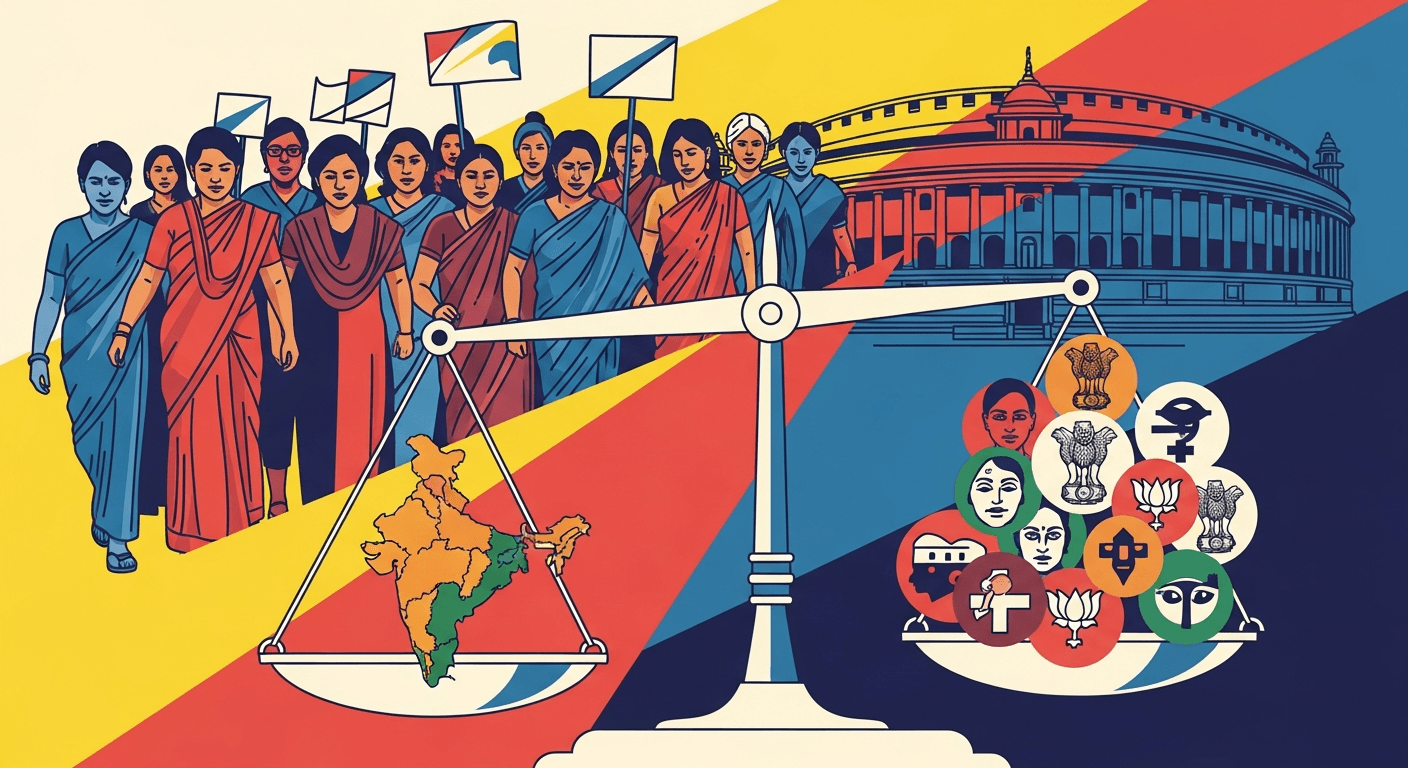
I read the recent report where the Prime Minister urged women to press political parties to let the quota-related bills pass without opposition and reminded voters that the long-pending promise of legislative reservation for women should not be postponed again (Times of India). The moment felt both hopeful and fragile — a reminder that good policy still needs social will and democratic muscle to survive the churn of party politics.
Why this matters to me
I've written before about the need for women's presence in decision-making and how delayed reforms become moral debts to half the population (Your Opportunity to Get Heard). The same thread runs through today: representation is not just symbolic. It changes agendas, priorities, and the quality of public conversation.
But the technicalities matter too. Linking a women's reservation to a larger exercise such as delimitation raises genuine questions about timing, trust and perceived winners or losers across states. Political opponents will always marshal procedural and constitutional arguments; supporters will frame it as overdue justice. Both sides can be right about parts of the story, while missing the central moral claim: half the nation is still under-represented.
The paradox of pressure
I find the Prime Minister's appeal to women to 'pressure' parties interesting for two reasons:
- It acknowledges that democracy is not a passive system. Citizens — especially those who stand to gain — must be active.
- It also risks instrumentalising women as a political bloc. Asking one demographic to be the engine of consensus can become a substitute for building genuine cross-party trust and transparent design.
So I keep asking: how do we convert righteous public pressure into durable, non-partisan institutions rather than episodic political advantage?
Practical steps I believe would help
Clear, independent explanations: A non-partisan commission (with civil society voices) should publish plain-language scenarios showing how seat increases and delimitation will affect each state and assembly. Opacity breeds suspicion.
Time-bound guarantees: If the law promises implementation by a specific election year, attach procedural checkpoints and publicly reported progress so it cannot be postponed by political convenience.
Local leadership pipelines: Reserve seats are only meaningful if women have the resources, training, and networks to contest and govern effectively. Invest in candidate training, local governance fellowships, and public financing mechanisms targeted at women aspirants.
Civil society arbitration: Create an independent ombuds mechanism for disputes arising from delimitation-linked changes so objections focus on facts, not theatre.
A caution and an invitation
Caution: reforms that are rolled out as one-off political spectacles are fragile. If parties believe they gain or lose materially from the way rules are written, the reform will be litigated, stalled, or reversed.
Invitation: If we truly want parity, women’s groups, progressive party leaders, constitutional experts, journalists and citizens must insist on clarity, fairness and checks — and do so loudly enough that obstruction becomes politically costly for the obstructors.
Closing
I am encouraged that the conversation is alive again. But hope without institutions is brittle. Let us push for implementation designs that are transparent, technically sound and built to last — and at the same time, empower real pipelines of women leaders so that reservation is the start of deeper change, not its end.
Regards,
Hemen Parekh
Any questions / doubts / clarifications regarding this blog? Just ask (by typing or talking) my Virtual Avatar on the website embedded below. Then "Share" that to your friend on WhatsApp.
Get correct answer to any question asked by Shri Amitabh Bachchan on Kaun Banega Crorepati, faster than any contestant
Hello Candidates :
- For UPSC – IAS – IPS – IFS etc., exams, you must prepare to answer, essay type questions which test your General Knowledge / Sensitivity of current events
- If you have read this blog carefully , you should be able to answer the following question:
- Need help ? No problem . Following are two AI AGENTS where we have PRE-LOADED this question in their respective Question Boxes . All that you have to do is just click SUBMIT
- www.HemenParekh.ai { a SLM , powered by my own Digital Content of more than 50,000 + documents, written by me over past 60 years of my professional career }
- www.IndiaAGI.ai { a consortium of 3 LLMs which debate and deliver a CONSENSUS answer – and each gives its own answer as well ! }
- It is up to you to decide which answer is more comprehensive / nuanced ( For sheer amazement, click both SUBMIT buttons quickly, one after another ) Then share any answer with yourself / your friends ( using WhatsApp / Email ). Nothing stops you from submitting ( just copy / paste from your resource ), all those questions from last year’s UPSC exam paper as well !
- May be there are other online resources which too provide you answers to UPSC “ General Knowledge “ questions but only I provide you in 26 languages !





No comments:
Post a Comment