
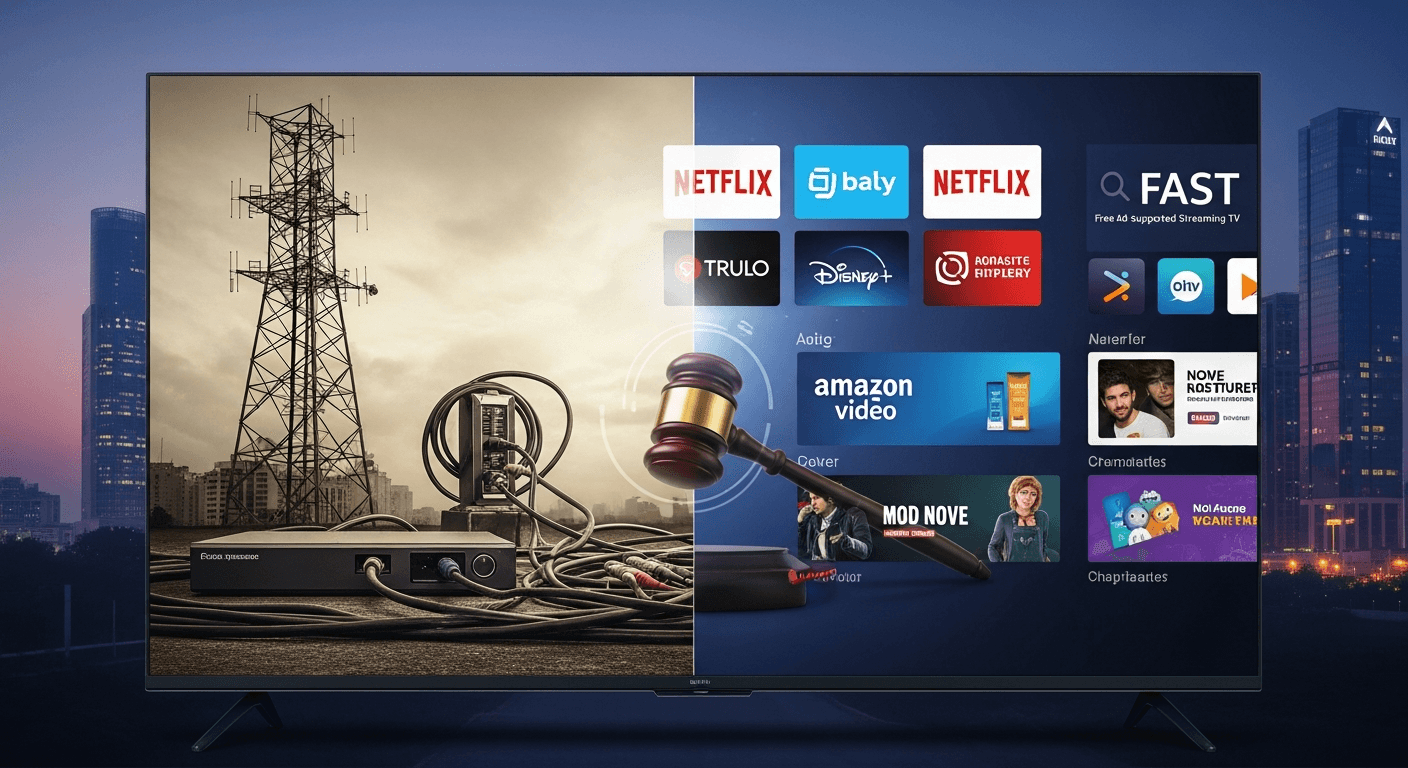
TRAI and FAST Channels
I watched TRAI’s Consultation Paper on Application-based Linear Television Distribution (ALTD) — which explicitly includes Free Ad-Supported Streaming Television (FAST) services — with a mix of relief and curiosity. Relief, because a rapidly expanding corner of our media ecosystem that has been operating in a regulatory grey zone is finally on the regulator’s radar. Curiosity, because the choices TRAI makes now will shape whether innovation and consumer protection move together — or at odds — as India’s connected-TV market accelerates.TRAI Information Note (PR No.48/2026)
What TRAI has put on the table
In short: TRAI asks whether application-based platforms that deliver linear/scheduled channels over the internet (pre-installed apps on smart TVs, downloadable smart-TV/mobile apps, web-based linear channels) should be treated as a distinct category — ALTD — and what regulatory obligations should attach to them. The request follows a reference from the Ministry of Information & Broadcasting and explicitly focuses on parity, content accountability and consumer protection.Press Information Bureau summary
Key questions TRAI seeks answers to (my reading):
- How to define ALTD/FAST services clearly so they aren’t left as a loophole between broadcasting and internet services?
- Who should be the accountable entity in a layered value chain (app/platform owner, device OEM, OS provider, content aggregator or broadcaster)?
- Should application providers be required to obtain an authorisation/registration similar to traditional distributors?
- What obligations should apply on content accountability, grievance redressal, consumer protection and advertising transparency?
- How to integrate ALTD viewership into TV audience measurement and ensure a level competitive playing field for broadcasters and advertisers?
These questions are more than academic. They cut to how royalties, retransmission, classification of channels (pay vs free-to-air), content compliance and advertising disclosures will be enforced across traditional and internet-delivered linear experiences.TRAI consultation press release
Why this matters — practical consequences
- For broadcasters: FAST creates new distribution reach but also potential revenue leakage when pay channels are repurposed as free or when advertising monetisation shifts outside existing contracts.
- For device makers and OS owners: pre-installed FAST apps can become primary gateways to content. If they’re held accountable, device economics and partner agreements will change.
- For platforms (aggregators/app owners): an authorisation regime or local compliance requirements could increase operating costs and affect cross-border product models.
- For advertisers & measurement firms: unless ALTD viewership data is integrated into ratings, advertisers will undervalue or mis-price this inventory — or make decisions on incomplete data.
- For consumers: the promise of free, ad-supported linear channels is great — but only if content accountability, user privacy and grievance mechanisms are robust.
My view — balance, not boxes
I’ve long argued that regulation should unlock consumer choice while increasing transparency in the TV ecosystem. Years ago I urged simpler, user-first channel selection and better data-driven regulation as the path to democratize TV access (MEDIA IS THE MESSAGE — my earlier reflections). TRAI’s paper is an opportunity to accomplish the same goal for the streaming era.
Principles I’d advocate policymakers and industry adopt:
- Clarity first: define ALTD and FAST in statute/regulation so obligations are not ambiguous.
- Single point accountability: identify a primary responsible entity for each channel/service listing (with contractual backstops across the value chain).
- Proportional authorisation: require registration/authorisation that is lightweight for startups but creates minimum compliance for content, consumer redressal and local representation for foreign operators.
- Measurement parity: build a framework to include ALTD viewership into audience measurement within a transparent, auditable architecture.
- Consumer protections: mandatory grievance redressal timelines, ad labelling (what’s native, what’s paid placement), and clear data/consent rules.
- Avoid over-prescription: don’t freeze innovation. Ruleframes should be technology-neutral and outcomes-focused.
What stakeholders should act on now
- Broadcasters and platform owners: respond to TRAI’s consultation with concrete proposals on accountability, contractual flows and how channel-level compliance can be ensured.
- Device OEMs and OS providers: prepare to describe their role in content placement, pre-install practices, and mechanisms for consumer opt-out.
- Advertisers and measurement firms: propose auditable data exchange formats or a neutral aggregator to incorporate ALTD viewership into ratings.
- Consumers and civil-society groups: insist on transparent ad-labelling, privacy safeguards and an accessible grievance mechanism.
TRAI has invited written comments by 4 May 2026 and counter-comments by 18 May 2026; submissions are to advbcs-2@trai.gov.in and jtadvisor-bcs@trai.gov.in. The full paper is available on TRAI’s website and is worth reading end-to-end before drafting responses.TRAI consultation PDF
A moment to get regulation right
FAST services are not a marginal novelty — they are the logical evolution of linear TV in a connected world. If we treat them like a sibling of traditional broadcasting with clear accountability and measured obligations, we will protect consumers without stifling invention. If we treat them as a lawless new frontier, we will replicate the very market failures that regulation has been trying to fix for years.
I welcome TRAI’s consultation. It is a chance to design rules that are future-ready: simple to comply with, fair to incumbents, friendly to new entrants, and protective of viewers.
Regards,
Hemen Parekh
Any questions / doubts / clarifications regarding this blog? Just ask (by typing or talking) my Virtual Avatar on the website embedded below. Then "Share" that to your friend on WhatsApp.
Get correct answer to any question asked by Shri Amitabh Bachchan on Kaun Banega Crorepati, faster than any contestant
Hello Candidates :
- For UPSC – IAS – IPS – IFS etc., exams, you must prepare to answer, essay type questions which test your General Knowledge / Sensitivity of current events
- If you have read this blog carefully , you should be able to answer the following question:
- Need help ? No problem . Following are two AI AGENTS where we have PRE-LOADED this question in their respective Question Boxes . All that you have to do is just click SUBMIT
- www.HemenParekh.ai { a SLM , powered by my own Digital Content of more than 50,000 + documents, written by me over past 60 years of my professional career }
- www.IndiaAGI.ai { a consortium of 3 LLMs which debate and deliver a CONSENSUS answer – and each gives its own answer as well ! }
- It is up to you to decide which answer is more comprehensive / nuanced ( For sheer amazement, click both SUBMIT buttons quickly, one after another ) Then share any answer with yourself / your friends ( using WhatsApp / Email ). Nothing stops you from submitting ( just copy / paste from your resource ), all those questions from last year’s UPSC exam paper as well !
- May be there are other online resources which too provide you answers to UPSC “ General Knowledge “ questions but only I provide you in 26 languages !


No comments:
Post a Comment