
Introduction
I write this as someone who has watched Mumbai’s street life for years: hawkers are part of the city’s DNA, and recent court directions recognising some 99,000 vendors have forced us to confront a simple fact — regulation is inevitable, and the alternative is endless conflict. The question is not whether to regulate, but how to do so in a way that protects livelihoods, keeps pedestrians safe, and preserves the functioning of a dense, dynamic metropolis.
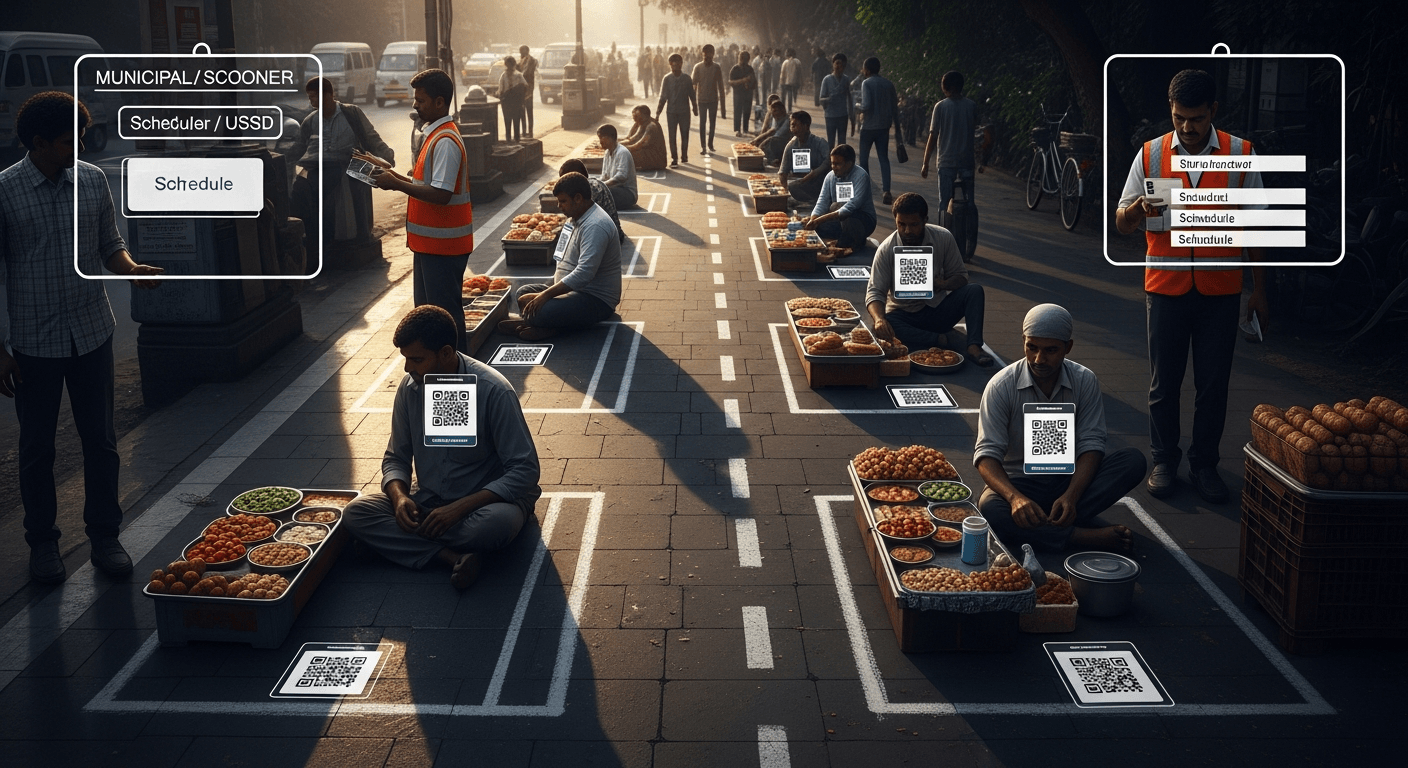
In this post I explain a practical approach I believe cities — starting with Mumbai — should adopt: a shift-based hawking system. The idea is straightforward: rather than granting permanent exclusive claims to scarce pavement space, the city organises time-bound, rotating vendor shifts across mapped vending zones, supported by lightweight technology and participatory governance. The aim is to manage density, reduce friction, and protect vendors’ livelihoods.
Mumbai’s street-vending context — the reality on the ground
Mumbai has a long and messy history with street vendors. Large surveys and judicial interventions over the last decade—culminating in recent rulings that validated and asked authorities to permit over 99,000 recognised hawkers—have made implementation urgent and politically charged Hindustan Times and ThePrint.
Key facts planners must keep in mind:
- The Street Vendors Act (2014) gives statutory protection and mandates Town Vending Committees (TVCs) to survey, demarcate zones and issue certificates.
- Historical surveys have produced inconsistent counts: hundreds of thousands operate across legal and informal channels while the civic capacity to allocate permanent pitches is far smaller.
- Local residents, traders’ groups and political actors often resist fixed vending zones in their neighbourhoods, making stationary allocation politically fraught.
These realities make a purely place-based licence system difficult to scale without sustained conflict.
What is shift-based hawking? A practical overview
Shift-based hawking organises vending rights by time as well as space. Instead of giving one vendor perpetual claim to a spot, the city divides each vending zone into spatial ‘slots’ and temporal ‘shifts’ (e.g., morning, lunch, evening, night markets). Vendors are allocated shifts either permanently (same shift each day) or on a rotating schedule.
Core components:
- Spatial mapping: define vending zones and micro-slots using pedestrian-flow and accessibility criteria.
- Temporal mapping: create standard shifts (for example: 06:00–10:00; 10:00–14:00; 14:00–18:00; 18:00–22:00).
- Allocation mechanism: a mix of priority categories (veteran vendors, disability, women-headed businesses), lotteries for new entrants, and opt-in rotation.
- Lightweight tech: an app/USSD scheduling system, QR-coded vendor IDs and geofencing to monitor slot occupation and support dispute resolution.
How shifts can be organised and allocated
Organising shifts
- Define shift lengths based on local footfall and product type (food typically clusters around meal shifts; garments around evening shopping hours).
- Assign micro-slots of fixed size on sidewalks or road-side buffers, ensuring minimum pedestrian clearance.
- Allow shared-use slots for mobile vendors (trolleys, baskets) and fixed stalls for stationary vendors.
Allocation methods
- Priority lists: vendors with verified prior work (per TVC records) and vulnerable groups get priority in their preferred shifts.
- Lotteries: for the remaining slots, use transparent lotteries held by the TVC and livestreamed for credibility.
- Rotation: offer a rotational pool where vendors can swap or bid for shifts using a modest, capped platform-credit system so that those who need particular hours can access them.
- Appeals & grievance redressal: TVC-run, time-bound process backed by independent oversight.
Technology support (lightweight and low-cost)
- Simple vendor registry with QR-coded IDs and shift allocation visible to vendor and enforcement teams.
- USSD/IVR booking for vendors without smartphones.
- Digital maps (public) showing active shifts per zone to help residents and enforcement understand where vendors are authorised.
- Cashless payments encouraged but not mandatory; settlement data can feed fair-play metrics.
Benefits
For vendors
- Legal recognition with predictable access to customers.
- Reduced harassment if allocation and enforcement are transparent.
- Options to access different shifts for diversified income, and platforms for rotating into better hours.
For city management
- Dynamic use of scarce curb/footpath space that matches pedestrian flows.
- Predictable enforcement: officers check shift compliance rather than making ad-hoc removals.
- Easier planning for sanitation, waste pickup and pedestrian safety.
For residents and businesses
- Less permanent obstruction of sidewalks; vendors are present in predictable time windows.
- Better hygiene and order, because service systems (toilets, bins) can be scheduled per shift cycles.
- Opportunity for curated evening/night-time markets that enhance local commerce.
Challenges and common criticisms
- Enforcement complexity: policing shift boundaries requires coordination between BMC, local police and TVCs.
- Equity and fairness: who gets the prime evening/meal shifts? Without safeguards, the system can reproduce existing inequalities.
- Informality & helpers: many stalls have helpers who lack documentation and are vulnerable to verification drives.
- Political pushback: corporators and resident associations may resist zones near their constituencies.
These are real problems — mitigations are part of the design, not reasons to avoid reform.
A short vendor anecdote
A few months ago I met a vendor outside my building who sells tea and snacks early in the morning. She described how mornings are reliable for her, but evenings are chaotic and dependent on local politics. Under a shift system she would keep her morning slot, gain a predictable clientele and avoid paying protection money — small changes that could double her monthly net income.
Case studies & hypothetical examples
Hypothetical: Bandra Local Market
Problem: high evening footfall but no authorised stalls; residents complain of blocked pavements.
Shift-based solution: four evening micro-slots along the market corridor, allocated via lottery (60%) and reserved for women and long-term vendors (40%). Geotagged IDs and a TVC monitor reduce conflict.
Implementation-lite pilot: a single ward operates shift-bookings via USSD and issues QR badges; the ward reduces roadside clutter and records a 30% fall in pedestrian obstruction complaints in three months.
Step-by-step implementation roadmap for city governments
- Policy design & legal clarity
- Issue an administrative order under the Street Vendors Act giving TVCs authority to pilot shift allocations.
- Data & mapping (0–3 months)
- Rapid pedestrian counts, vendor surveys, and identify candidate pilot wards.
- Stakeholder formation (0–2 months, parallel)
- Constitute ward-level TVC subcommittees with vendors, residents, police and NGOs.
- Pilot design (3 months)
- Define zones, shifts, slot sizes, and allocation rules.
- Technology setup (3 months)
- Simple registry, QR IDs and USSD booking.
- Launch pilot (3–6 months)
- Intensive outreach, real-time monitoring and conflict mediation.
- Review & scale (6–12 months)
- Collect KPIs, stakeholder feedback and expand ward-by-ward.
Stakeholder engagement strategies
- Proactive consultation: convene vendor unions, resident associations and market associations before mapping.
- Transparent allocation: open lotteries, public lists and clear eligibility criteria to build trust.
- Capacity building: train TVC members and field officers on mediation and non-confrontational enforcement.
- Incentives: remove petty fines when vendors comply and offer microgrants for those switching from illegal to shift-authorised vending.
Metrics for success
- Pedestrian clearance: percentage of sidewalks meeting minimum clearance standards during non-vending periods.
- Vendor earnings stability: change in median daily income for shift-participating vendors.
- Compliance rate: percent of vendors occupying authorised shifts with valid QR IDs.
- Grievances resolved: number and time-to-resolution for TVC disputes.
- Resident satisfaction: periodic surveys before and after implementation.
Policy recommendations
- Mandate pilot authority: the state should empower municipal TVCs to run time-bound pilots with fast-track approval.
- Protect vulnerable vendors: reserve a share of slots for women, elderly and disability-affected vendors and waive small fees for them.
- No-eviction windows: avoid eviction drives during pilot phases; focus on registration and mediation.
- Legal recognition of shifts: issue vending certificates that explicitly state assigned shifts; use these to limit harassment.
- Data-driven scaling: expand only after piloted KPIs show improvements in pedestrian mobility and vendor welfare.
Conclusion
Shift-based hawking is not a panacea, but it is a pragmatic middle path between chaotic informality and rigid, exclusionary formalisation. It acknowledges that public space is scarce, yet recognises that livelihoods must be protected. For Mumbai’s 99,000 recognised vendors—and for the many more who remain in the shadows—time-based allocation, transparent governance and light-touch technology offer a pathway to coexistence.
I have argued before for alternatives such as pop-up markets and mobile vending as practical complements to formal pitches; a shift-based system builds on those ideas while adding predictability and administrative tractability (my earlier reflections on pop-up markets and hawkers’ rights).
If you are an urban planner, a TVC member, an NGO worker or a policy student, start small, measure honestly, and scale only when both people and pavements benefit.
Regards,
Hemen Parekh (hcp@recruitguru.com)
Any questions / doubts / clarifications regarding this blog? Just ask (by typing or talking) my Virtual Avatar on the website embedded below. Then "Share" that to your friend on WhatsApp.
Get correct answer to any question asked by Shri Amitabh Bachchan on Kaun Banega Crorepati, faster than any contestant
Hello Candidates :
- For UPSC – IAS – IPS – IFS etc., exams, you must prepare to answer, essay type questions which test your General Knowledge / Sensitivity of current events
- If you have read this blog carefully , you should be able to answer the following question:
- Need help ? No problem . Following are two AI AGENTS where we have PRE-LOADED this question in their respective Question Boxes . All that you have to do is just click SUBMIT
- www.HemenParekh.ai { a SLM , powered by my own Digital Content of more than 50,000 + documents, written by me over past 60 years of my professional career }
- www.IndiaAGI.ai { a consortium of 3 LLMs which debate and deliver a CONSENSUS answer – and each gives its own answer as well ! }
- It is up to you to decide which answer is more comprehensive / nuanced ( For sheer amazement, click both SUBMIT buttons quickly, one after another ) Then share any answer with yourself / your friends ( using WhatsApp / Email ). Nothing stops you from submitting ( just copy / paste from your resource ), all those questions from last year’s UPSC exam paper as well !
- May be there are other online resources which too provide you answers to UPSC “ General Knowledge “ questions but only I provide you in 26 languages !




No comments:
Post a Comment