
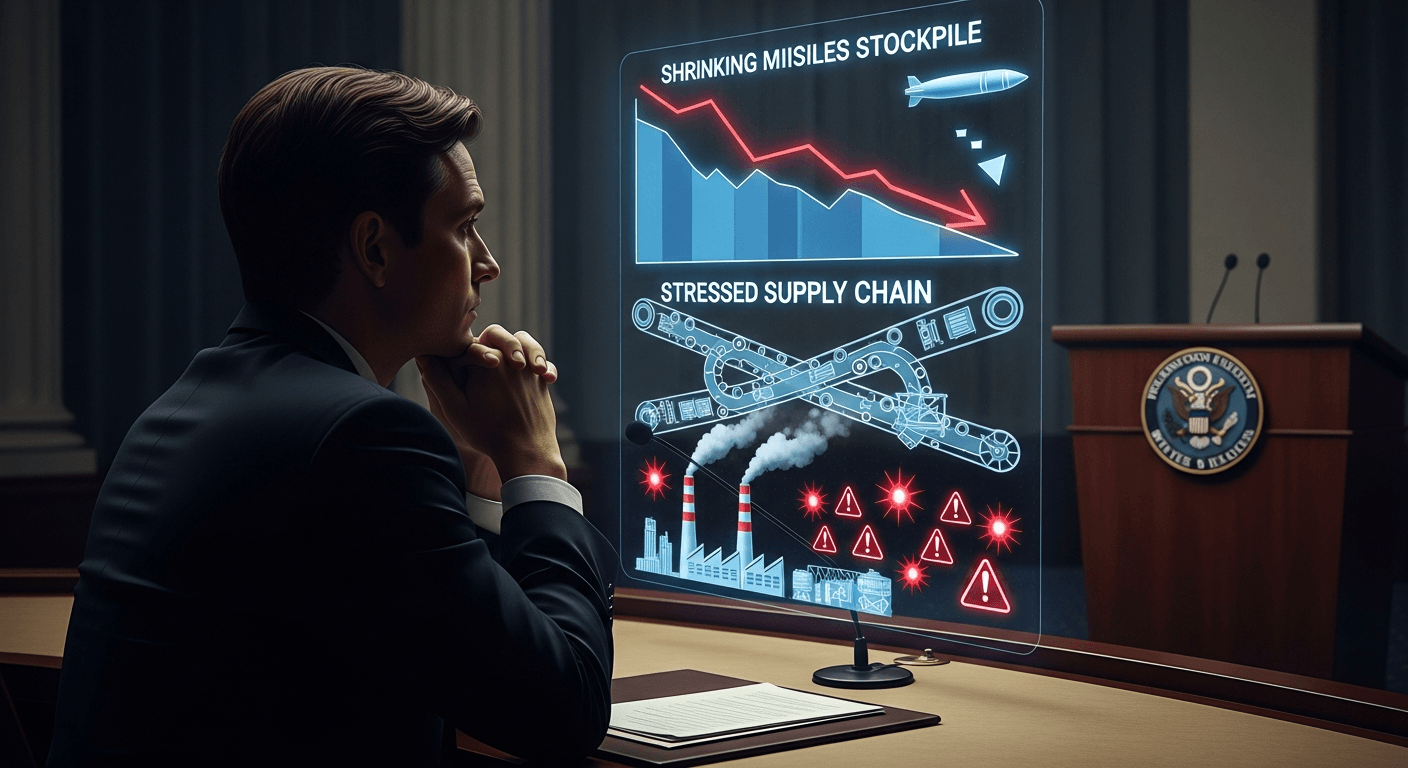
The doubt inside the room
I caught myself replaying a recent reporting thread that describes a senior legislator — a senator, not a vice president — quietly pushing back in closed-door national-security meetings about whether the military is painting the full picture of an ongoing conflict.
I write about this because the substance matters more than the personalities. The questions being raised in those rooms touch on six practical, structural risks that deserve attention whenever a democracy sends its best weapons into harm’s way.
1) Munitions depletion: a simple arithmetic with complex consequences
When you send expensive interceptors, long-range strike missiles and precision-guided munitions into a theater at scale, the arithmetic is straightforward: you reduce inventories. What becomes complicated is the cascade that follows:
- Readiness trade-offs across theaters — the same reserves used in one conflict are the backstop for contingencies in Europe, East Asia and Korea.
- Production lag — factories, suppliers and rare components don’t spin up overnight.
- Cost asymmetry — adversaries can often use cheap, mass-produced tools to force expensive defensive expenditures.
The reporting from outlets like Mediaite and Political Wire has flagged that internal estimates and public briefings sometimes tell different stories about the pace and scale of that depletion (Mediaite, Political Wire). That mismatch is not academic — it shapes political decisions and procurement priorities.
2) Information incentives: why briefings can skew toward optimism
Every organization has incentives. In wartime, the incentive to present coherent, decisive narratives is intense:
- Leaders want to maintain public support and reassure allies.
- Military briefers naturally emphasize what has been achieved, sometimes compressing uncertainty into confident assertions.
- Political actors may prefer a simple, optimistic story to keep strategy aligned and audiences calm.
Those incentives can produce a public picture that understates uncertainty or underplays replenishment timelines. That’s why a questioning voice from the legislature or oversight community is healthy — it forces better documentation and honest timelines.
3) Supply-chain realism: the gritty ledger behind big headlines
Countless invisible dependencies sit behind a single missile or interceptor: rare-earth components, specialized guidance chips, hardened casings, test ranges, and the skilled workforce to assemble them. Scaling production is not just about turning on a line — it’s a multi-year, multinational project in many cases.
Practical questions I watch for:
- Which subsystems are single-source? Where are the chokepoints?
- What are realistic lead times for the most stressed items?
- Can substitutes be fielded without unacceptable performance loss?
Without sober answers to these, optimistic stockpile claims are more narrative than logistics.
4) Trust inside national-security teams: why private dissent matters
When a senator raises doubts in private — rather than publicly attacking colleagues — that signals an attempt to preserve unity while getting better information. That dynamic matters:
- Private scrutiny can prompt deeper reviews without sowing panic.
- But if dissent is routinely sidelined, decision-makers lose a corrective mechanism.
Institutional trust depends on processes that reward candid, evidence-based pushback and protect those who raise it.
5) A pragmatic checklist for policymakers and oversight
If I were advising staff in the room, my checklist for the next briefing would be short and forensic:
- Inventory transparency: publish redacted line items showing pre-conflict, expended, and remaining quantities for key munitions.
- Production mapping: publicize lead times and bottlenecks for critical subsystems (not every classified detail, but honest schedules).
- Contingency thresholds: define clear metric triggers for production ramp, allocation prioritization, or political consultation.
- Cross-theater risk assessment: quantify how current drawdown affects response options in other hotspots.
- Independent audit: empower an interagency or congressional inspector to verify replenishment claims.
- Communication protocol: commit to communicating uncertainty ranges, not single-point proclamations.
This list is about restoring decision-quality and public confidence, not about scoring political points.
6) The neutral, structural observation I keep returning to
Structurally, this episode reiterates a pattern I’ve followed for years: in times of crisis, the systems that were designed for steady-state procurement and measured diplomacy are stress-tested in ways they weren’t optimized for. That mismatch — between the tempo of conflict and the tempo of supply chains, politics and public communication — is the real governance problem.
Fixing it requires cross-disciplinary work: logisticians, honest auditors, communicators who can tell messy truths, and political leaders willing to prioritize strategic readiness over short-term narrative victories.
Sources and further reading
- Reporting that prompted these reflections: Mediaite — JD Vance ‘Repeatedly Questioned’ If Pentagon Gave Trump Accurate War Info.
- Additional coverage and synthesis: Political Wire — Vance Doubts the Pentagon's Depiction of the Iran War.
Regards,
Hemen Parekh
Any questions / doubts / clarifications regarding this blog? Just ask (by typing or talking) my Virtual Avatar on the website embedded below. Then "Share" that to your friend on WhatsApp.
Get correct answer to any question asked by Shri Amitabh Bachchan on Kaun Banega Crorepati, faster than any contestant
Hello Candidates :
- For UPSC – IAS – IPS – IFS etc., exams, you must prepare to answer, essay type questions which test your General Knowledge / Sensitivity of current events
- If you have read this blog carefully , you should be able to answer the following question:
- Need help ? No problem . Following are two AI AGENTS where we have PRE-LOADED this question in their respective Question Boxes . All that you have to do is just click SUBMIT
- www.HemenParekh.ai { a SLM , powered by my own Digital Content of more than 50,000 + documents, written by me over past 60 years of my professional career }
- www.IndiaAGI.ai { a consortium of 3 LLMs which debate and deliver a CONSENSUS answer – and each gives its own answer as well ! }
- It is up to you to decide which answer is more comprehensive / nuanced ( For sheer amazement, click both SUBMIT buttons quickly, one after another ) Then share any answer with yourself / your friends ( using WhatsApp / Email ). Nothing stops you from submitting ( just copy / paste from your resource ), all those questions from last year’s UPSC exam paper as well !
- May be there are other online resources which too provide you answers to UPSC “ General Knowledge “ questions but only I provide you in 26 languages !




No comments:
Post a Comment