
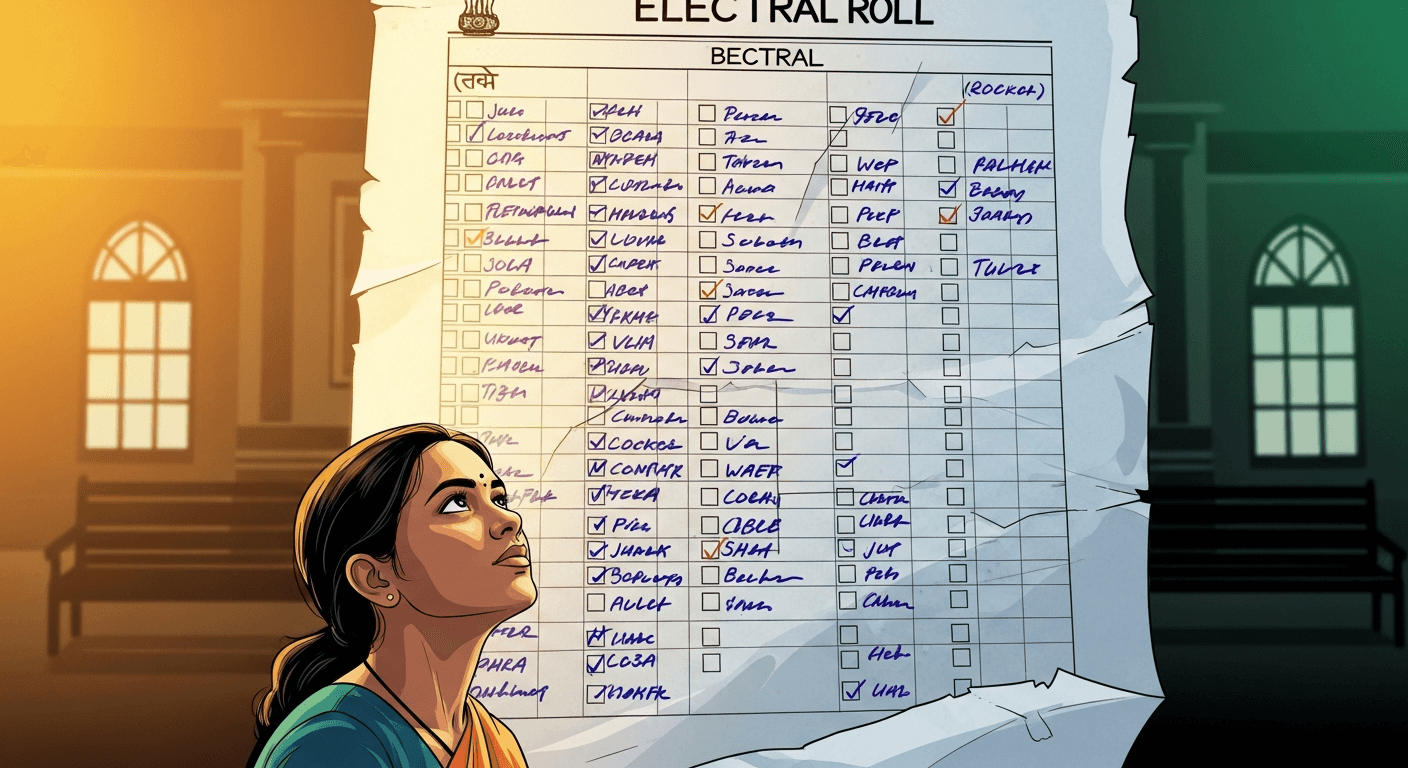
Why this ruling matters to me
When I read that the Supreme Court has observed that a person born in India has the right to remain on the electoral roll and to vote, my first response was simple: relief. Voting is more than a checkbox in a system; for me it is an intimate expression of belonging — a civic ritual that ties me to the future I help choose.
The headlines capture the legal development in blunt terms, but what I keep returning to is the human story behind every entry and deletion on a roll. A name on that list represents a life with memory, stakes, hopes and responsibilities. The court’s emphasis that this right is not just constitutional but sentimental resonated with me deeply (Times of India coverage).
Process, fairness and the weight of numbers
The immediate context for the Court’s remark was a large-scale revision exercise that led to many deletions and a pile of pending appeals. When administration meets elections under pressure, process mistakes can ripple into denied voices — and into distorted outcomes in closely fought constituencies. That is why due process and timely adjudication matter as much as the abstract affirmation of rights.
This is not an abstract problem. Large deletions and unresolved appeals can tip tight contests, and the court pointed out that if deletion rates are large relative to victory margins, those outcomes deserve a second look. The law and the institutions that run elections must account for both statistical realities and the moral duty to include, not exclude.
Technology, verification and the human margin of error
We live in an age where voter rolls are maintained digitally, biometric and demographic information can be cross-checked, and automated flags can identify “logical discrepancies.” Those tools can improve efficiency and reduce fraud — when applied with care.
But automation without procedural safeguards becomes an instrument of exclusion. I have warned before about reforms and election administration that emphasize technical fixes without strengthening transparent grievance mechanisms and accessible adjudication (my earlier reflections on electoral reform and EVMs). Recent events underline that point: legitimacy depends not just on the accuracy of data but on the fairness of the processes that create, review, and correct that data.
Inclusion as legitimacy
Democracy’s claim to legitimacy rests on two pillars: rules that are fair and processes that are seen to be fair. Removing names from a voter list — especially when appeals are pending — chips away at that perception. The Court’s insistence that tribunals be allowed to adjudicate and that deletion exercises shouldn’t be rushed by election timetables is a reminder that institutional patience is sometimes the best safeguard of public trust.
To me, inclusion is not merely sentimental rhetoric. It is a pragmatic shield against disenfranchisement and the erosion of electoral trust. If the system’s default is to include and then verify, rather than to purge and then hope for redress, we are more likely to preserve both justice and stability.
What I hope we do next
- Treat the electoral roll as an evolving ledger of citizenship that demands transparent, timely review rather than abrupt purges.
- Strengthen appellate and tribunal mechanisms so pending appeals are heard out of turn where necessary — especially in constituencies with narrow margins.
- Make technological verification tools subject to human oversight, with clear, accessible channels for a citizen to check and correct their entry in real time.
A personal ask
I believe we should design systems that treat people as participants, not as statistical anomalies. If you care about democracy in practical terms, pressure for administrative transparency is not a remote, technocratic demand: it is a call to protect the simplest civic act — showing up and casting a ballot.
Where I’ve said this before
My earlier posts have been focused on the fragility and the promise of our electoral system. If you want to follow a few of my earlier thoughts on electoral processes and safeguards, I’ve written about concerns with administrative change and the need for systemic reforms in posts like these: ECI: How about zero booth? and Heads I Win : Tails You Lose.
Regards,
Hemen Parekh
Any questions / doubts / clarifications regarding this blog? Just ask (by typing or talking) my Virtual Avatar on the website embedded below. Then "Share" that to your friend on WhatsApp.
Get correct answer to any question asked by Shri Amitabh Bachchan on Kaun Banega Crorepati, faster than any contestant
Hello Candidates :
- For UPSC – IAS – IPS – IFS etc., exams, you must prepare to answer, essay type questions which test your General Knowledge / Sensitivity of current events
- If you have read this blog carefully , you should be able to answer the following question:
- Need help ? No problem . Following are two AI AGENTS where we have PRE-LOADED this question in their respective Question Boxes . All that you have to do is just click SUBMIT
- www.HemenParekh.ai { a SLM , powered by my own Digital Content of more than 50,000 + documents, written by me over past 60 years of my professional career }
- www.IndiaAGI.ai { a consortium of 3 LLMs which debate and deliver a CONSENSUS answer – and each gives its own answer as well ! }
- It is up to you to decide which answer is more comprehensive / nuanced ( For sheer amazement, click both SUBMIT buttons quickly, one after another ) Then share any answer with yourself / your friends ( using WhatsApp / Email ). Nothing stops you from submitting ( just copy / paste from your resource ), all those questions from last year’s UPSC exam paper as well !
- May be there are other online resources which too provide you answers to UPSC “ General Knowledge “ questions but only I provide you in 26 languages !



No comments:
Post a Comment