
Introduction
I write this as both a technologist and a policy observer: India’s recent cloud selection guidance marks a decisive pivot from a generic “cloud-first” posture to a sovereignty-conscious, classification-led approach. The headlines are blunt — large citizen-facing systems such as Aadhaar, UPI, PAN and other critical registries are being steered away from open commercial public clouds toward government or MeitY‑notified sovereign cloud options, and a three‑tier data classification (Top Secret / A / B) is being used to decide hosting options [1]. In this post I explain the concept of “Desi data,” unpack what the new cloud rules and “Top Secret & A‑B sovereign cover” mean in practice, and offer a pragmatic checklist for agencies and companies navigating the change.
What I mean by “Desi data” and why it matters
By “Desi data” I mean datasets and systems whose sensitivity, scale, or civic purpose ties them fundamentally to India’s governance, economy and social fabric — identity, payments rails, tax, land records, criminal justice and other public‑interest registries. The distinction is not simply geographic residency. It is about legal and operational control, access governance, risk of extraterritorial demands, and the national consequences of compromise.
Why this matters now
- National security and stability: compromise of identity or payments platforms can cause systemic harm.
- Regulatory alignment: DPDP, sectoral rules (e.g., payments, securities) and MeitY procurement expectations are tightening [2].
- Trust and political legitimacy: citizens and public agencies need assurance that critical systems cannot be unduly accessed offshore.
I have argued for a considered, not knee‑jerk, approach to localization before — thinking about how to operationalize “why” into “how” is the key challenge I raised earlier in my posts on data localization and the digital dividend [3].
Summary: the new cloud rules and what “Top Secret & A‑B sovereign cover” mean
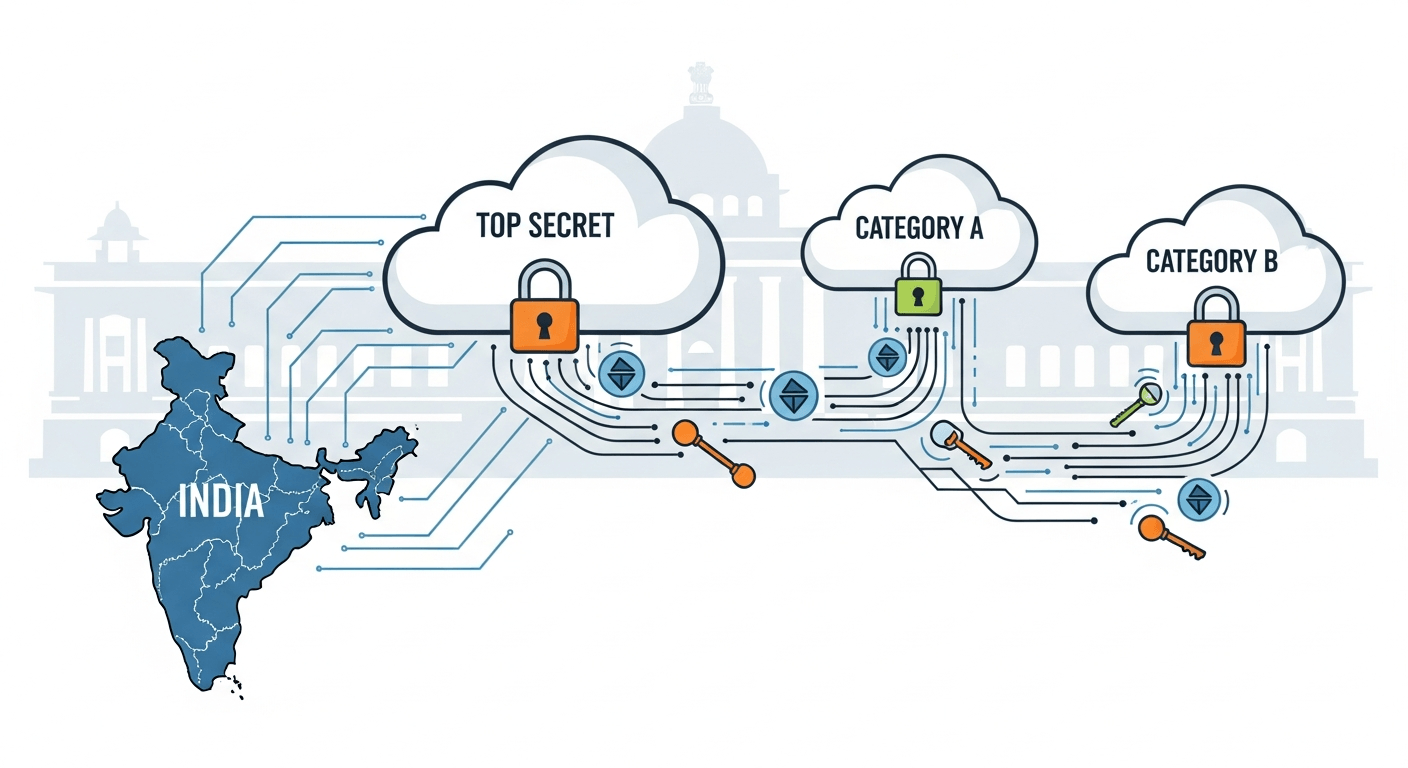
- Three buckets: Top Secret (and Secret), Category A, Category B. Top Secret/Secret workloads should not be hosted on cloud platforms; Category A workloads must be hosted on government cloud (e.g., NIC/MeghRaj/state clouds) or a MeitY‑notified sovereign cloud provider; Category B may be eligible for standard public cloud under safeguards [1][2].
- Purpose: the framework is to ensure operational and legal control, limit foreign administrative access, and reduce exposure to conflicting foreign surveillance or legal regimes.
- Procurement pathways: the rules encourage faster nomination/empanelment routes to onboard empanelled sovereign providers (avoiding lengthy global tenders) for public sector workloads [2].
Practical implications for Indian companies and government agencies
Data classification and mapping
- Inventory first: map systems, datasets, data flows and interdependencies. Identify which workloads fall into Top Secret / A / B by impact analysis (national security, financial stability, service continuity).
- Update classification: factor in metadata, backups, DR sites and telemetry/monitoring data — host policies may apply to these too.
Storage, keys and cryptography
- Key custody: design for Indian‑resident key management for Category A — ensure encryption keys and admin planes are under Indian control or segregated as per the sovereign offering.
- Backups and DR: mandate local copies for Category A; ensure recovery sites conform to sovereign constraints.
Vendor contracts and operational controls
- Contractual SLAs: require auditors’ rights, source‑code escrow (where feasible), and restrictions on overseas administration or debug access.
- Access controls and admin planes: insist on role‑based access limited to India‑based administrators and on detailed logging and restricted remote admin procedures.
- Sub‑processor chains: require disclosure and approval of all sub‑processors and nested cloud services.
Compliance and auditability
- Continuous compliance: prepare for regular audits, certifications and accreditation by MeitY or nominated entities.
- Data lineage and DPIAs: implement data protection impact assessments for A/B classification and maintain lineage records.
Recommended action checklist (practical, actionable items)
- Rapid inventory and risk triage (0–30 days)
- Create a prioritized inventory of systems + data flows and assign preliminary Top Secret/A/B labels.
- Identify immediate Category A candidates (identity, payments, tax).
- Contracts & technical control review (30–90 days)
- Insert clauses for Indian residency of keys/admin, audit rights, sub‑processor disclosure, and data exit / portability.
- Require CSPs to demonstrate separation of admin plane and local key custody for Category A.
- Migration & operations plan for Category A (90–180 days)
- Build migration runway to MeitY‑empanelled sovereign providers or NIC/state clouds with defined rollback/DR playbooks.
- Harden IAM, monitoring, and incident response with clear escalation to national CSIRT lines.
Risks and enforcement concerns
- Fragmentation vs. interoperability: rapid, prescriptive localization can fragment systems and raise integration costs between central and state systems or with private sector.
- Vendor lock‑in and capacity: demand surge for empanelled sovereign cloud capacity may outstrip supply, raising costs and slowing projects.
- Operational maturity: sovereign offerings must match industry standards for security, resilience and observability — otherwise risk shifts from jurisdictional leakage to systemic downtime.
- Compliance ambiguity: unclear classification thresholds and enforcement mechanisms risk inconsistent implementation across ministries and states.
Enforcement and enforcement risk mitigation
- Expect rolling compliance audits and sectoral addenda (payments, securities).
- Mitigate enforcement risk by documenting classification rationale, keeping an auditable trail of decisions, and aligning procurement to MeitY empanelment processes [2].
Policy recommendations (short)
- Clarify classification criteria and publish use‑case examples: central guidance should include concrete examples to reduce inter‑agency ambiguity.
- Scale sovereign supply: invest in capacity and standardized APIs so sovereign clouds can interoperate with private clouds under controlled mechanisms.
- Balanced risk approach: allow hybrid models (local execution + isolated analytics pools) for regulated private sectors while keeping control for Category A datasets.
- Transparent certification: set up a fast, transparent accreditation for sovereign CSPs with clear timelines for revalidation.
Conclusion
India’s move to assign Top Secret and A/B sovereign cover to “Desi data” is a necessary recalibration — not an anti‑cloud statement, but an insistence on choosing the right cloud for the right data. For policy makers and tech leads the task is operational: classify clearly, build the migration and contractual rails, and ensure sovereign offerings meet the same resilience and security bar as commercial clouds. For compliance officers: documentation and auditable controls will be the currency of trust.
For those who follow my earlier writing, this is a continuation of themes I have returned to for years — moving from why data localization matters to how to implement it pragmatically [3]. The next phase will be about building capacity and standards so that sovereignty does not impose fragility.
References
- Recent reporting and summary of the MeitY guidance and press coverage [1].
- MeitY / Cloud Management Office guidance for cloud selection and procurement practices [2].
- My prior reflections on data localization and the operational “how” of storing personal data in India [3].
Regards,
Hemen Parekh
Any questions / doubts / clarifications regarding this blog? Just ask (by typing or talking) my Virtual Avatar on the website embedded below. Then "Share" that to your friend on WhatsApp.
Get correct answer to any question asked by Shri Amitabh Bachchan on Kaun Banega Crorepati, faster than any contestant
Hello Candidates :
- For UPSC – IAS – IPS – IFS etc., exams, you must prepare to answer, essay type questions which test your General Knowledge / Sensitivity of current events
- If you have read this blog carefully , you should be able to answer the following question:
- Need help ? No problem . Following are two AI AGENTS where we have PRE-LOADED this question in their respective Question Boxes . All that you have to do is just click SUBMIT
- www.HemenParekh.ai { a SLM , powered by my own Digital Content of more than 50,000 + documents, written by me over past 60 years of my professional career }
- www.IndiaAGI.ai { a consortium of 3 LLMs which debate and deliver a CONSENSUS answer – and each gives its own answer as well ! }
- It is up to you to decide which answer is more comprehensive / nuanced ( For sheer amazement, click both SUBMIT buttons quickly, one after another ) Then share any answer with yourself / your friends ( using WhatsApp / Email ). Nothing stops you from submitting ( just copy / paste from your resource ), all those questions from last year’s UPSC exam paper as well !
- May be there are other online resources which too provide you answers to UPSC “ General Knowledge “ questions but only I provide you in 26 languages !



No comments:
Post a Comment