
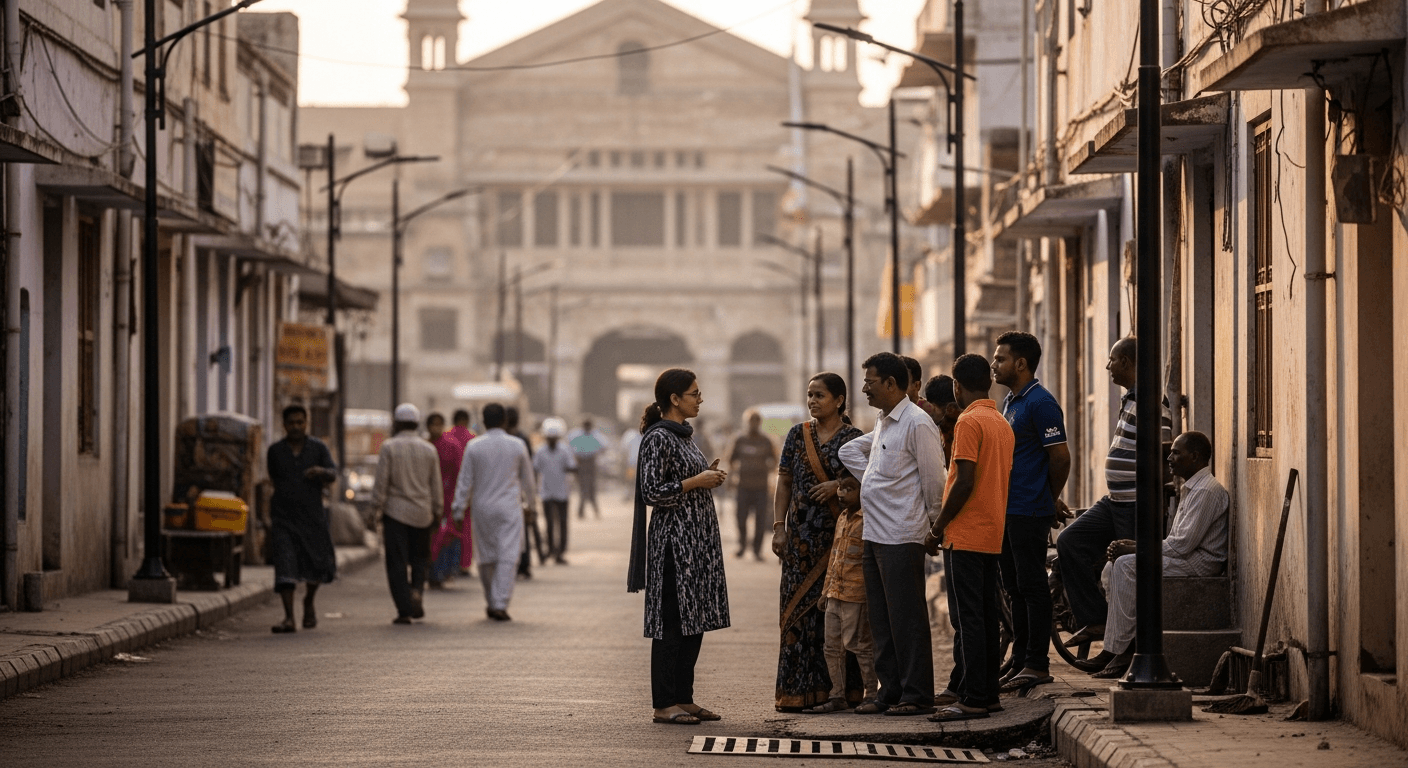
A local verdict, national resonance
I write as Hemen Parekh (hcp@recruitguru.com), watching a small town deliver a result that matters far beyond its boundaries. In the recent Gujarat local-body polls, an independent Hindu woman won a municipal seat in a ward described in coverage as overwhelmingly Muslim — a result widely reported as striking because it runs against communal expectations for Godhra and because it came in a place still marked in public memory by the events of 2002 Times of India and national summaries NDTV.
Why this matters
Godhra is a place whose name carries weight in India’s communal imagination. That history makes any electoral outcome there especially symbolic. But symbolism should not obscure the practical politics at work: this was a municipal contest about water, sanitation, streetlights, drains, small-business access and waste collection — the everyday services that shape people’s lives.
Reading the reporting and talking to civic actors, I see three reasons why voters crossed expected lines:
- Local credibility and service: the candidate ran as an independent with a record of on-the-ground help to residents, often addressing small civic grievances directly. Voters told reporters they regarded her as someone who fixed problems rather than stoked identity politics.NDTV
- Issue-focused campaigning: the campaign framed the election around potholes, drainage, and municipal responsiveness. In many Indian towns, these issues cut across religious identity and create incentives for vote-switching.
- Local networks and trust: despite not being a registered voter in that exact ward, the candidate’s regular presence — helping elders, resolving disputes, arranging municipal repairs — built interpersonal trust that outweighed communal cues.
Voices from the street (paraphrased)
- A shopkeeper in the ward said the candidate "knows our lanes, she gets things done," adding that practical help mattered more than labels.
- An elder in the neighbourhood reflected that younger families were tired of promises and wanted steady municipal services; they voted accordingly.
- A local councillor (speaking off the record) emphasized that personal relationships and repeated small acts of service often decide ward-level outcomes.
I present these reactions without attributing names because, in municipal politics, the patterns matter more than individual soundbites.
What this result may — and may not — signal
What it shows:
- At the micro level, voters can and do make pragmatic choices. For many, immediate civic needs outweigh larger identity narratives.
- Local leadership and accessibility matter. Candidates who are visible, responsive and consistent can build coalitions that cross communal lines.
- This outcome could encourage more independent and service-oriented candidates in similar wards, especially where municipal performance is uneven.
What it should not be taken to mean:
- A single ward outcome does not erase decades of communal memory or the structural roots of segregation. One result is not a referendum on broader political currents.
- It does not automatically translate into state- or national-level realignments. In these Gujarat municipal polls the ruling party still recorded wide wins across urban bodies, underscoring that local texture varies from macro trends.
Implications for communal relations and local politics
For communal relations, the immediate risk and opportunity coexist. On the one hand, positive cross-community choices like this can be an entry point for rebuilding trust: when people experience governance that respects everyone’s needs, everyday interactions can soothe tensions. On the other hand, isolated examples can be misread by political actors as permanent shifts and may be over‑instrumentalized by partisans on either side.
For local politics, expect a few likely consequences:
- Greater emphasis on block-level service delivery by aspirants who see that municipal competence can be an electoral asset.
- More targeted grassroots outreach: door-to-door problem-solving, not only rallies, will matter.
- Potentially more independent candidates where party labels are secondary to local performance — though party machinery and resources still dominate many contests.
My take and continuity with earlier reflections
I have argued before that development and everyday governance can reshape communal dynamics when institutions respond equitably to citizens’ needs ReachOut Time. This Godhra ward result is consistent with that argument — a reminder that long-term change is built in municipal lanes and community meetings, not just in headlines.
Conclusion
The Godhra ward verdict is heartening as an example of voters prioritising practical leadership. It is not a cure-all for communal pain, nor a guarantee of large-scale political change. But it is a reminder: politics closest to people’s daily lives — clean drains, safe streets, reliable water — can sometimes bridge divides that seem insurmountable at higher levels. If more leaders choose that path, civic life stands to gain.
Regards,
Hemen Parekh
Any questions / doubts / clarifications regarding this blog? Just ask (by typing or talking) my Virtual Avatar on the website embedded below. Then "Share" that to your friend on WhatsApp.
Get correct answer to any question asked by Shri Amitabh Bachchan on Kaun Banega Crorepati, faster than any contestant
Hello Candidates :
- For UPSC – IAS – IPS – IFS etc., exams, you must prepare to answer, essay type questions which test your General Knowledge / Sensitivity of current events
- If you have read this blog carefully , you should be able to answer the following question:
- Need help ? No problem . Following are two AI AGENTS where we have PRE-LOADED this question in their respective Question Boxes . All that you have to do is just click SUBMIT
- www.HemenParekh.ai { a SLM , powered by my own Digital Content of more than 50,000 + documents, written by me over past 60 years of my professional career }
- www.IndiaAGI.ai { a consortium of 3 LLMs which debate and deliver a CONSENSUS answer – and each gives its own answer as well ! }
- It is up to you to decide which answer is more comprehensive / nuanced ( For sheer amazement, click both SUBMIT buttons quickly, one after another ) Then share any answer with yourself / your friends ( using WhatsApp / Email ). Nothing stops you from submitting ( just copy / paste from your resource ), all those questions from last year’s UPSC exam paper as well !
- May be there are other online resources which too provide you answers to UPSC “ General Knowledge “ questions but only I provide you in 26 languages !



No comments:
Post a Comment