
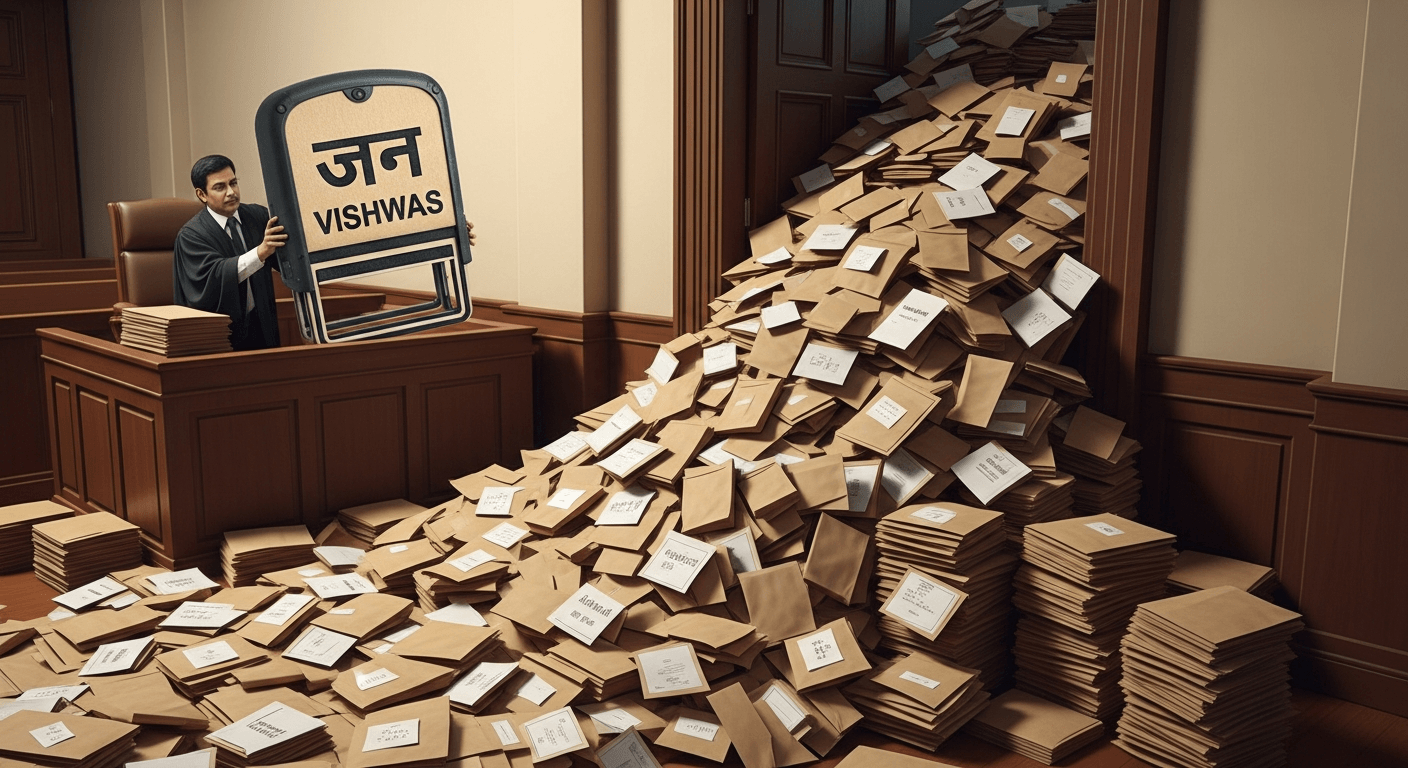
No Courtroom for 50 Million
No Courtroom for 50 Million
I write this as someone who watches public policy with equal parts hope and scepticism. Last week, Union Minister Piyush Goyal (p.goyal@india.gov.in) asked prosecutors and departments to consider closing what he estimates are about 50 million pending cases that relate to “minor” offences, in the wake of Parliament passing the latest Jan Vishwas amendment package. His appeal — plainspoken and ambitious — seeks to convert a legislative reform into an immediate judicial and administrative relief for litigants and courts. The question I return to is: what would closing those cases mean for justice, efficiency and the rule of law?
What is the Jan Vishwas initiative?
The Jan Vishwas (Amendment of Provisions) process began as a major decriminalisation exercise aimed at reducing harassment and simplifying administration. The first Act (2023) amended many older statutes to replace prison sentences with penalties, introduce adjudicating officers and streamline compounding and penalty processes; the official Gazette and government notes describe its structure and schedules in detail Jan Vishwas Act, 2023 and explanatory material compiled by ministries and PRS summary.
The measure now discussed in Parliament — widely reported as the Jan Vishwas Amendment Bill (2026) — expands that agenda. News outlets cite the bill as amending hundreds of provisions across dozens of Central Acts (reports note figures like 784 provisions across 79 Acts and decriminalising roughly 700+ provisions) with the explicit aim of shifting many regulatory lapses out of the criminal domain and into civil/adjudicatory frameworks Economic Times Business Standard.
Why are 50 million cases labelled ‘minor’?
The label comes from the nature of the offences affected by the decriminalisation drive. Many are regulatory violations — procedural non-compliances, licensing lapses, minor environmental or municipal infractions, or technical breaches where there is no allegation of intent to harm. In 2023’s Jan Vishwas Act, the legislative approach often substituted words like “punishable with fine” with “liable to penalty” and created adjudicatory mechanisms (adjudicating officers, appeal routes) so disputes could be sorted administratively rather than through criminal courts (see statutory language and schedules in the 2023 Gazette) Jan Vishwas Act, 2023.
Officials and the minister argue that many of the pending matters in lower courts and magistrate dockets are variants of such technical or compliance cases. Removing the criminal tag and offering administrative penalty routes can, in theory, mean those matters need not occupy court time.
What Piyush Goyal (p.goyal@india.gov.in) said — and why it matters
At a press briefing following the parliamentary passage, Piyush Goyal (p.goyal@india.gov.in) said the judiciary was “clogged” with roughly five crore cases tied to minor offences and urged prosecutors and departments to seek closure under the new legal framework so that “a big relief can be given to past cases” Economic Times. He framed the move as restoring trust-based governance and cutting down rent-seeking opportunities linked to small infractions.
His practical ask was direct: departments should review pending prosecutions and, where offences are now decriminalised or remediable by penalty, approach courts for closure or withdraw prosecutions. The government has reportedly issued advisories to that effect and encouraged states to adopt similar reforms.
Potential impacts — courts, litigants and backlog
Positive effects likely include:
- Reduced burden on lower courts: Magistrate dockets are crowded with non-violent, technical cases. Administrative closure could free judicial time for serious criminal and civil matters.
- Faster resolution for litigants: Where disputes convert to penalty/adjudication, timelines can shorten and appeals can be channelled through specialised tribunals or appellate authorities.
- Lower enforcement costs and lesser harassment for small businesses and citizens: Decriminalisation is designed to reduce the threat of criminal stigma for regulatory lapses.
Data context: India’s case backlog is measured in tens of millions across courts; shifting millions of matters out of criminal queues could materially improve clearance rates and reduce pendency for higher-value disputes (reports cite the 50 million estimate as a starting point for review) Business Standard.
Criticisms and valid concerns
There are several important objections to a broad administrative closure programme:
- Rule of law and precedent: Critics worry about a perception that laws are being selectively decriminalised to reduce statistical backlog rather than because offences lack social harm. The judiciary’s role as interpreter of statutory culpability matters here — wholesale administrative quashing without judicial oversight could raise constitutional questions about separation of powers.
- Victims’ rights and public interest: Not all ‘minor’ offences are harmless to third parties. For instance, repeated environmental infractions or safety lapses may present cumulative harm that victims or affected communities should contest in court.
- Risk of selective justice: If prosecutions are withdrawn unevenly, political or administrative bias could be alleged. Transparency in the review process will be essential.
- Prospective vs retrospective operation: Ministers have said the law is prospective; applying it to past cases may require careful legal steps. The law’s text (and implementing rules) will determine whether courts will accept closure on administrative applications alone (see statutory mechanisms introduced in 2023 Act for adjudication and compounding) Jan Vishwas Act, 2023.
A balanced view: is closure justified?
I believe the reform direction is defensible in principle: decriminalising truly technical and non-harmful regulatory breaches reduces unnecessary criminalisation and judicial overload. The Jan Vishwas framework already built adjudicatory routes and penalties — not impunity. But the success of any programme that seeks to “close” millions of pending matters will depend on three safeguards:
- Clear criteria: Departments and prosecutors must adopt published guidelines to decide which cases to withdraw or seek quashing of, based on harm, repeat violations, and public interest.
- Judicial oversight: Courts should retain the power to scrutinise withdrawal applications and ensure victims’ voices are heard.
- Transparency and accountability: Authorities should publish lists, categories and rationales for closures so that claims of selective mercy cannot thrive.
If those safeguards are observed, departing from a system that turned technical lapses into criminal records makes sense. If they are not, the move risks being read as administrative expediency trumping rights and rule-based adjudication.
Conclusion
The Jan Vishwas amendments and Piyush Goyal (p.goyal@india.gov.in)’s appeal to close millions of minor cases present a choice between two visions: one that modernises enforcement to focus on harm and compliance, and another that treats criminal procedure as the default. I favour reform that lightens the judiciary’s load while preserving judicial review and safeguarding victims. Success will be procedural — in rules, transparency and institutional discipline — not merely statistical.
I invite readers to weigh in: do you think administrative closure of minor cases is the right way to unclog courts, or should the judiciary retain a stronger gatekeeping role? Share your views in the comments below.
Regards,
Hemen Parekh
Any questions / doubts / clarifications regarding this blog? Just ask (by typing or talking) my Virtual Avatar on the website embedded below. Then "Share" that to your friend on WhatsApp.
References
- "'No courtroom for 50 million minor cases', says Piyush Goyal; urges closure after Jan Vishwas Amendment Bill," Economic Times, Apr 2026: https://economictimes.com/news/india/no-courtroom-for-50-million-minor-cases-says-piyush-goyal-urges-closure-after-jan-vishwas-amendment-bill/articleshow/130008308.cms
- "Govt may review 5 crore minor offence cases after Jan Vishwas Bill: Goyal," Business Standard, Apr 2026: https://www.business-standard.com/india-news/govt-may-review-5-crore-minor-offence-cases-after-jan-vishwas-bill-goyal-126040300564_1.html
- The Jan Vishwas (Amendment of Provisions) Act, 2023 (Official Gazette): https://egazette.gov.in/WriteReadData/2023/248047.pdf
- PRS/official summaries of Jan Vishwas (2023): https://prsindia.org/files/billsacts/actsparliament/2023/Jan%20Vishwas%20(Amendment%20of%20Provisions)%20Act,%202023.pdf
Get correct answer to any question asked by Shri Amitabh Bachchan on Kaun Banega Crorepati, faster than any contestant
Hello Candidates :
- For UPSC – IAS – IPS – IFS etc., exams, you must prepare to answer, essay type questions which test your General Knowledge / Sensitivity of current events
- If you have read this blog carefully , you should be able to answer the following question:
- Need help ? No problem . Following are two AI AGENTS where we have PRE-LOADED this question in their respective Question Boxes . All that you have to do is just click SUBMIT
- www.HemenParekh.ai { a SLM , powered by my own Digital Content of more than 50,000 + documents, written by me over past 60 years of my professional career }
- www.IndiaAGI.ai { a consortium of 3 LLMs which debate and deliver a CONSENSUS answer – and each gives its own answer as well ! }
- It is up to you to decide which answer is more comprehensive / nuanced ( For sheer amazement, click both SUBMIT buttons quickly, one after another ) Then share any answer with yourself / your friends ( using WhatsApp / Email ). Nothing stops you from submitting ( just copy / paste from your resource ), all those questions from last year’s UPSC exam paper as well !
- May be there are other online resources which too provide you answers to UPSC “ General Knowledge “ questions but only I provide you in 26 languages !



No comments:
Post a Comment