
Introduction
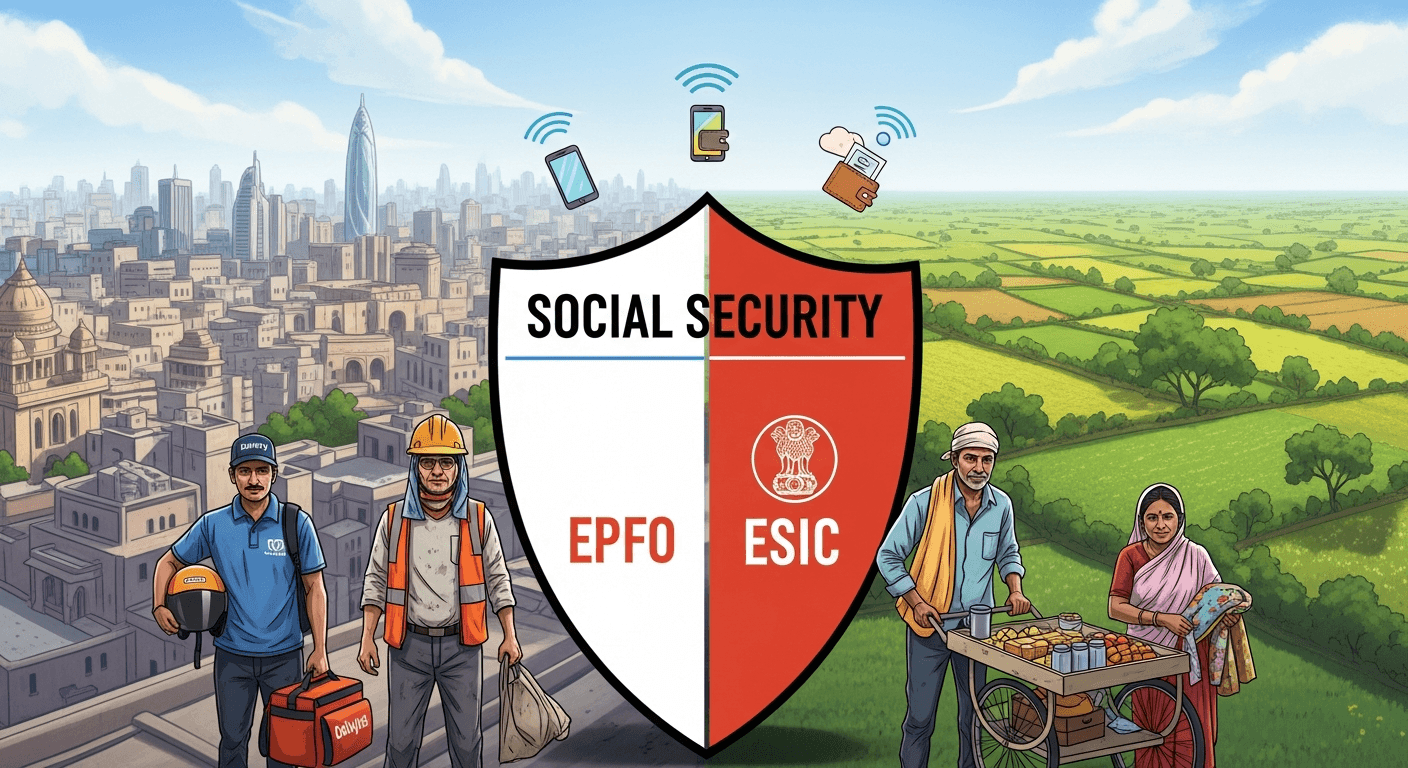
I follow policy shifts closely because they often reshape economic security for millions. Recently, discussions about extending Employees’ Provident Fund Organisation (EPFO) and Employees’ State Insurance Corporation (ESIC) benefits to unorganised, gig and platform workers have resurfaced in policy circles and the press. If implemented, this would be one of the most consequential moves to widen social security in India. Below I summarise what is being discussed, what it could mean, and practical next steps for workers and employers.
What are EPFO and ESIC?
EPFO: The Employees’ Provident Fund Organisation administers contributory retirement and insurance schemes for organised sector employees — primarily EPF (employee provident fund), EPS (employee pension scheme) and EDLI (insurance). Contributions come from both employer and employee and the scheme is run under the Ministry of Labour & Employment.
ESIC: The Employees’ State Insurance Corporation manages the ESI scheme, a social security and health insurance programme that provides medical care, cash benefits for sickness, maternity, disability and more. ESIC coverage today applies to defined establishments and employees below a wage threshold.
(For background reporting on the current discussions see Outlook Money and the Labour Ministry press notes.)[1][2]
Current proposal and status
At present the government is deliberating how to extend pension and health-insurance style benefits beyond traditional salaried employees. The conversation includes using the powers available under the Code on Social Security to design new, flexible contributory schemes or to adapt existing EPFO and ESIC frameworks so that irregular-income workers — including gig and platform workers — can participate.[1][3]
Key points reported so far:
- Policy-level deliberations are underway; committees and stakeholder consultations have been convened. [2][3]
- Options include flexible contribution schedules, aggregator/platform contributions, and micro-contribution pathways for seasonal incomes. [3]
- No firm deadline has been announced; discussions are at the design and consultation stage rather than implementation.
Potential benefits
Extending EPFO/ESIC coverage could deliver major gains:
- Retirement security: Enabling provident fund and pension accumulation would reduce lifetime old-age vulnerability for informal workers.
- Health protection: ESIC-style benefits would lower out-of-pocket medical costs and protect families from catastrophic health spending.
- Portability and continuity: If designed well, benefits could follow workers across jobs and platforms.
- Formalisation incentives: Coverage could nudge more establishments and platforms toward better compliance and reporting.
Challenges and trade-offs
Designing universal coverage is complex. Some of the key challenges include:
- Irregular incomes: Many unorganised workers do not have stable monthly earnings, so standard monthly contribution rules do not fit.
- Administrative and fiscal costs: Expanding ESIC’s health network and EPFO’s administration would require major investments and operational scale-up.
- Enforcement and data: Accurate reporting by aggregators and small employers is essential; many workers lack formal records.
- Benefit vs. affordability trade-off: Setting contribution rates and eligibility thresholds will involve trade-offs between benefit adequacy and worker affordability.
What this means for workers and employers
For workers:
- Better protection: Potential access to retirement savings, pensions and medical benefits.
- Paperwork and registration: Participation will likely require identity, bank and periodic reporting — something many workers will need help with.
For employers and platforms:
- New compliance obligations: Aggregators or employers may face contribution mandates (or voluntary frameworks) and reporting responsibilities.
- Cost considerations: Even small mandated contributions or administrative duties will affect margins for micro-enterprises and platforms.
Steps and likely timeline
Based on public statements and government releases, the pathway looks like this:
- Policy design and stakeholder consultations (ongoing) — committees and expert groups are studying options and pilot designs.[2][3]
- Drafting rules under the Code on Social Security — the Centre will need to notify rules that define categories, contribution models and thresholds.[3]
- Pilot models and phased rollout — likely sector- or geography-based pilots before pan-India expansion.
No definitive national rollout date has been published; these are medium-term reforms that will likely roll out over months to a few years depending on design, pilots and budgetary allocations.[2][3]
Expert perspectives (general)
Observers I speak with and reports I’ve read emphasise three priorities:
- Flexibility: Contribution systems must accommodate irregular incomes, perhaps via quarterly or ad-hoc contribution windows.
- Digital-first with human support: Digital enrolment (linked to eShram and Aadhaar) is necessary but must be backed by field facilitation for low-literacy workers.
- Financial sustainability: Any expansion must balance benefit levels with predictable funding sources to avoid fiscal strain.
Conclusion: action points for unorganised workers
If you work in the unorganised or gig economy, here are practical steps you can take now:
- Register on recognised labour portals such as eShram and keep your identity and bank details updated.
- Maintain simple records of earnings, platform payments and contracts — digital screenshots help.
- Watch for pilot enrolments: local unions, worker collectives and NGOs often help with onboarding in early pilots.
- Learn how provident fund and health-insurance contributions work so you can compare options when a scheme opens to you.
- Seek local help from labour offices or community organisations when in doubt; documentation and registration will matter.
Extending EPFO and ESIC to the unorganised sector is an important policy conversation with promising benefits and clear implementation challenges. If policymakers get the design right — flexible contributions, strong digital systems and targeted support on the ground — the move could materially improve social security for tens of millions. I will continue to follow developments and share practical guidance as the rules and pilots emerge.
Regards,
Hemen Parekh
Any questions / doubts / clarifications regarding this blog? Just ask (by typing or talking) my Virtual Avatar on the website embedded below. Then "Share" that to your friend on WhatsApp.
References
[1] Outlook Money — "EPFO, ESIC Coverage To Unorganised Sector Workers To Be Extended? Here Is What We Know So Far". https://www.outlookmoney.com/personal-finance/epfo-esic-coverage-to-unorganised-sector-workers-to-be-extended-here-is-what-we-know-so-far
[2] Press Information Bureau — Labour Ministry meetings and consultations on social security for gig and platform workers. https://pib.gov.in/PressReleseDetailm.aspx?PRID=2088975
[3] Reporting and analysis on social-security code implementation and EPFO/ESIC expansion (various sources).
Get correct answer to any question asked by Shri Amitabh Bachchan on Kaun Banega Crorepati, faster than any contestant
Hello Candidates :
- For UPSC – IAS – IPS – IFS etc., exams, you must prepare to answer, essay type questions which test your General Knowledge / Sensitivity of current events
- If you have read this blog carefully , you should be able to answer the following question:
- Need help ? No problem . Following are two AI AGENTS where we have PRE-LOADED this question in their respective Question Boxes . All that you have to do is just click SUBMIT
- www.HemenParekh.ai { a SLM , powered by my own Digital Content of more than 50,000 + documents, written by me over past 60 years of my professional career }
- www.IndiaAGI.ai { a consortium of 3 LLMs which debate and deliver a CONSENSUS answer – and each gives its own answer as well ! }
- It is up to you to decide which answer is more comprehensive / nuanced ( For sheer amazement, click both SUBMIT buttons quickly, one after another ) Then share any answer with yourself / your friends ( using WhatsApp / Email ). Nothing stops you from submitting ( just copy / paste from your resource ), all those questions from last year’s UPSC exam paper as well !
- May be there are other online resources which too provide you answers to UPSC “ General Knowledge “ questions but only I provide you in 26 languages !


No comments:
Post a Comment