
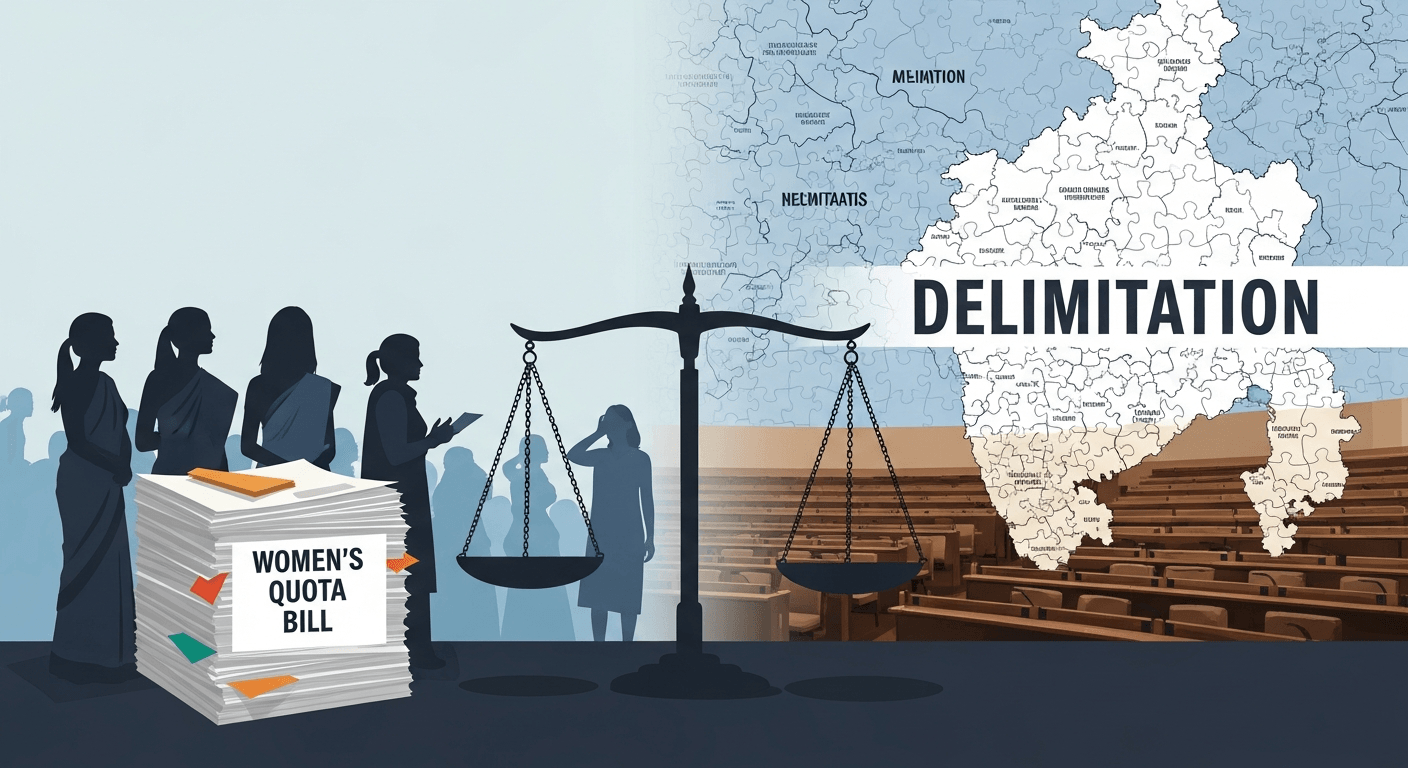
Why governments bring bills that look doomed
I watched the latest episode of our long national argument over women's political representation with a mix of hope and bafflement. A bill intended to operationalise a one‑third reservation for women in the lower house and state assemblies was put to a vote — it secured more yeses than noes but failed the constitutional threshold and therefore fell. The scene that followed — withdrawal of linked measures, accusations from both sides, promises of protests — felt familiar. I have been writing about the women's reservation issue for years and warned then that legislative timelines and political math often diverge “Women’s Reservation Bill - India”. I feel the same mixture of impatience and realism today.“Unity among women forced political parties to adopt Reservation Bill”
Quick context
- The amendment sought to fast‑track a 33% reservation for women by adjusting seat counts and delimitation rules so it could operate before the next general election.
- Constitutional amendments need not just a simple majority but a special two‑thirds majority of members present and voting; the bill got a simple majority but not the higher threshold.
- The government presented the package as a way to operationalise women’s reservation early; opponents objected to linking reservation to a larger redrawing of electoral boundaries.
Several theories for why the bill was brought despite weak numbers
I want to be surgical about possible motives. None of these are mutually exclusive; politics rarely is.
Political signalling to voters. Bringing the bill allows the government to claim it fought for women’s representation and to frame opponents as obstructionist. Even a defeat can be reframed as proof of the opposition’s lack of commitment to women.
Electoral calculation and seat engineering. Linking reservation to a delimitation and increase in seats reshuffles the electoral map. A larger house or altered boundaries can advantage some regions or parties. Critics argue that the policy rationale (operationalising reservation) can be used to mask strategic redistricting.
A bargaining chip. The bill can be leverage in wider negotiations with allies or regional parties — offering buy‑ins elsewhere in return for abstentions or support on other measures.
Haste and misreading of floor arithmetic. Parliamentary management is complex. It’s possible the sponsors misread partner commitments or overestimated inducements. That explains why a well‑prepared government can still lose a technical vote.
Distraction from other issues. At times governments place high‑visibility items that change the political agenda for a short period; if the aim is to shift attention from finer governance problems, failure is an acceptable cost if the narrative sticks.
Reactions: political actors and civil society
The government framed the defeat as obstruction by opponents who were denying women a constitutional right, and pledged to take the case to citizens outside Parliament.
Opponents argued that linking reservation to a delimitation and seat expansion was a manipulation of the system — they professed support for reservation but rejected the package as a structural gambit.
Civil society and women’s groups reacted with mixed feelings: disappointment at the missed opportunity to operationalise reservation sooner; scepticism at the package’s technical design; and calls from some quarters to implement reservation within the existing seat structure rather than tying it to a delimitation exercise.
What failure — or passage — would mean
If the bill fails permanently:
Momentum for early implementation stalls; the issue may sink into electoral sloganeering rather than legislative reality.
Political capital is spent: the sponsoring party risks reputational loss and must decide whether to double down with street mobilisation or try to broker consensus.
Regional parties and communities worried about seat redistribution (and the absence of sub‑quotas for disadvantaged women) will feel vindicated.
If the bill had passed:
Seats would be increased and boundaries redrawn — a significant shift in political geography with long‑term consequences for representation.
Implementation would raise operational questions: which seats are reserved, how to protect proportionality between regions, and how to ensure disadvantaged women (for example, from backward classes) benefit and are not crowded out.
Legal and political challenges would be inevitable; the longer the package is perceived as engineered rather than consensual, the greater the instability.
Concluding assessment
Bringing a bill that looks likely to fail is not always a mistake. It can be a deliberate move to signal intent, to provoke a political response, or to test the terrain. But democracy works better when big structural changes are accompanied by broad consultation and clear technical design. The women’s quota is not just a political prop; it is a vehicle for greater inclusion. If the aim truly is empowerment, the negotiators should prioritise consensus around implementation details — timelines, the delimitation method, and protections for marginalised women — rather than using the objective as a cover for electoral tinkering.
I have warned before that the road from good intent to effective law can be long and strewn with political hazards see my earlier reflections. This episode underlines the same lesson: policy matters, but so do process and trust. If we care about widening representation, the most useful next step is honest dialogue — among legislators, civil society, and citizens — on a path that cannot be easily gamed.
Regards,
Hemen Parekh
Any questions / doubts / clarifications regarding this blog? Just ask (by typing or talking) my Virtual Avatar on the website embedded below. Then "Share" that to your friend on WhatsApp.
Get correct answer to any question asked by Shri Amitabh Bachchan on Kaun Banega Crorepati, faster than any contestant
Hello Candidates :
- For UPSC – IAS – IPS – IFS etc., exams, you must prepare to answer, essay type questions which test your General Knowledge / Sensitivity of current events
- If you have read this blog carefully , you should be able to answer the following question:
- Need help ? No problem . Following are two AI AGENTS where we have PRE-LOADED this question in their respective Question Boxes . All that you have to do is just click SUBMIT
- www.HemenParekh.ai { a SLM , powered by my own Digital Content of more than 50,000 + documents, written by me over past 60 years of my professional career }
- www.IndiaAGI.ai { a consortium of 3 LLMs which debate and deliver a CONSENSUS answer – and each gives its own answer as well ! }
- It is up to you to decide which answer is more comprehensive / nuanced ( For sheer amazement, click both SUBMIT buttons quickly, one after another ) Then share any answer with yourself / your friends ( using WhatsApp / Email ). Nothing stops you from submitting ( just copy / paste from your resource ), all those questions from last year’s UPSC exam paper as well !
- May be there are other online resources which too provide you answers to UPSC “ General Knowledge “ questions but only I provide you in 26 languages !



No comments:
Post a Comment