
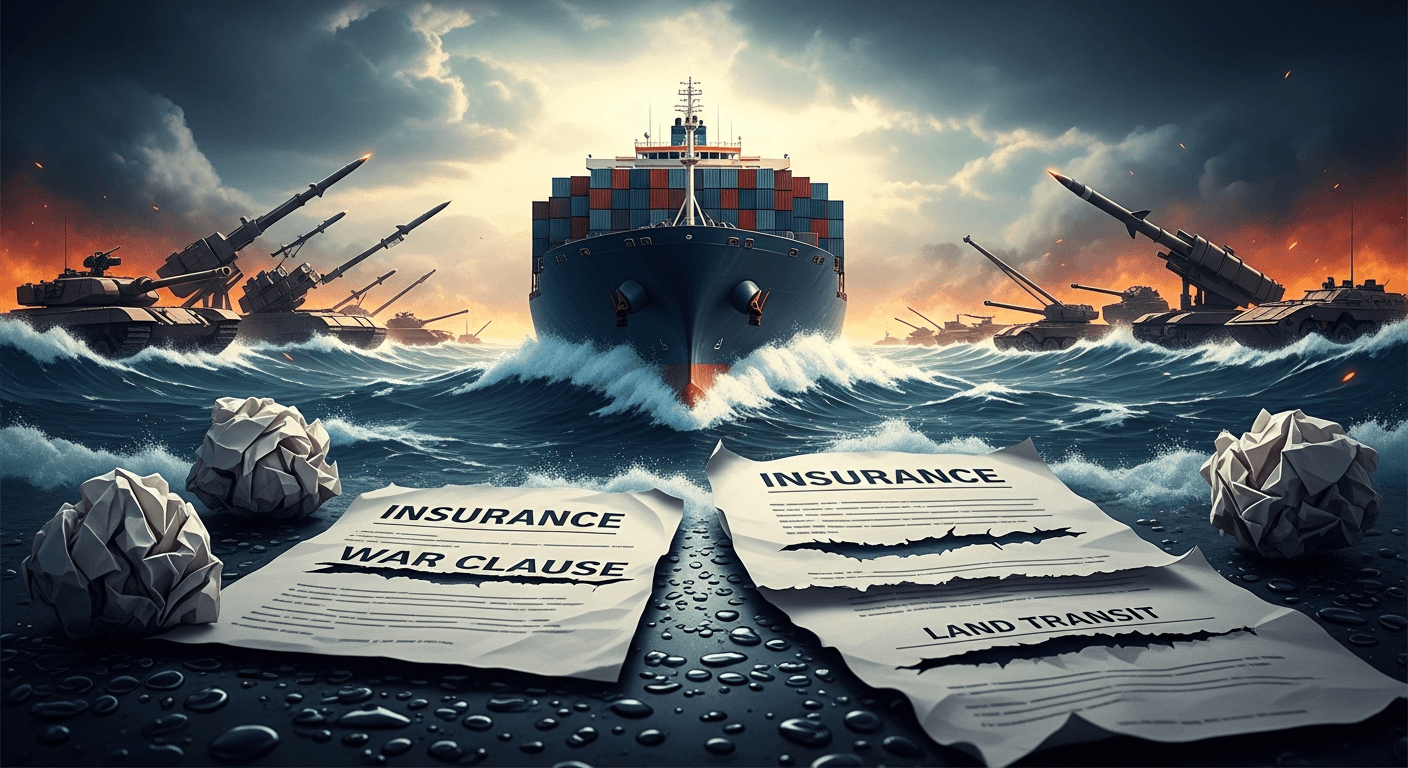
The overlooked gaps in war-risk cargo coverage
I write about risk because I live in a world of second chances — for ideas, for plans, and for commerce. Over the past decade I’ve watched supply chains bend under political shocks and watched clients assume their insurance would simply absorb the damage. Too often it doesn’t. In this post I want to name the blind spots I see when cargo moves through—or near—conflict, and offer practical steps to close them.
Why this matters now
Global trade routes skirt active flashpoints more often than they did a generation ago. Mines in the Black Sea, missile strikes near ports, and widening sanctions regimes all change the risk map overnight. Insurers respond with war-risk endorsements, but those endorsements are precise instruments: useful, but limited. My goal is not to alarm; it’s to make choices clearer so shipper, carrier and broker can take responsibility where market-standard cover leaves them exposed.
What standard cargo policies leave out
Most mainstream cargo policies are written on Institute Cargo Clauses (ICC) foundations. Those standard clauses explicitly exclude war and strike perils and allow those risks to be brought back only under named war/strike endorsements (e.g., Institute War Clauses, Institute Strike Clauses). This has several practical consequences, repeatedly documented in analyses of cargo insurance in conflict zones Cargo Insurance in Conflict Zones and in industry guidance from brokers and trade groups Insuring Cargo in Conflict Zones.
The main overlooked gaps (and why they bite)
Land transit ("war on land")
War endorsements typically respond while cargo is on board an overseas vessel or aircraft. Once cargo is discharged and in inland transit or at terminals, the war endorsement often stops. That gap leaves cargo owners exposed during the most vulnerable stretch: unloading, storage and trucking to destination. Specialist "war on land" cover exists but is limited, expensive and often comes with strict warranties (escorts, secure storage) World Insurance Services guidance.
Named-peril vs all-risk framing
War and strike extensions are usually named perils. If a cause of loss isn’t explicitly listed, it’s not covered. By contrast, ‘‘all-risk’’ marine policies cover losses unless specifically excluded. The named-peril framing makes subtle differences matter — and surprises happen when a cause sits between categories.
Cancellation and insurer notices
Underwriters can cancel or restrict war cover with short notice when a region deteriorates. Shipments already departed may remain covered, but forthcoming voyages can be left uninsured at very short notice.
Geographic triggers and watch lists
Coverage is often tied to insurer-designated war zones (Joint Cargo Committee / JWC / JCC lists). If a vessel enters an unapproved area, cover may be cancelled or voided if that passage was not declared or agreed in advance.
Consequential loss and delay
Most war-risk policies focus on physical damage. Losses from delay, market loss, or inability to perform (loss of contract) are usually excluded. In modern, just-in-time supply chains, financial exposure from delay can vastly exceed physical damage.
Sanctions, confiscation and regulatory actions
Political or regulatory acts—freezing of goods, detention for sanctions compliance—may not be treated as insured perils. These exposures are growing as governments use trade measures as tools of statecraft.
CBRN and nuclear exclusions
Nuclear or radioactive perils are commonly excluded absolutely. In a theater with CBRN risks, protection evaporates for some exposures.
Cyber and supply-chain interdependence (emerging gap)
As shipping, terminals and documentation move to digital systems, cyber events that produce warlike disruptions are testing traditional wording. Is a state-sponsored cyber-attack that halts port operations a war peril, a cyber exclusion, or neither? The market is still grappling with this.
Practical checklist — what I recommend to shippers and logistics leaders
- Start with the broker: ask for a plain-language summary of where and when war/strike endorsements respond and how they treat land transit, storage and transshipment.
- Map the journey: highlight moments off-vessel (ports, terminals, hinterland trucking) and insist on clarity about whether war cover runs during these legs.
- Consider layered protection:
- Institute War Clauses (cargo) for sea/air carriage
- Separate "war on land" cover if inland legs cross high-risk areas
- Trade credit / political risk cover for confiscation and sanctions exposure
- Contractually shift risk where you can: back-to-back declarations, clear Incoterms, and pre-agreed premium settlements when routing changes are needed.
- Security and mitigations: armed escorts, guarded storage, and vetted alternative routes can make obtaining cover possible or materially cheaper.
- Crisis playbook: plan for immediate insurance notification, preservation of evidence, and claims specialists who know war-risk wording.
A few myths I’ve seen repeated
- "All-risk" means everything: not true when war perils are carved out and only reintroduced as named perils.
- Carriers will cover war losses: carrier liability regimes and conventions (Hague-Visby, COGSA) typically exclude war-like perils; vessel P&I/hull cover also treats war separately.
- War cover equals business interruption: war-risk policies usually indemnify physical damage and associated salvage/general average — not loss of market or consequential loss.
Where the market is moving
Insurers are refining geo-specific watch lists and integrating intelligence to apply surcharges dynamically. Specialty war-on-land facilities exist but are costly and conditional. Underwriters increasingly require pre-notification, security measures, and route approvals before they’ll accept exposure. Several industry briefs and recent updates document these shifts — it’s an evolving dialogue between buyers, brokers and the war-risk market Charterama overview.
What I said before
I’ve long argued that risk is rarely binary; it’s a spectrum we must manage with layered thinking. Years ago I wrote about trade friction, technological shocks and how geopolitical events bleed into commercial risk — the same dynamic plays out in today’s war-risk market (see my earlier thinking on trade and geopolitical friction). If you’ve followed my work, you’ll know I favour pragmatic, layered defences over wishful thinking.
Final thought
Insurance is not a substitute for judgement. It’s a tool. When you ask "Do I have war-risk cover?" make sure you follow with "For which legs, for which causes, and for which losses?" The answers will determine whether you sleep at night — or whether you discover the gap after the first missile lands.
Connect with me: Hemen Parekh — hcp@recruitguru.com
Regards,
Hemen Parekh — hcp@recruitguru.com
Any questions / doubts / clarifications regarding this blog? Just ask (by typing or talking) my Virtual Avatar on the website embedded below. Then "Share" that to your friend on WhatsApp.
Get correct answer to any question asked by Shri Amitabh Bachchan on Kaun Banega Crorepati, faster than any contestant
Hello Candidates :
- For UPSC – IAS – IPS – IFS etc., exams, you must prepare to answer, essay type questions which test your General Knowledge / Sensitivity of current events
- If you have read this blog carefully , you should be able to answer the following question:
- Need help ? No problem . Following are two AI AGENTS where we have PRE-LOADED this question in their respective Question Boxes . All that you have to do is just click SUBMIT
- www.HemenParekh.ai { a SLM , powered by my own Digital Content of more than 50,000 + documents, written by me over past 60 years of my professional career }
- www.IndiaAGI.ai { a consortium of 3 LLMs which debate and deliver a CONSENSUS answer – and each gives its own answer as well ! }
- It is up to you to decide which answer is more comprehensive / nuanced ( For sheer amazement, click both SUBMIT buttons quickly, one after another ) Then share any answer with yourself / your friends ( using WhatsApp / Email ). Nothing stops you from submitting ( just copy / paste from your resource ), all those questions from last year’s UPSC exam paper as well !
- May be there are other online resources which too provide you answers to UPSC “ General Knowledge “ questions but only I provide you in 26 languages !



No comments:
Post a Comment