
Introduction
I like to imagine life as a theater with no final curtain. The phrase "A dancer never exits the stage" is not a literal claim about choreography; it is a way of seeing how practice, presence, and meaning persist beyond any single performance. In this piece I explore that idea in literal and metaphorical ways, remember how art keeps living in memory, and offer practical takeaways that stretch beyond dance into everyday grace.
The literal stage: practice, rehearsal, return
If you watch a dancer closely, you see cycles: rehearsal, dress rehearsal, performance, critique, refinement. The body learns its language through repetition until movement becomes an argument made without words. Even when the feet stop, the training leaves traces — posture, breath, a reflexive pause at the corner of a phrase.
This is the simplest meaning of my title: training never truly stops. A dancer’s muscles, neural pathways, and instincts remain. Moments of rest are not exits but quiet rehearsals for what will come next.
The metaphorical stage: presence and resilience
Metaphorically, the stage is any arena where we show up: the office, the kitchen, the classroom, the hospital room where someone sings softly to a patient. To say a dancer never exits the stage is to say the work of showing up — of being present — is continuous.
Resilience shows itself not as a single triumphant return but as the willingness to step back into the light after a stumble. The dancer who has fallen does not vanish; she readies herself, breathes, and rises. That readiness is the life-long discipline we can borrow: practice that prepares us for surprise and disappointment.
Presence as practice: the art of small returns
Presence is less about spotlight moments and more about the small returns: the daily bow to a practice, the short walk that steadies a mind, the sentence rewritten a dozen times until the meaning is honest. Presence is an endurance built of choices—short, deliberate acts that accumulate into a persistent habit of being there.
In performance, presence is contagious. The dancer’s calm focus steadies the orchestra, the stagehands, the audience. In life, our steadiness becomes shelter for others.
Art as living memory
Art remembers what we forget. A movement, once performed, migrates into the bodies of witnesses. Someone in the audience will carry a gesture home and reproduce it in a different key — in a lullaby sung to a child, in a patient’s steadying breath. In that way, the performance never fully leaves the world.
I have written about continuity and predictions of self before, thinking about how ideas outlive their moment Man Who Sees Future. The thread is the same: creative acts seed future selves, and what we practice becomes a kind of living memory in others.
Aging and grace: changing choreography
Aging does not mean exit; it means new choreography. The body reshapes the dance and the dancer reshapes intention. Grace in later years is not imitation of youth; it is a translation of experience into new movement vocabulary — smaller, wiser, clearer.
I like the image of an older dancer whose steps are fewer but whose presence expands. The stage is the same, but the story has deepened. That is a lesson for how we imagine careers, relationships, and projects: adaptation is not defeat but a higher fidelity to the work’s core.
A small vignette
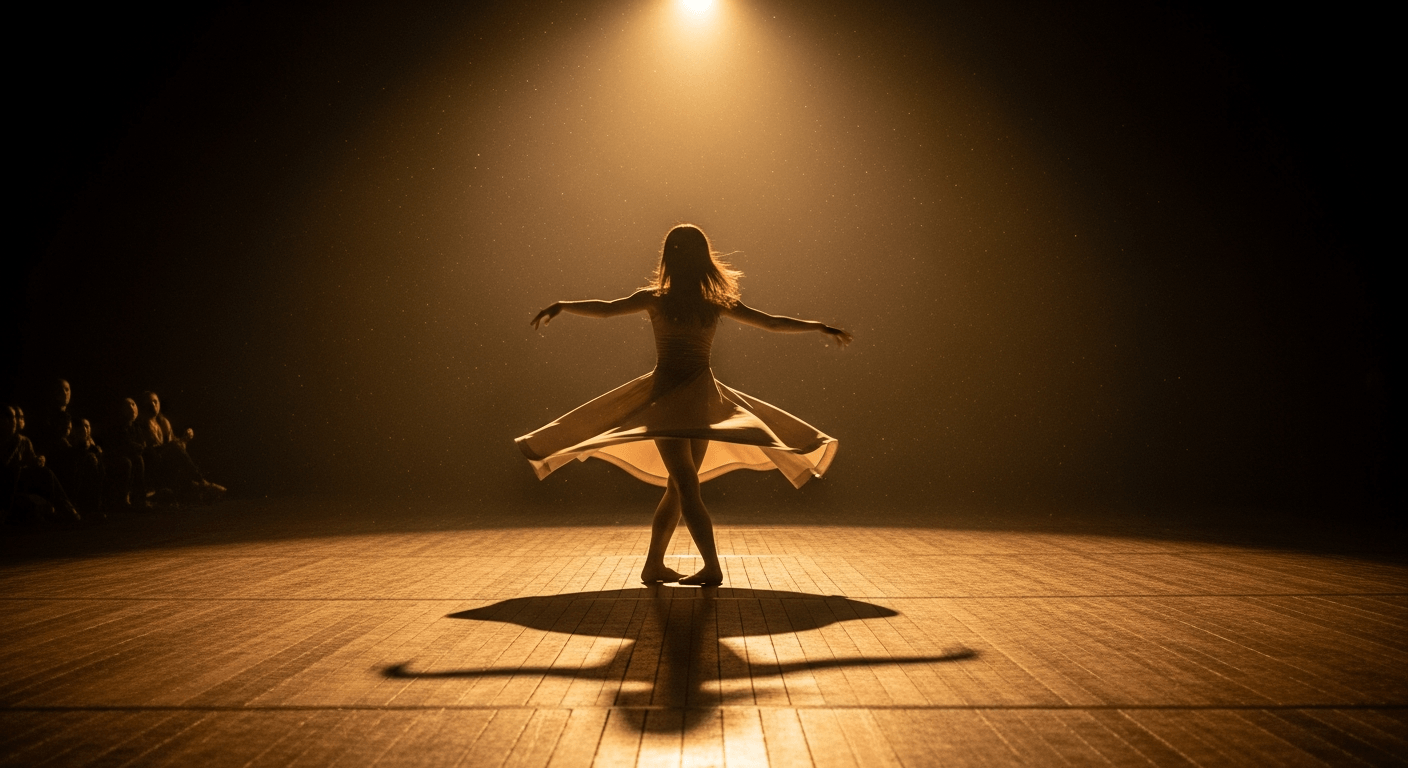
I picture an empty community hall at dawn. A single light slices the dust in the air. A woman in worn shoes steps into it, remembers a phrase, loses the rhythm, laughs, and finds it again. No audience, no applause — only the lamp, the floor, and the slow reclaiming of something that was always hers.
That image feels like rescue. The dancer has not exited; she simply reclaims the stage for herself.
Practical takeaways (for life beyond dance)
- Practice the small things: a short habit repeated daily builds capacity for the big moment.
- Treat presence as a muscle: train it by noticing once an hour what you are doing and why.
- Normalize gentle returns: when you fail, rehearse your next step instead of ending your story.
- Translate, don’t imitate: when circumstances change, adapt your method to keep purpose intact.
- Leave art in people: share, teach, record, or speak about what you learn so your work becomes living memory.
Closing reflection
To live as if one never exits the stage is to adopt an attitude of fidelity to practice, a generosity of presence, and a patience with change. We are, each of us, dancers of different sorts — in our work, in care, in conversation. The practice is what persists, and persistence is the quiet refusal to let a single performance define the whole life.
When I think of that woman in the empty hall, I think of the gentle hum we all carry: discipline, longing, the impulse to try again. That hum is the true stage light — it never fully goes out.
Regards,
Hemen Parekh hcp@recruitguru.com
Any questions / doubts / clarifications regarding this blog? Just ask (by typing or talking) my Virtual Avatar on the website embedded below. Then "Share" that to your friend on WhatsApp.
Get correct answer to any question asked by Shri Amitabh Bachchan on Kaun Banega Crorepati, faster than any contestant
Hello Candidates :
- For UPSC – IAS – IPS – IFS etc., exams, you must prepare to answer, essay type questions which test your General Knowledge / Sensitivity of current events
- If you have read this blog carefully , you should be able to answer the following question:
- Need help ? No problem . Following are two AI AGENTS where we have PRE-LOADED this question in their respective Question Boxes . All that you have to do is just click SUBMIT
- www.HemenParekh.ai { a SLM , powered by my own Digital Content of more than 50,000 + documents, written by me over past 60 years of my professional career }
- www.IndiaAGI.ai { a consortium of 3 LLMs which debate and deliver a CONSENSUS answer – and each gives its own answer as well ! }
- It is up to you to decide which answer is more comprehensive / nuanced ( For sheer amazement, click both SUBMIT buttons quickly, one after another ) Then share any answer with yourself / your friends ( using WhatsApp / Email ). Nothing stops you from submitting ( just copy / paste from your resource ), all those questions from last year’s UPSC exam paper as well !
- May be there are other online resources which too provide you answers to UPSC “ General Knowledge “ questions but only I provide you in 26 languages !



No comments:
Post a Comment