
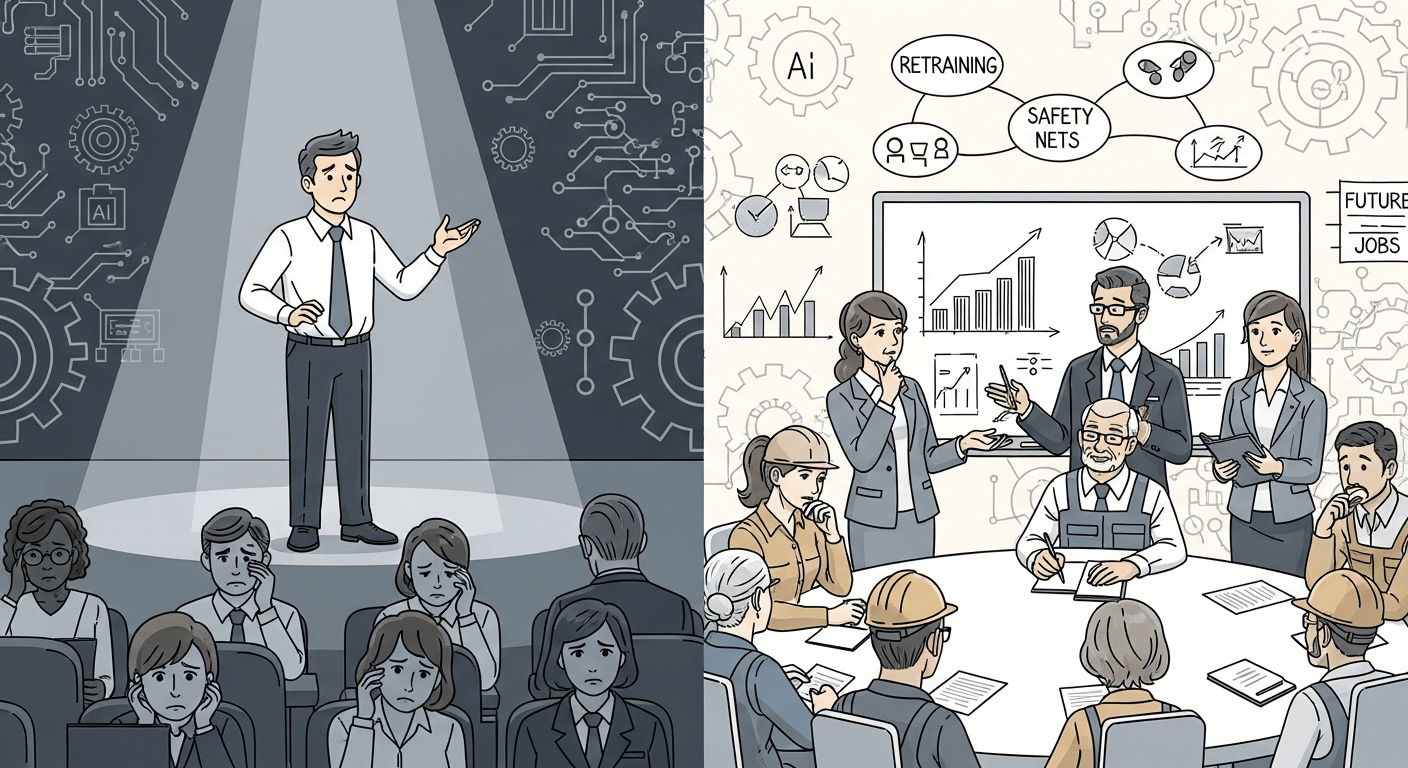
I remember feeling uneasy when headlines exploded this week: a blunt line—“he knows absolutely nothing about the effects of technological revolutions on the labor market”—was fired at an AI CEO and quickly amplified across social channels. The exchange matters because it’s not just personalities sparring: it’s a test of who gets to shape public expectations about AI and work.
What was said (reported)
According to press reports, a senior AI researcher publicly rejected a stark warning about AI-driven job losses. In a widely circulated post, Yann LeCun (yann@amilabs.xyz) is reported to have written that “Dario is wrong. He knows absolutely nothing about the effects of technological revolutions on the labor market,” and urged people to listen to economists who study labour markets rather than AI lab chiefs Business Today Times of India.
Those remarks were aimed at warnings from Dario Amodei (dario@anthropic.com), CEO of Anthropic, who has publicly suggested AI could replace large numbers of white‑collar entry-level roles and, more broadly, reshape labour markets Fortune. Press coverage paraphrases both sides; where exact phrasing is uncertain I have flagged statements as reported or paraphrased.
The players and context
Yann LeCun (yann@amilabs.xyz) is a prominent AI researcher and one of the field’s most visible voices. Dario Amodei (dario@anthropic.com) co‑founded Anthropic after leaving OpenAI and runs a company focused on building large AI models with a strong emphasis on safety and alignment.
Anthropic markets models (Claude and successors) that emphasize safety-by-design and human-aligned behaviour; Amodei has repeatedly warned about hard-to-predict social and economic impacts of increasingly capable models, including possible disruption to many white‑collar jobs Fortune.
Why this argument matters
At stake are two linked issues:
- Authority: who should frame public expectations—the builders who see capability first-hand, or economists and labour-market specialists who study long-run employment trends?
- Consequence management: how do we prepare workers, firms and policy for plausible disruption without triggering panic or complacency?
When an AI leader warns of rapid, large-scale job losses, businesses and governments hear a red flag. When peers say those warnings are outside the speaker’s domain, the public hears a counter‑balance: predictions should be grounded in labour economics and historical evidence.
Responses and reactions (reported)
Coverage shows sharp responses across the ecosystem: some AI researchers and executives say technologists shouldn’t overstep into economics; others insist builders must warn about realistic worst-case pathways so policymakers act now. Commentators have pointed out that both perspectives matter—the builders can identify fast technical trajectories, while economists can model labour adjustments and policy levers Business Today.
Expert perspectives on job displacement
History shows technology usually displaces tasks, not entire occupations overnight. Yet the pace matters: slow automation gives markets time to adapt through new sectors, retraining and capital investment; rapid automation risks concentrated disruption for cohorts and regions.
Rather than offer definitive forecasts, most labour economists advise scenario planning: model moderate augmentation, rapid task replacement, and hybrid outcomes where some roles shrink while new tasks—often requiring different skills—expand. That’s why many commentators recommend listening to both technologists (for pace and capability) and economists (for absorption and policy) when assessing risk.
Practical policy and business responses
If we accept uncertainty, responsible steps are straightforward and bipartisan:
- Invest in continuous training focused on complementary human skills: judgment, communication, domain expertise and AI supervision.
- Create portable safety nets (earnings insurance, wage insurance, expanded unemployment support) to ease transitions for displaced workers.
- Encourage firms to deploy AI incrementally with human‑in‑the‑loop designs that preserve learning pathways for junior staff.
- Fund research into task reallocation and regional transition policies so communities aren’t left behind.
- Regulate disclosure: require firms to report significant workforce impacts tied to AI deployments so policymakers can act on data rather than anecdotes.
These are pragmatic, not ideological, measures—useful whether AI augments work or substitutes for it.
My view and a reminder from past writing
I’ve long written about how automation reshapes recruitment and job design; years ago I explored how AI tools change hiring workflows and task allocation Parekh’s note on AI in recruitment. Those changes showed me two durable truths: (1) technological change is uneven across sectors and tasks; (2) policy and corporate choices determine whether disruption leads to broad prosperity or concentrated pain.
So when Yann LeCun (yann@amilabs.xyz) tells us to listen to economists, he’s right to demand rigorous analysis. And when Dario Amodei (dario@anthropic.com) urges urgency, he’s offering an inside view of possible speed. Both stances are signals we should use: combine builders’ early warnings with economists’ frameworks to design resilient policy.
Takeaways
- Don’t treat this as a personality dispute; treat it as a methodological debate about evidence and forecasting.
- We need technical transparency (so builders’ claims can be evaluated) and rigorous labour analysis (so forecasts feed into policy).
- Practical steps—reskilling, safety nets, measured deployment of AI—reduce downside risk regardless of which scenario plays out.
I’ll close with a simple principle I often return to: technology creates opportunities and dislocations in equal measure. Our choices—about regulation, corporate behaviour, and public investment—decide whether the balance favors broad prosperity or concentrated harm.
Regards,
Hemen Parekh
Any questions / doubts / clarifications regarding this blog? Just ask (by typing or talking) my Virtual Avatar on the website embedded below. Then "Share" that to your friend on WhatsApp.
Get correct answer to any question asked by Shri Amitabh Bachchan on Kaun Banega Crorepati, faster than any contestant
Hello Candidates :
- For UPSC – IAS – IPS – IFS etc., exams, you must prepare to answer, essay type questions which test your General Knowledge / Sensitivity of current events
- If you have read this blog carefully , you should be able to answer the following question:
- Need help ? No problem . Following are two AI AGENTS where we have PRE-LOADED this question in their respective Question Boxes . All that you have to do is just click SUBMIT
- www.HemenParekh.ai { a SLM , powered by my own Digital Content of more than 50,000 + documents, written by me over past 60 years of my professional career }
- www.IndiaAGI.ai { a consortium of 3 LLMs which debate and deliver a CONSENSUS answer – and each gives its own answer as well ! }
- It is up to you to decide which answer is more comprehensive / nuanced ( For sheer amazement, click both SUBMIT buttons quickly, one after another ) Then share any answer with yourself / your friends ( using WhatsApp / Email ). Nothing stops you from submitting ( just copy / paste from your resource ), all those questions from last year’s UPSC exam paper as well !
- May be there are other online resources which too provide you answers to UPSC “ General Knowledge “ questions but only I provide you in 26 languages !



No comments:
Post a Comment